
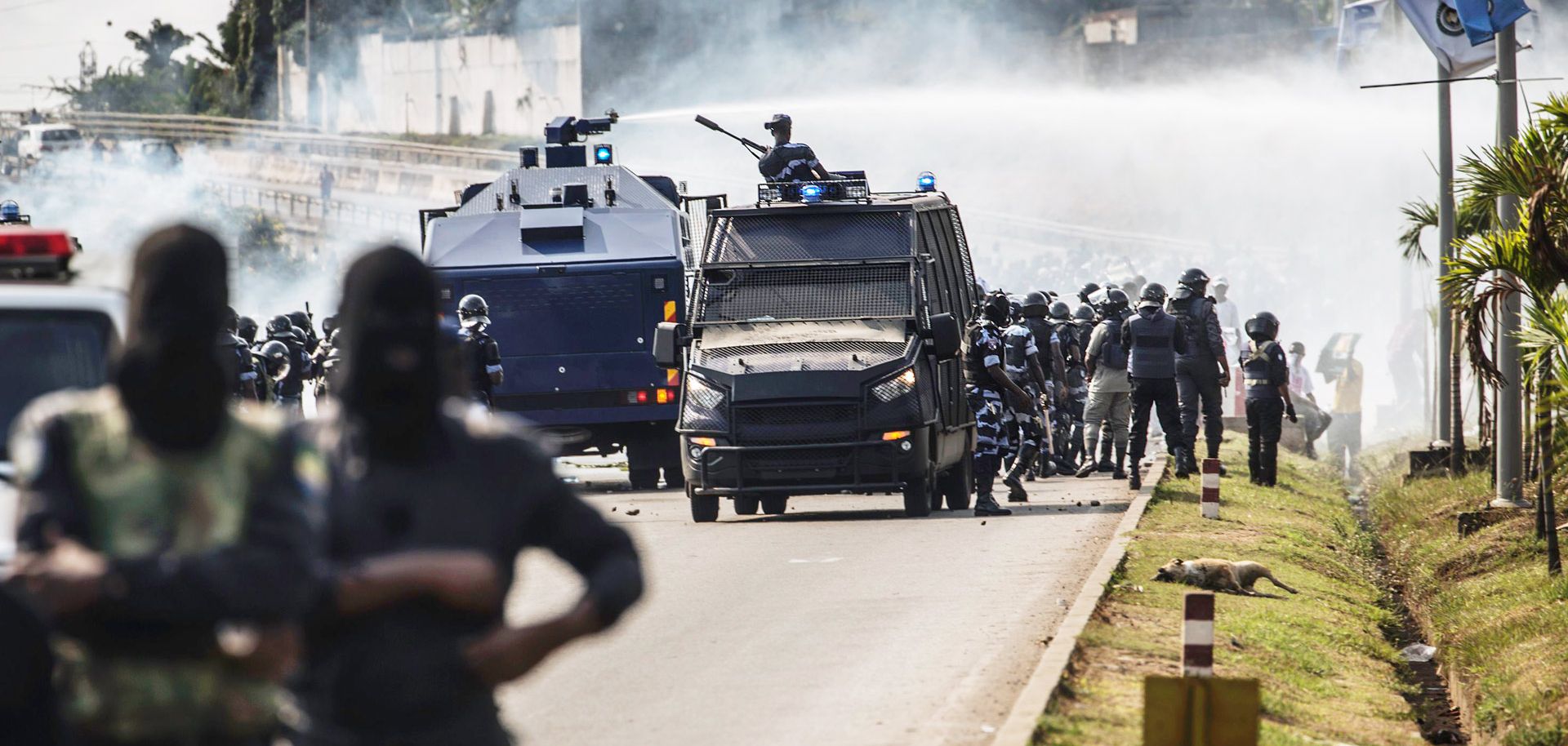
Tension was mounting in Gabon for months as the country prepared for its highly anticipated presidential election, the first since 2009 and an unprecedented vote in many ways. For the first time in years, most of the opposition appeared to have rallied behind a single candidate: former government insider, diplomat and African Union Commission Chairman Jean Ping. In the days leading up to the race, several alternative candidates dropped out to throw their weight behind Ping, who was broadly considered the opposition's best chance to unseat Bongo.
Once the vote had taken place, Ping proved himself one of the strongest contenders the opposition has ever fielded. Though the results of the Aug. 27 election were expected to take 72 hours to be counted, Ping announced a day later that opposition polls had shown he had won. Given his deep understanding of African politics and the difficulties of mounting an offensive against an entrenched figure such as Bongo, Ping was no doubt trying to shape the electoral narrative before the government could. Though Gabonese officials quickly denounced Ping's statement as premature, and Bongo moved to reassure voters of his confidence in his success, the seeds of doubt had already been planted.
They began to bear fruit when it became clear that Bongo's win had been cemented by a razor-thin margin. Bongo's father, Omar Bongo, had consistently claimed wide leads over his opponents — when he was challenged at all — during his presidential tenure from 1967 to 2009. His son, however, has never managed to marshal the same level of support, either at home or abroad. After Bongo ran to succeed his father, who died in office, credible allegations of voter fraud marred his electoral victory. The scandal also spurred violent protests that left several demonstrators dead and forced French oil company Total SA to temporarily pull its foreign employees out of Gabon.
An Uphill Battle
This year's election has had no shortage of controversy, either. Once again, numerous complaints of electoral fraud have been lodged, raising suspicions that have been compounded by the national electoral commission's decision to postpone its announcement of the results by more than 12 hours. Bongo's home province of Haut-Ogooue reported a voter turnout of 99.9 percent, with more than 95 percent voting in favor of the president. Ping's staff, trading mutual allegations of fraud with the government, has already refused to accept the official results. The war of words has emboldened supporters on both sides of the aisle, making a bad situation even worse.
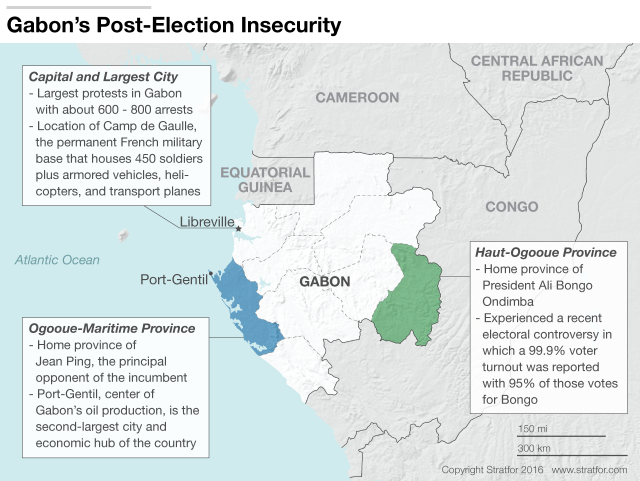
As Ping and his backers are likely already aware, unseating Bongo and his government will be an uphill battle. For one, Bongo maintains the loyalty of the military and security services, which have already been deployed to crack down on dissent and raid Ping's campaign headquarters. As long as the president holds a monopoly on violence in Gabon, Ping will have a hard time overcoming or turning Bongo's troops. Moreover, none of Gabon's neighbors — Equatorial Guinea, Cameroon and the Republic of Congo — are likely to come to Ping's aid, whether rhetorically, militarily or financially. Each of these countries is ruled by a long-serving president who will back his peers for both regional and personal gain. Beyond Central Africa, most states are ambivalent toward Gabonese politics and have little reason to devote the political capital required to effect change in the country, regardless of whether evidence of gross electoral fraud comes to light in the days ahead.
Furthermore, Gabon itself lacks a history of armed rebellion. Though the country has seen coup attempts before, all either failed or were reversed by French interventions. The odds of Ping and his constituents mounting a serious challenge to the government on their own, therefore, are slim at best.
But it is yet to be seen what impact France may have on Gabon's current situation. It remains, by far, the most prominent foreign actor there. France has 10,000 nationals in the country, notable economic investments across many different sectors of the Gabonese economy, and a permanent military base housing more than 900 soldiers in Libreville. In recent years, Paris has tried to normalize relations with its former colonies, but results have been mixed. French President Francois Hollande, for instance, declared in 2013, "The time where France designated African heads of state is over." Yet on Aug. 28, just a day after Gabon's election concluded, France's ruling Socialist Party released a statement that said, "While early estimates indicate that the outgoing president Ali Bongo would be beaten by Jean Ping, serenity must preside over the election’s outcome." The communique went on to say, "For a half century the Bongo family has governed Gabon. A power transition would be a good sign of a healthy democracy and an example." Even in its effort to shed its colonial legacy, France has injected itself into Gabon's internal affairs, prompting the Gabonese government to denounce all foreign interference in the election.
What to Watch For
As Ping's supporters work to overturn the Bongo government in the days ahead, their success will hinge on whether they can translate the outrage felt by Ping's constituents into a wider and more coherent movement. Signs of this would include the participation of the military, police, government bureaucrats, educators, clergy and other community leaders in the protests. If the demonstrations then spread enough to effectively paralyze the country, France might be forced to wade into the conflict to protect its interests in Gabon.
Widening protests against Bongo could also provoke a reaction inside his administration, particularly if the grip of the president and his inner circle appears to be slipping. Though this scenario currently appears unlikely, the chances of it occurring would increase if Bongo's loyalists start to break ranks, eroding his base of power. As security continues to deteriorate in Gabon, defections become more likely, perhaps even escalating into a coup against the president if those closely allied to him begin to see him as a liability.
The influence that Western military and intelligence services have over Gabonese political elites cannot be dismissed either, particularly with regard to France. The French Socialist government has repeatedly declared its intention to abandon Francafrique, a term used to describe France's decades-old system of exerting influence over its former African holdings. A key component of this system was Paris' support for friendly African governments, including that of Bongo's father. The crisis now brewing in Gabon could present Hollande's administration with a chance to set itself apart from its predecessors by proving that it does not cozy up to Africa's strongmen — an opportunity that could be especially valuable ahead of France's 2017 presidential election.
Should France decide to get involved, it could do so in a number ways, including by doing nothing at all. This, in fact, would be the most likely scenario, essentially allowing France to remain "neutral" as it did in 2009, though it would inevitably lead to speculation that Paris implicitly supports the status quo. If, however, the Gabonese government yields to public pressure to release the data from the polling stations, revealing extensive fraud in the process, the European Union may choose to try to isolate Gabon. At this point, economic sanctions against Gabon cannot be ruled out, a development that would likely force France to try to mediate a deal between the two. Though military intervention is a possibility as well, France is highly unlikely to use it unless it was required in order to protect French interests or nationals in Gabon. (Several reports have indicated that many French citizens left Gabon in the weeks leading up to the election and that the French military commander in Libreville has been ordered not to interfere as the situation plays out.)
But social unrest or violence of any serious magnitude would also present a problem for Ping: maintaining legitimacy. If the protests his campaign stokes turn deadly, Bongo's government could easily pin the blame on the opposition, undermining its support at home and abroad. The line between demanding electoral transparency and inciting violence is thin, and it will become an increasingly difficult one to walk if Gabon's security environment continues to degrade in the weeks ahead.
