
Ever since the overstretched Syrian government forces largely withdrew from Kurdish areas of the country in 2012 and 2013, a precarious peace has existed between the loyalists and the YPG. The underlying enmity between the two occasionally spills out into open fighting in Aleppo and al-Hasaka provinces. Nevertheless, the tenuous peace has largely held up for two reasons. First, there is limited contact between the YPG and the loyalist forces, which share front lines only in the few remaining loyalist pockets in al-Hasaka province and in areas of Aleppo province. Second, both factions face bigger threats in the Islamic State and the rebels.
A Zero-Sum Game
The YPG has grown much stronger in northern Syria since 2013, while the loyalist position has weakened considerably. The Syrian government, for instance, lost Raqqa province, west of al-Hasaka, to the rebels and the Islamic State, only to see the YPG claim the northern portions of the province. The pattern repeated itself in al-Hasaka. An Islamic State offensive on government positions in and around the province's eponymous capital drove the loyalists back; when the YPG recaptured those positions, it kept them for itself. The result is an increasingly confident and secure YPG arrayed across Syria's northern reaches and a Syrian government with precarious footholds in isolated, surrounded and distant pockets in the cities of al-Hasaka and Qamishli.
As clashes broke out between loyalist and YPG factions — especially in al-Hasaka, where ill-disciplined National Defense Forces make up most of the loyalist garrison — the Syrian army High Command and YPG leaders were able to arrange cease-fires. Damascus has even taken measures to ensure the peace by removing problematic commanders from its garrisons. The disquiet now facing Damascus is that the YPG may no longer be interested in maintaining the peace and could instead seize the opportunity to try to capture the remaining loyalist positions in al-Hasaka. After all, the YPG position is as secure as it has ever been. With Turkish-Russian rapprochement increasing the threat of a future Turkish offensive, it is in the Kurdish group's interest to secure its rear areas before facing Ankara's attacks.
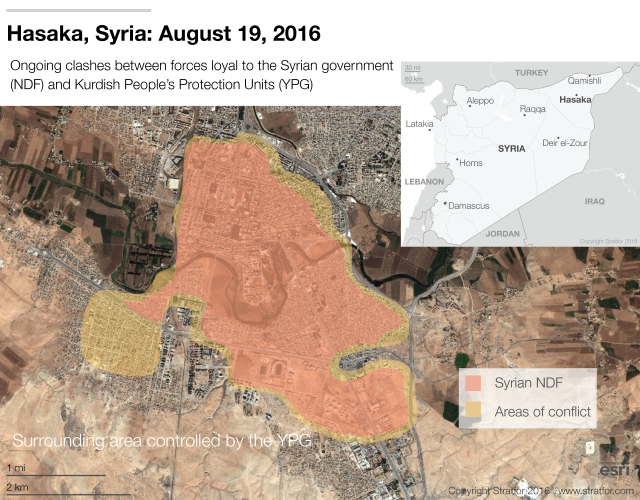
On the other hand, holding on to what territory it has in al-Hasaka province is strategically important for Damascus. The loyalist-controlled Qamishli airport is the primary supply point for the besieged Republican Guard garrison to the southwest in Deir el-Zour. In addition, the loyalist positions in al-Hasaka allow the government to maintain ties with numerous local factions and recruitment pools still faithful to President Bashar al Assad. To make matters worse for Damascus, loyalist forces rely heavily on the YPG in the ongoing battle for Aleppo. For instance, northwest of the embattled city, YPG-held Afrin blocks the direct route between the Azaz rebels in northern Aleppo province and other rebel groups in and around the city. Meanwhile Sheikh Maqsood, the YPG-held district in Aleppo city, flanks and protects the loyalists' last remaining supply line into the areas of the city that they still control.
A Difficult Position
This puts the Syrian government in a bind. Though it cannot simply abandon its positions in al-Hasaka without a fight, that fight could escalate into a wider conflict with the YPG that would undermine its strength in the crucial battle for Aleppo. The most likely course of action for the loyalists, therefore, is to deter YPG aggression in al-Hasaka by demonstrating to the Kurds that they would pay a heavy price if they do not accept a cease-fire. The government delivered this message Aug. 17 with airstrikes, the first aimed against YPG positions in al-Hasaka province. In demonstrating its air superiority, the Syrian government was trying to remind the Kurds that loyalist aircraft could strike YPG-held territory just as they have attacked rebel-held territory throughout the civil war.
If there was a silver lining for Damascus in this latest round of clashes with the Kurds, it would be the potentially positive effect on reported initial contacts between Syria and Turkey. Turkey is increasingly alarmed by YPG territorial expansion along its border with Syria. The YPG-dominated Syrian Democratic Forces' recent seizure of Manbij from the Islamic State, and its advance toward al-Bab and Jarabulus, has heightened Turkey's concerns. Turkey's interests would be served if fighting erupted between the Kurds and Syrian loyalists in Aleppo province, which would not only remove pressure from the rebels in Aleppo but also slow Kurdish advances there. But it would not want to see territorial gains by the Kurds if they were to defeat the loyalist pockets in al-Hasaka.
The confrontation between loyalist and Kurdish forces in al-Hasaka illustrates the convoluted nature of the Syrian civil war. Not only does it involve multiple factions, but it also showcases the overlapping — and sometimes divergent — interests of the actors in the war. It demonstrates, too, how flare-ups on isolated battlefronts in Syria pose a significant risk of carrying over into battle zones. This is clearly manifest in the way that the al-Hasaka fighting threatens to undo the partnership between the YPG and loyalist forces in Aleppo. Examining the core interests, priorities and objectives of the various forces fighting the war illuminates the ways those factions can attempt to mitigate — or wring advantage from — sudden crises.
