
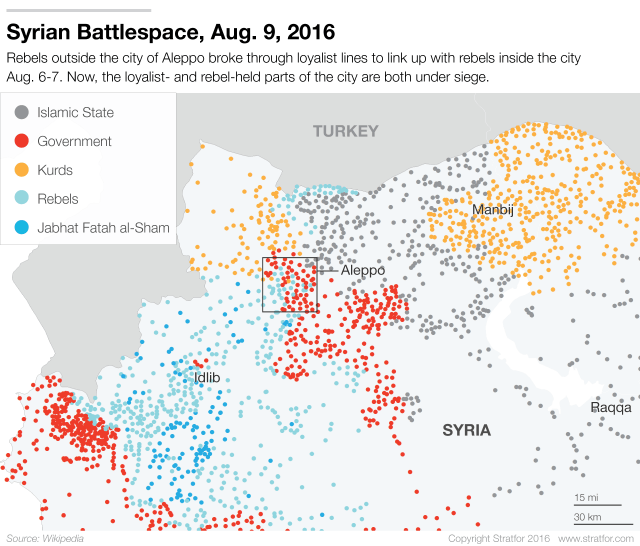
After a weeklong offensive, rebels outside of Aleppo broke through loyalist lines Aug. 6, linking up with their allies inside the city. Although there is now a direct ground link into the city, the rebel-held parts of Aleppo are still technically under siege: Loyalist forces are shelling the area, preventing an influx of significant supplies. The rebels have also managed, however, to cut the primary loyalist supply road into western Aleppo, so the loyalist and rebel areas of the city are now both under siege.
From the start, the rebel offensive into Aleppo faced long odds. Fighters had to overcome not only loyalist defenses but also Russian airstrikes. The breakthrough came only after a week of protracted battle and heavy casualties, ending when fighters from the Jaish al-Fatah coalition ousted loyalist forces from the artillery academy of Aleppo, the site of a base that lies just west of the Ramoussah roundabout. Having secured the base, Fatah Halab rebels inside the city were able to break out to meet the Jaish al-Fatah relief force. Currently, a gap of approximately 2 kilometers (1.2 miles) connects the rebel-held areas of Aleppo to the outside. This link, mostly in Ramoussah district, is under constant air and artillery attack, impeding rebel relief efforts.
The successful rebel offensive has enhanced the prestige of Islamist rebel group Jabhat Fatah al-Sham, the group formerly known as Jabhat al-Nusra, which officially cut ties with al Qaeda in late July. Jabhat Fatah al-Sham is a key member of the Jaish al-Fatah coalition and was instrumental in the offensive to break the siege. The coalition's actions will make it popular in Syria; at a time when eastern Aleppo was besieged and bombarded by Russian and Syrian airstrikes, Jaish al-Fatah was the only force to come to the rescue of the approximately 250,000 civilians in rebel-held areas. This will undoubtedly facilitate the coalition's recruitment efforts.
Jabhat Fatah al-Sham badly needs the positive publicity. Rumors at the beginning of July suggested that the U.S.-led coalition intends to coordinate airstrikes with Russia against the group, spurring it to change its name and distance itself from al Qaeda. Now, Jabhat Fatah al-Sham needs to embed more deeply among other rebel groups to make itself indispensable on the battlefield. The successful offensive demonstrated the group's critical role in the fighting as well as the advantages of rebel unity. The United States will now have significantly more difficulty persuading other rebels to dissociate themselves from Jabhat Fatah al-Sham.
But breaking the loyalist siege of Aleppo does not mean rebel victory in the city. Russian airstrikes and Syrian artillery fire continue to bombard the narrow link with rebel-held parts of the city. Loyalist forces, moreover, are preparing to mount a counterattack. For several days now, troops loyal to Syrian President Bashar al Assad have been streaming into Aleppo. These new arrivals include Hezbollah fighters from the elite Radwan unit, Iraqi fighters from the Harakat Hezbollah al-Nujaba militia and Palestinian fighters of the al-Quds Brigades. Syrian government forces — including members of the 15th Special Forces Division, Tiger Forces, Republican Guard and 4th Mechanized Division — have also been arriving. Backed by artillery and air support, these loyalist troops will soon launch an offensive of their own against the rebels.
The fate of the city of Aleppo is of critical importance to loyalist and rebel fighters alike. Retaking the city would allow the government to cement its position and quell talks of political transition. And if the rebels were to lose Aleppo, military victory against Damascus would become a distant dream. Washington, meanwhile, is trying to revive efforts to achieve a cease-fire. But with loyalists and rebels locked in a deadly fight in Aleppo, establishing and implementing any such deal will be impossible in the near future.
