
Following calls by Turkish President Recep Tayyip Erdogan and the ruling Justice and Development Party (AKP), citizens have flooded the streets of Turkey, launching what appears to be a countercoup that may be close to achieving success. According to several sources, the July 15 coup is being conducted by a small but highly organized segment of the military. But resistance to those forces is mounting quickly. Civilians and police alike are now taking back public squares across the country, including Taksim Square, as well as Ataturk International Airport. Though unconfirmed reports also suggest that the leader of the coup has been identified and is surrendering to security forces, the countercoup is still very much underway, and its outcome is far from certain.
Details on the situation in Turkey are vague, but the public's initiative will make it more difficult for the military forces engaged in the coup to keep their grip on power. Perhaps more notable, though, the commander of Turkey's 1st Army announced that the military does not support coups against the Turkish government. The commander of the 3rd Army, meanwhile, ordered troops to return to their bases. Together, the statements imply that significant parts of the military remain loyal to Erdogan's administration and could try to overturn their peers' apparent coup.

At this point, without the military's guaranteed backing, Erdogan has been forced to rely on appeals for public support. He also appears to have some backing from the police. In the early stages of the coup, the military targeted police forces, seizing their headquarters and, allegedly, their arms. But according to the latest reports, riot police units are present in Taksim Square, attempting to force the military from its positions there. The police will be critical to Erdogan's attempt to overturn the coup, since his recent police reforms have given him a much stronger support base there than in the military. Taksim Square presently appears to be dominated by pro-government civilian protesters, though the military elements engaged in the coup continue to control key locations in Ankara. The president's backers also appear to have retaken Ankara's TRT television station. Meanwhile, in Istanbul, tanks are reportedly withdrawing from the Ataturk International Airport as large numbers of civilians flock to the site.
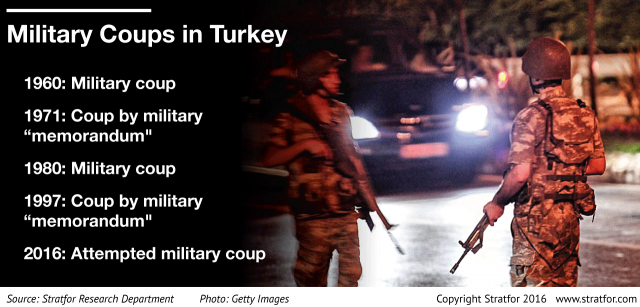
Amid the chaos, the position of the Turkish Air Force has yet to be made certain. Many Gulenist sympathizers exist within the air force's ranks, suggesting the branch is likely on the side of those launching the coup. Indeed, since the coup began there have been constant reports of fighter aircraft and helicopters circling over Ankara, activity that has now expanded to Istanbul. In one incident, Cobra attack helicopters even allegedly fired at the headquarters of Turkish intelligence, a service that is run by Erdogan's ally, Hakan Fidan. Air forces have played a critical role in coups before, and the fact that we now see Turkish aircraft conducting "show of force" operations and, in some cases, attacking strategic targets shows that Turkey's air force has likely chosen which side it is on. But it is unclear whether the air force's aircraft and the army's helicopters are acting in unison, since at least one report indicates a Turkish Air Force jet may have shot down a helicopter belonging to the forces behind the coup.
