
Editor's Note: This travelogue was written by a Stratfor analyst traveling in Vietnam.
Monuments and statues say a great deal about the places in which they stand, and they often serve as a measure of political sentiment. In Ukraine, for example, the toppling of Soviet-era statues during the 2014 uprisings demonstrated the anti-Russia attitudes sweeping parts of the country. Likewise, Ho Chi Minh City's monuments speak volumes about Vietnam, an emerging economic power that, like Ukraine, finds itself pulled in different directions by larger world powers. As the dust settles in Vietnam's commercial hub after a recent whirlwind visit from U.S. President Barack Obama, the city's more permanent celebrities reveal a contradiction in Vietnam's national identity.
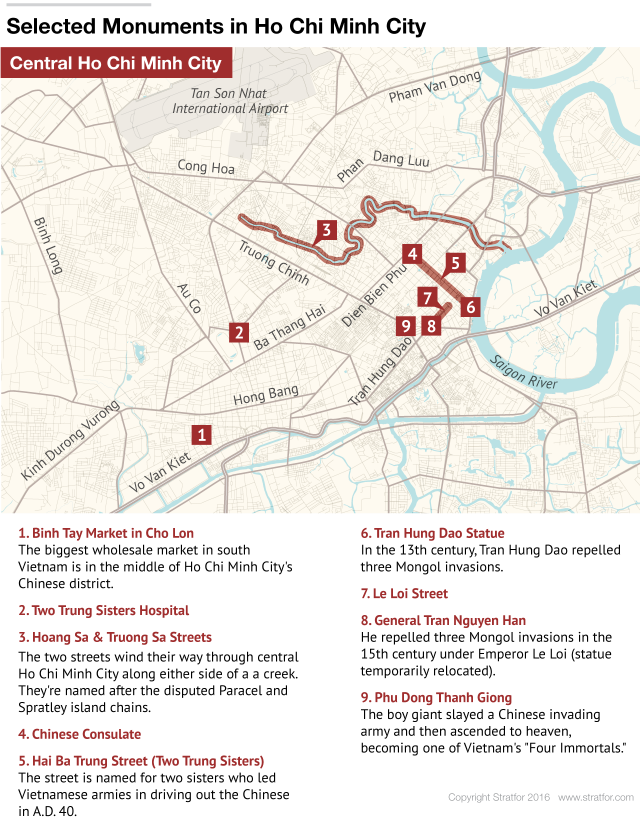
The former capital of South Vietnam has undergone many changes since it fell to North Vietnamese forces on April 30, 1975, ending the Vietnam War and reunifying the country. Along with the city's name, formerly Saigon, the northern victory altered the landscape of Ho Chi Minh City. Street names changed, and new monuments and historical markers cropped up to honor the Vietnamese casualties of the Tet Offensive. Nonetheless, a few relics of old Saigon remain in Ho Chi Minh City, harkening back to an earlier period in Vietnam's history. Many of the public monuments, streets and temples that weathered the political turmoil of the past century share a common theme, commemorating leaders of myth and of history who vanquished northern invaders over the past four millenniums.
National Defenders
Tran Hung Dao, though not the first to repel northern invaders, is credited with one of Vietnam's most famous military victories. Across Vietnam, exhibits, murals and shadowboxes depict his celebrated battle in 1288, when his army defeated a Mongol naval invasion by setting iron stakes in northern Vietnam's Ha Long Bay. Once the tide receded, the stakes emerged from the water, stranding the Mongol ships and leaving them vulnerable to attack — marking the third time Tran had driven Mongol marauders from the country. A towering statue of the hero presides over downtown Ho Chi Minh City from the center of a traffic circle amid some of the city's finest hotels and office buildings. About 3 kilometers (2 miles) from the statue, admirers can pay their respects in a more private setting at Tran Hung Dao Temple.
One of the main thoroughfares feeding into Tran's roundabout is named for Hai Ba Trung, or the two Trung sisters. The Trung sisters are considered the first Vietnamese leaders to drive out Chinese occupiers in A.D. 40. After their victory, they maintained power for three years before committing suicide together in the face of certain defeat by the superior Chinese army. Often portrayed riding on the back of an elephant, the Trung sisters are the first in a long line of Vietnamese women who have taken up arms to defend their country. Their namesake street leads from the Saigon River past a number of diplomatic missions, including, ironically, the Chinese mission. In addition to Hai Ba Trung Street, a hospital in Ho Chi Minh City bears the sisters' name and features a monument of them just within the entrance gates.
One national defender immortalized in Ho Chi Minh City comes from the realm of mythology. Thanh Giong, better known as St. Giong, was born nearly 4,000 years ago. Legend has it that he did not say a word or eat a morsel until he heard that his country had come under attack from northern invaders. The young St. Giong then ate and grew until he was a giant. Once the king had granted his request for an iron horse and a new set of armor, St. Giong charged into battle, slaying every last intruder. Afterward, he climbed a mountain, removed his armor and ascended to heaven, securing his place among the "Four Immortals" of Vietnam's national founding mythology. However fanciful St. Giong's story may be, its message is clear: Fending off northern aggression is a fundamental part of Vietnam's history and cultural identity.
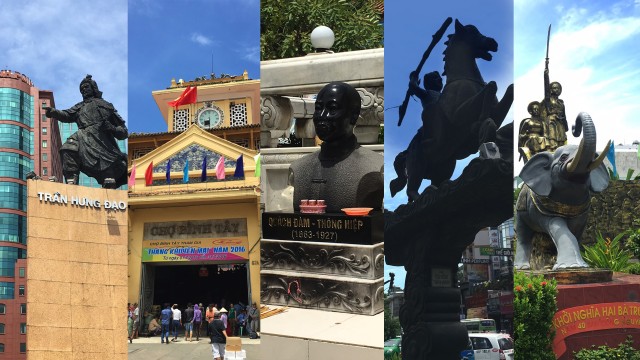
The city's monuments tell the story of Vietnam's constant battle to keep its northern neighbor, China, at bay.
Another national defender is notably absent from Ho Chi Minh City. A statue of Gen. Tran Nguyen Han, whose armies countered three more invasions from the north in the 15th century, once occupied one of the city's most prominent locations in front of the central Ben Thanh Market. But in 2014, construction on Ho Chi Minh City's first metro line forced his removal, at least temporarily. The statue will be reinstated once construction has concluded, and in the meantime, Le Loi Street, a major arterial near the general's former perch, will continue to honor the emperor whom he served.
A Different Kind of Invasion
The subjects of these monuments, real and mythological, all tell the story of Vietnam's constant battle to keep its northern neighbor, China, out of its territory. (The Mongol Yuan dynasty ruled China from 1279 to 1368, though few Vietnamese distinguish among the various identities of their northern aggressors.) Throughout Vietnam, many more streets and statues honor other generals, emperors and folk heroes for their roles in the fight.
At the same time, one of the most powerful landmarks in Ho Chi Minh City serves as a reminder of China's enduring influence on Vietnam's development. Binh Tay Market, the city's largest wholesale market, sits in the middle of the Chinese district known as Cho Lon, about 6.4 kilometers from the city center. Cho Lon is the oldest part of town, formed around a Chinese trading post that was established well before the Vietnamese and French began to settle what is now Ho Chi Minh City. In the central courtyard of the massive market, which provides consumer goods for most of southern Vietnam, stands a bust of Quach Dam, a 19th-century businessman. Unlike many of those honored by monuments in the city, Quach was himself something of a northern invader: Born in southern China's Guangdong province, he migrated to Vietnam for business. Today, stall keepers treat his statue in Binh Tay Market as an altar, offering prayers and incense in hopes that he will bring good business. After all, his wealth and influence helped construct the bustling marketplace that surrounds his likeness.
Quach offers a symbolic counterpoint to Ho Chi Minh City's other monuments, but the real evidence of China's economic power in Vietnam lies beyond the city. Just to the north, in the adjacent Binh Duong province, local leaders have created industrial zones that capitalize on Vietnam's cheap labor market. China ranks fourth in investment in the country, according to Vietnam's Foreign Investment Agency — over $25 billion, a figure that jumps to $57 billion if one includes Taiwan's investments with those of mainland China, as Vietnam does. In Binh Duong, Chinese firms are well represented, contributing more than 200 projects and $2.1 billion in registered capital investments as of 2015, according to the vice chairman of the local People's Committee. Instead of national heroes, Binh Duong celebrates global commerce, with corporate logos and signs at the center of its traffic circles and factories lining its highways.
As symbols of Vietnam's national identity, the Chinese factories in Binh Duong — and all over the country — may not be as poignant as the monuments that dot Ho Chi Minh City's busy thoroughfares. But they are no less important to Vietnamese history. While Ho Chi Minh City's statues bear witness to Vietnam's long and storied past, the factories represent the country's present and future economic position. The tension between the country's current economic demands and its historical opposition to Chinese influence explains the rifts within Vietnam's Communist Party and the broader identity crisis in Hanoi over its relations with Beijing. Meanwhile, Vietnam's citizens draw inspiration from the national heroes who kept their northern neighbor at bay, even as they pray at the altar of a Chinese-born businessman.
