
With another presidential election on the horizon in 2019, Bolivia's ruling Movement Toward Socialism (MAS) coalition is once again pushing for President Evo Morales' re-election. In February, Bolivians voted by a narrow margin to prohibit Morales from seeking a fourth term as president. Less than four months later, the Six Federations of the Cochabamba Tropics — a group of coca producers led by Morales — called for a national referendum to put the president's eligibility for office to another public vote. MAS officials are now considering a formal request for a new referendum.
Before a new referendum could be held, the coalition's request would need to clear several legal hurdles. If Bolivia's constitutional and electoral courts, and then its legislature, approve the referendum request, then the matter may return to a national vote. And if Morales wins another election, Bolivia will likely remain a difficult place for companies to do business.
In the February referendum, 51 percent of voters rejected the proposal to grant Morales another run for office. But Bolivian law does not limit the number of referendum requests that a political group can bring to the courts on a given subject. This means the courts could consider a new referendum request on Morales' eligibility, notwithstanding its failure in the earlier vote. A Morales presidency in 2019, therefore, cannot be ruled out. Morales lost the February vote by only about 3 percentage points, and a new referendum could yield another close vote.
Over the next several months, MAS could decide when and how to submit its request. Though the coca growers' federation has scheduled a two-day congress in July to discuss the matter, some pro-MAS organizations have already begun collecting signatures for the request. Once the necessary signatures are collected, Bolivia's legislature will propose a referendum and the courts will rule on its validity. After that, the MAS-controlled national legislature will vote on whether a referendum can be held.
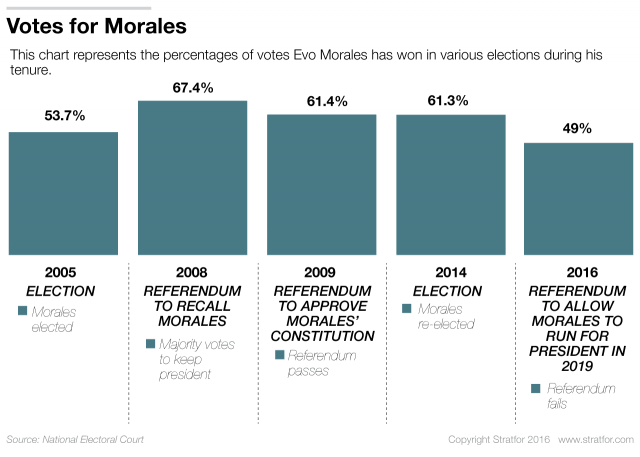
Considering Morales' 57 percent approval rating, another vote could well enable him to run for re-election. But a new referendum may also deter some private firms considering investments in Bolivia. Morales' populist economic policies, unlike those of Venezuela's government, for example, have not threatened Bolivia's stability. In fact, by carefully managing its natural gas revenues from exports to Brazil and Argentina, the Bolivian government has been able to bolster its finances, despite the decline in oil prices. Even so, throughout Morales' 10-year tenure, the Bolivian government has expropriated concessions from foreign firms without offering compensation.
Over the next few months, MAS will determine whether it can proceed with a new referendum request. As the coca growers' federation and other MAS-affiliated social movements continue to collect signatures, the referendum request gets ever closer to becoming a reality.
