
Kuwait's spending is out of control, and, like its neighbors, the country is trying to cut expenditures. This year the situation has become particularly dire. The 2016-2017 budget has a deficit of $40 billion, which is 50 percent higher than in previous years and is a substantial portion of the approximately $63 billion budget. Much of the shortfall can be attributed to ever-increasing public sector wages, so the government has proposed an alternative wage system that would save an estimated 15 billion to 19 billion Kuwaiti dinars ($50 billion to $63 billion) over the next decade.
The wage reforms in question are part of Kuwait's "strategic alternative wage reform law," a set of changes recommended by the International Monetary Fund that has languished in parliament, unpassed, for the better part of the past year. The IMF has proposed similar changes in consultations with all six oil-dependent Gulf Cooperation Council nations. The Kuwaiti plan sets tiers for annual pay increases. Some 30-40 percent of government employees would get a 20-25 percent one-time pay hike meant to normalize salaries for underpaid employees. A further 25-35 percent of workers are deemed to already be earning suitable salaries and would get only a 5 percent increase, a rate nearly in accordance with inflation. If implemented, the plan would equalize government salaries throughout the workforce.
Oil workers, who account for a large portion of public wages and who tend to earn five times as much as other government workers, were an integral part of the original wage adjustment plans. In fact, it was the disparity between them and other public employees that prompted discussions of wage reform in the first place. But though the proposed reforms will raise wages, oil workers demanded more, staging a debilitating strike. The strike was the first to bring workers from the upstream (exploration and production) and downstream (refining and processing, marketing and distribution) sectors together since 1995. It was also the first since Kuwait announced its record budget deficit. The tactic worked, and the government has agreed to exempt 20,000 current oil workers from the proposal. Under a deal struck May 23, existing members of the oil workers union will be entitled to a 7.5 percent annual pay increase, and new workers will receive a 5 percent increase per year. This means that raises for many oil workers will outpace inflation.
The government has yielded to the outsized power of the oil sector, which is far and away the most critical component of the economy. Although the strike was brief, it demonstrated how easily oil worker unions could devastate the country. Over a three-day period, crude oil production was halved from its normal rate of 2.77 million barrels per day. Working feverishly, the government managed to bring production nearly back to normal levels within a day, a process originally estimated to take three. The short span of the strike meant that the disruption was only a minor blip in global oil markets. Had it gone on, however, it could have posed a serious risk to Kuwait's economy and, by extension, to that of the region.
Throughout the strike, labor leaders remained cordial, even responding to Emir Sabah Al-Ahmad Al-Jaber Al-Sabah's condemnation of their coercive methods by hailing the ruler's wisdom. But polite or not, union leaders showed that their ability to destabilize the most important sector of the economy outweighed the government's power to impose its will. And because Kuwait has the most liberal labor laws in the Gulf, there is more room for disruption. The government has managed to delay tougher decisions about oil sector wages, but it will eventually have to address the issue.
Gulf Ramifications
Kuwait is in some ways a bellwether for the rest of the Gulf Cooperation Council (GCC). Its neighbors will soon need to implement similar reforms and will have to solve the competing objectives of imposing critical reforms while maintaining stability in key sectors. Kuwait's acquiescence to labor pressure sets a dangerous precedent for other nations in an era of tough decisions, communicating to citizens across the Arab world that they can force the government to adjust its directives if the costs are high enough.

But Kuwait is also in a unique position compared with other GCC members. Its parliament is powerful by Gulf countries' standards, possessing the ability to exert pressure on the executive branch (even removing the emir) and to veto its decisions with a two-thirds majority. The legislature was key in unpegging Kuwait's dinar from the U.S. dollar in 2007, a decision that derailed GCC plans to adopt a single currency by 2010. Kuwait's citizens also have the greatest amount of freedom of speech in the region, partly because Kuwait does not have the same ethnic or sectarian splits as nearby Bahrain or Saudi Arabia. This less authoritarian system of government has meant that economic reform efforts have come early, but it has also made those reforms susceptible to populist disruption.
And Kuwait's citizens have taken advantage of this freedom by being vocal about what they expect from the government, particularly when it comes to economic reform. Demand among Kuwaiti youth for high-paying public sector employment is higher than in other Gulf countries, and more women participate in the workforce than in neighboring countries. This puts a great deal of pressure on the government to absorb these workers.
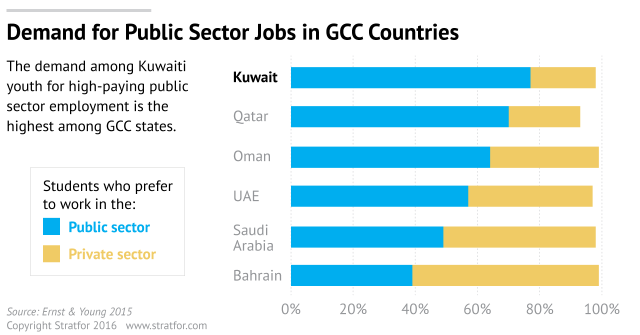
The government has made some progress in easing this pressure. In 2015, it managed to impose limits on expatriate employment in the public sector, opening up more slots for locals — a feat other Gulf states have been unable to manage. But the limits have their disadvantages. Because there are fewer foreigners in these jobs, making cuts to the public sector has been more difficult for Kuwait. Other Gulf nations can deport or lay off expatriates instead of making painful cuts to salaries for citizens. The Kuwaiti government is aware of this and has threatened to hire more foreigners to fill any gaps in employment.
Kuwait is small and its economic problems, though serious, are not as severe as those of other countries in the region. Saudi Arabia, for example, has a deficit that is draining foreign exchange reserves, and Oman is being forced to consider drastic social spending cuts. Conversely, Kuwait and its unique political system can implement reforms, such as the controversial wage policy, more quickly than can other Gulf nations. That Kuwait, despite its advantages, capitulated to oil unions bodes poorly for similar plans in other Gulf nations. It is clear that as regional governments push to impose similar, urgent reforms, workers will push back.
