
A long-dormant conflict between Morocco and the ethnic Sahrawi people who inhabit the disputed Western Sahara territory, which both parties claim, threatens to escalate. Meanwhile, the U.N. Security Council will take up a crucial vote on April 29 that likely will decide the fate of its peacekeeping mission there. In March, the Moroccan government expelled civilians attached to the mission after U.N. Secretary-General Ban Ki Moon called Morocco's presence in Western Sahara an "occupation." A U.N. report released a month later detailed the state of the standoff between the Polisario Front, an armed Sahrawi activist group, and Moroccan forces, magnifying fears of renewed fighting between the two. Now, the ambiguous status of the peacekeeping mission is driving U.N. concerns surrounding the conflict in Western Sahara, which Ban said could erupt into "full-scale war."
After colonial power Spain withdrew from Western Sahara in 1975 and Morocco annexed the area, the Polisario Front, with backing from Algeria, began fighting to gain independence for the Sahrawi. The subsequent clashes have left tens of thousands dead and displaced more than 100,000. In 1991, a cease-fire was negotiated between Polisario and Moroccan forces, with the aim of enabling a referendum on the country's future. Since then, the United Nations Mission for the Referendum in Western Sahara (MINURSO) has kept the conflict in check through military patrols, observation and inspection along the divide between the Moroccan-controlled portion of Western Sahara and the Polisario-controlled zone to the east. The border between the two areas is demarcated by a Moroccan-built wall and littered with millions of land mines.
The U.N. peacekeepers do not physically enforce the cease-fire, instead monitoring infractions and observing whether the sides are abiding by the agreement's stipulations. Though the U.N. presence in Western Sahara has limited violence between Polisario and Morocco, the source of their conflict remains unresolved. To decide the disposition of the territory, Polisario has demanded that a referendum be held, but Morocco disagrees with the group about what the referendum should determine. Polisario seeks an independent territory. Morocco, on the other hand, wants to limit the question to whether Western Sahara would be granted autonomy under Moroccan administration. Furthermore, the two sides do not agree on who should be eligible to vote on the referendum. The disputes derailed attempts to hold referendums in 1994 and 2000, keeping the political situation at a standstill.
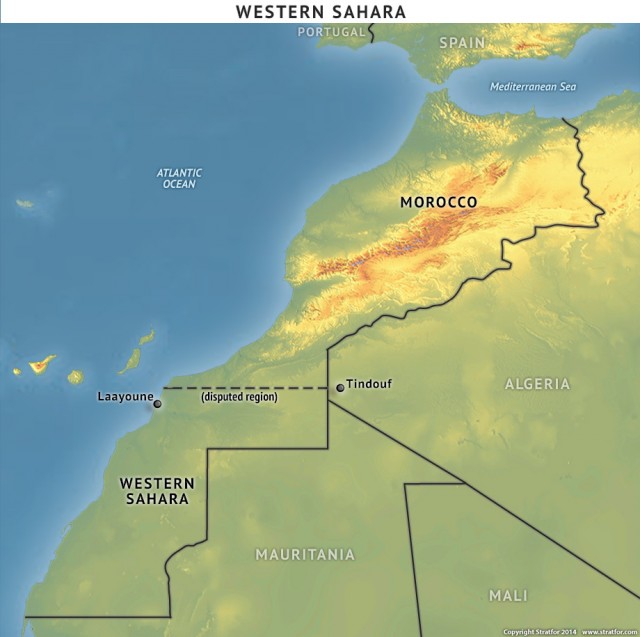
While the MINURSO mission has quelled insurgency in Western Sahara, Morocco and the Polisario Front remain at a political impasse. And recent events have jeopardized the mission. Since making the comments that drew Morocco's ire, Ban has apologized, saying he regretted his choice of words. But Moroccan King Mohammed VI insists that, in light of Ban's remarks, the U.N. can no longer purport to be a neutral arbitrator in the dispute.
Although Morocco expelled the MINURSO mission's 84 civilian members, the U.N.'s 26 troops and 216 military observers remain. The U.N. Security Council has scheduled a vote on a one-year extension of the mission to address the issue of restoring its civilian administration. It is unlikely that the extension would be rejected or that Morocco would expel the mission's military component. But there are concerns that, without its civilian component, the mission will lose its effectiveness. This could lead to more violations of the cease-fire, which could then turn into a broader armed conflict that would be difficult to quell.
Morocco's reduction of the U.N. mission has elicited a twofold response from the Sahrawi. On April 20, Emhamed Khadad, the Sahrawi coordinator with the MINURSO, said Polisario is ready to engage in negotiations with Morocco as soon as possible and "without preconditions." But in a letter to Ban, Polisario leader Mohamed Abdelaziz warned that Sahrawi separatists will return to armed struggle unless the United Nations pressures Morocco to fully restore the U.N. mission.
However, relations between Algeria and Morocco may have as much bearing on the risk of a resurgent violence in Western Sahara as the U.N. mission's status does. If, in response to the diplomatic difficulties, Algiers decides to ramp up its support for Polisario, or even engage Moroccan forces directly, the situation could destabilize. Algerian support is crucial for Polisario, which at its height boasted about 15,000 troops. Defections and internal political issues have weakened the force, leaving it with fewer than 5,000 fighters, but it possesses heavy weaponry from Algeria. And even though Algeria no longer supplies Polisario with equipment, it still provides training support, and it could re-equip the group if it chose to.
The cease-fire between Polisario and Morocco has provided Algeria with an effective check on Moroccan expansion. Algerian support for Polisario has always been closely related to its ambition to limit Morocco's regional power and expand its own hegemony in North Africa. As a result, Algeria has perceived Morocco's limits on the U.N. mission as Rabat's attempt to assert itself more in the region, which could increase tensions between the two nations. Although the U.N. mission itself does not provide a significant physical deterrent to the eruption of violence, any Moroccan decision to reduce it could translate into renewed Moroccan-Algerian hostilities. And these hostilities could play out between Morocco and the Polisario Front.
Moreover, the internationalization of the Western Sahara conflict could go even further. Gulf Cooperation Council states have consistently supported Morocco in its battle against the Polisario Front. While Algeria's foreign policy is based on staunch pro-sovereignty and noninterference principles, the country would not accept a perceived increase in Moroccan influence in the region. This could lead Algeria to try to assert more influence itself, escalating tensions between the two. A resurgence of violence in Western Sahara could also affect Algeria's relations with the GCC. Algeria has remained neutral with regard to the competition between Saudi Arabia and Iran in the Middle East, emphasizing its important economic and political relationships with both. However, because Saudi Arabia has reacted to Algeria's neutrality with suspicion, a rise in violence in Western Sahara could drive a wedge between Algeria and the GCC.
