
Zhang had been the head of Hebei's Political and Legal Affairs Commission since 2008, overseeing China's police, intelligence services and judicial services at the provincial level. He was also a career Public Security Bureau officer who served in Beijing and Hebei province and, more important, a member of the Hebei provincial standing committee. This committee consists of about a dozen provincial leaders, including the Party secretary, governor, mayors of key cities and the heads of several provincial departments, usually including the Political and Legal Affairs Commission chief. These officials collectively set the province's policies. Consequently, even though Zhang's expertise centered on security and judicial affairs, as part of the committee he would have had input on the province's economic policy, including the degree to which it implemented Beijing's policies to curb heavy industry, which often produce with high overhead costs and yield low profit margins.
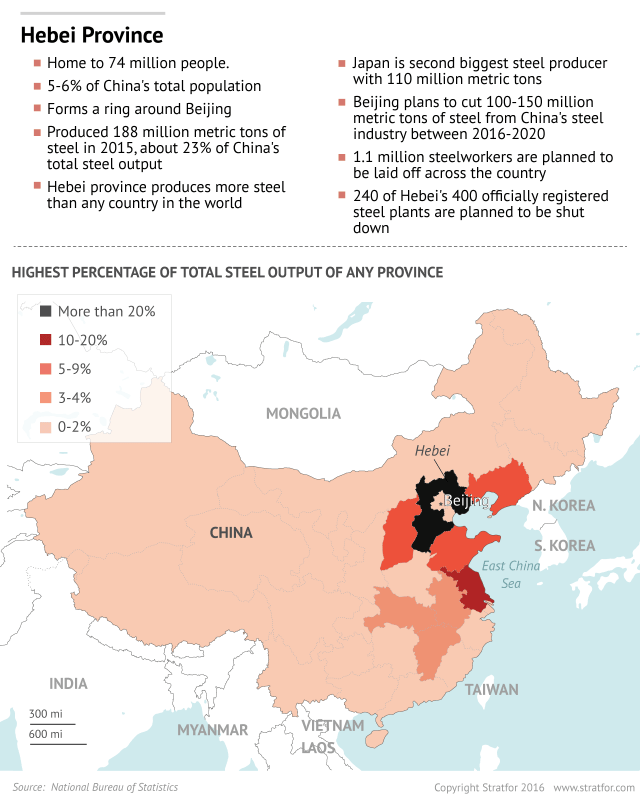
Hebei is a major center for China's heavy industries, especially steel. It contributes 23 percent of China's total steel production. But Beijing plans to slash steel production by 150 million metric tons over the next five years, and Hebei is likely to bear a tremendous share of those cuts. Local employment at steel plants, often the economic pillars of particular towns and villages, will suffer most, to say nothing of the other economic and social upheaval resulting from these measures. And in fact, upheaval has already begun: Labor protests erupted in Hebei this year and continue to break out frequently. Workers are being furloughed, and there has been no sign of any central government funds being disbursed as part of the $15 billion assistance package unrolled by Beijing at the beginning of 2016. Anecdotal evidence suggests that many workers have not even heard of the program.
Corrupt Ties
But it seems implausible that Zhang was removed simply for being incompetent. Corruption aside, his entire career had been one of continued advancement as a professional public security officer, suggesting he was effective at his duties. Moreover, it is unlikely that anti-graft investigators were unaware of Zhang's activities until now. Zhang survived investigations in 2014 without incident, likely by trading information on his connections and patrons for his political survival.
For example, Zhang appears to have had strong ties to former Politburo Standing Committee member Zhou Yongkang, the biggest opponent — and therefore the biggest target — of Xi's presidency in its early days. Zhang's rapid rise in Hebei from 2007 to 2008 corresponds with Zhou's promotion from minister of public security to Central Political and Legal Affairs Commission chief, supporting the idea that they had a close relationship. In 2014, amid a purge of Zhou's expansive network, including the political and legal affairs system, the petroleum industry and the Party leadership of Sichuan province, Zhang was reportedly questioned by the Central Commission for Discipline Inspection several times but was not punished as others were.
Furthermore, Zhang was close with Ma Jian, who was investigated in January 2015, if not earlier, as part of the purge in the Ministry of State Security that accompanied the investigation into Zhou. Ma's corrupt ties to property tycoon Guo Wengui are also well known, so the anti-corruption authorities likely have a strong understanding of the network with which Zhang is now in trouble for associating.
Removing Obstacles
Given the amount of evidence against him, Zhang is probably not being punished now for his corrupt practices in the past. He might even have been useful to the Party's anti-corruption efforts in 2014. After all, legal concerns are of secondary importance to political concerns in suppressing threats to Xi's power and removing obstacles to implementing his policies. But there is reason to think that Zhang's fall is the result of greater political attention on Hebei's standing committee and its resistance to central government policies. Though investigations began in 2015, Beijing may be starting in earnest now because of Hebei's importance in the structural reform of China's bloated heavy industries.
Four members of the Hebei provincial standing committee have been removed since Xi took power. The first to fall, as early as 2014, was the head of Hebei's Organization Department, Liang Bin, though this appears to be related to his close ties with disgraced Hu Jintao aide Ling Jihua and his notoriously corrupt circle in Shanxi province. More directly, in 2015 the anti-corruption agency investigated Secretary-General Jing Chunhua in March and Party Secretary Zhou Benshun in July.
Thus, there appears to be a concerted effort to remove members of the Hebei standing committee, intimidate the rest and perhaps appoint officials friendly to Xi's interests to key positions. If this is the case, opposition to structural reform policies, at least in Hebei but perhaps in other provinces, come not only from lower-level governments but extend all the way up into the provincial governments as well. Similar purges targeted at other standing committees resisting Beijing's economic policies could occur. After all, a similar investigation into the head of the Political and Legal Affairs Committee in Liaoning province, another area of tremendous industrial overcapacity, has already begun.
