
Desalination and water recycling can go a long way in making up for scant natural water resources. Israel, for example, has been highly successful in using both to overcome its inherent lack of water. The water reserves in the arid nation are extremely vulnerable both to its neighbors and its environment. These conditions have necessitated a rather unusual response: Israel recycles and desalinates a sizable share of its water. Recycled water, which is essentially reclaimed wastewater, accounts for 55 percent of agricultural water consumption, and Israel's desalination capacity is expected to equal its natural internal resources within the next four years.
Of course, Israel is a rare case whose small size and relative wealth have gone a long way toward making its water management strategy a success. In the short term, most countries will have a hard time replicating its achievements. Though Israel has advanced desalination technology enough to push costs down, there is still room for improvement. If desalination and water recycling are to be used on a broader scale, scientists will have to find a way to reduce the amount of energy consumed in the filtration process to make them more competitive with natural water resources. Even then, the high costs of transporting water over long distances would remain, limiting the effect seawater desalination could have.
Bringing down energy consumption is key, and some progress has recently been made on that front. Desalination by reverse osmosis — currently the industry standard — requires forcing water through cell membranes at high pressures to reduce the salt concentration present in either seawater or brackish water. Achieving those high pressures typically requires a large amount of energy, but graphene filters may soon change that. Graphene is much more permeable than the materials traditionally used to make desalination filters, reducing the amount of energy needed to separate salt from the water passing through it. According to some estimates, graphene filters can lower the monetary cost of producing water through desalination by as much as 20 percent.
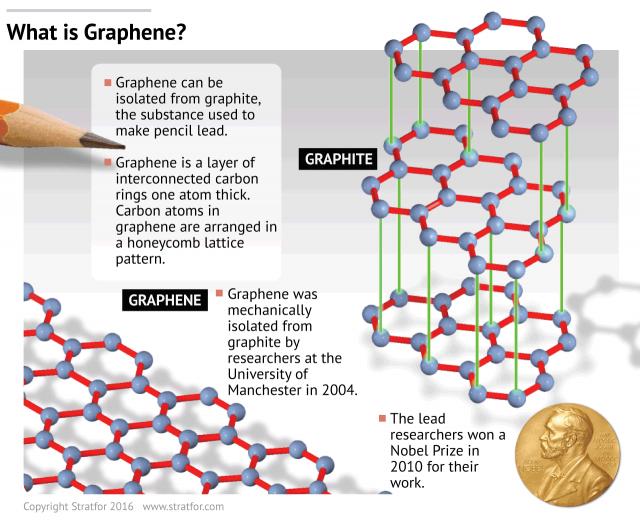
As is often the case with graphene products, though, the filter's limitation lies in the process of manufacturing it. Graphene and the materials derived from it often have fantastic properties, including great strength, high conductivity or increased permeability. However, these properties are lost when production is scaled up because of deformities introduced during fabrication. In light of this problem, graphene filters have been slow to develop, and efforts have been diverted to recycling wastewater for the oil and natural gas industry, which does not require as much uniformity in filters.
But a new manufacturing technique may make it possible to produce graphene filters with the size and standardization needed for large-scale desalination. Australian and U.S. researchers have developed a process that uses a blade to spread a viscous graphene-oxide material into a thin sheet. The sheet can remove virtually anything from water, including chemicals, salts, viruses and bacteria. Eventually, the process could allow for the faster production of large graphene-based desalination filters — a crucial step toward their wide-scale commercial development. While several hurdles still remain, the fact that the research had a commercial backer — Ionic Industries — makes it more likely that the experiment's results will be applied beyond the academic setting.
If they are, graphene-oxide filters could become a formidable tool in combating water scarcity, though they may not be widely used for at least another five to 10 years. As water resources become increasingly strained in some of the biggest cities and most populated countries, improvements in purification technologies will be important for more effectively using the limited water the world has left.
