
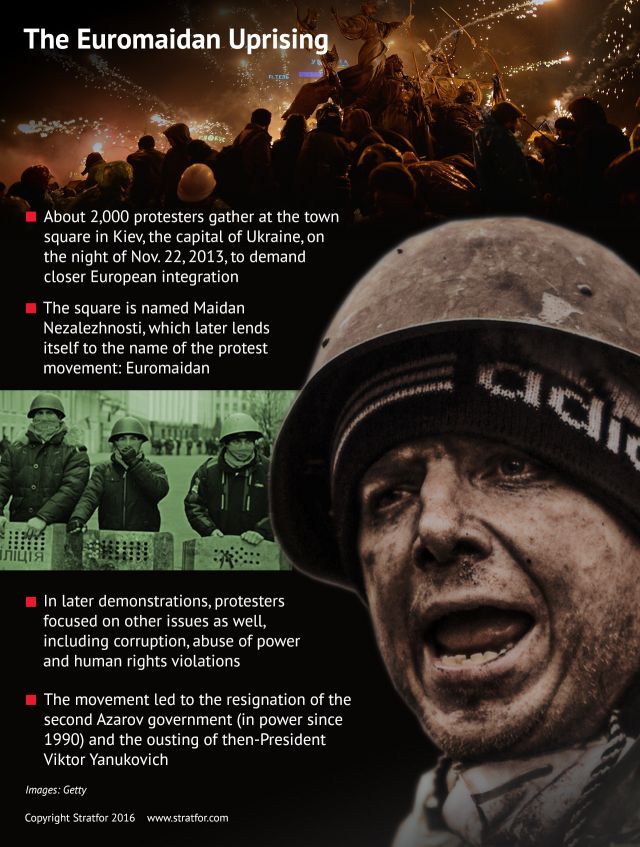
In addition to their shared enemy, Ukraine and Turkey have something else in common: geography. Each is located on the Black Sea, which also happens to be the site of one of Russia's largest military buildups over the past two years. In response to the Euromaidan uprising in Kiev, which set Ukraine and Russia on a collision course, Russia annexed Crimea, expelled Ukrainian military forces from the peninsula and beefed up its own military presence there. The moves put Ukraine at a strategic disadvantage, forcing Kiev to remove its naval assets from its major base in Sevastopol (or lose some of them entirely) and relocate to a smaller naval base in Odessa.
Russia's annexation of Crimea also affected Turkey, which has its own substantial naval presence on the Black Sea and controls access to and from the sea via the Bosporus. Russia's buildup in Crimea has been especially worrisome to Ankara since Turkey shot down a Russian fighter jet near its border with Syria, bringing relations between the two to a new low. Russia has since put in place trade restrictions against Turkey, and the two have become increasingly antagonistic in Syria. Clearly, Ukraine and Turkey have a serious interest in bolstering their defenses to counter the perceived Russian threat, especially in Crimea and the Black Sea.
It is unsurprising, then, that this was the focus of Poroshenko's visit. Though few specific details were announced on the security agreements struck between the two countries, a joint declaration did reveal that Ukraine and Turkey intend to strengthen security in the Black Sea and increase cooperation with each other and with NATO. It was also noted that steps would be taken to end the occupation of Crimea and to implement joint projects in the space sector and defense industry.
Beyond what was officially announced, there are other security measures that Turkey and Ukraine could take to strengthen their united front against Russia. For example, the joint military exercises already being conducted under NATO in the Black Sea could be expanded and made more frequent. Turkey could also sell weapons to Ukraine; Russia would interpret this as an aggressive act, but it is nevertheless an option if Russia continues its role as an agitator in the Ukrainian and Syrian conflicts. In fact, in a visit to Kiev in February, Turkish Prime Minister Ahmet Davutoglu agreed to set up working groups with Ukraine on the joint production of weapons systems.
Another potential area of cooperation between Ukraine and Turkey outside of the direct military realm is the mobilization of the Crimean Tatars, an ethnically Turkic group that, prior to Russia's annexation of Crimea, made up about 10 percent of the peninsula's population. Many Crimean Tatars have been detained or expelled from Crimea for refusing to support Russia's takeover of the peninsula, serving as a source of anti-Russia sentiment in Crimea and in Ukraine proper. Disillusioned Crimean Tatars were among those responsible for electricity cutoffs from the Ukrainian mainland to Crimea in December 2015, and there are reports of Crimean Tatar volunteer brigades being formed alongside Ukrainian groups that want to reclaim the peninsula from Russian military forces. While this is probably an unrealistic goal, such groups could serve as an avenue of influence that Ukraine and Turkey may have an interest in exploiting.
Still, any Ukrainian and Turkish military cooperation is likely to be limited as the two countries primarily focus on their respective conflicts in eastern Ukraine and Syria, which are entirely distinct in terms of both geography and tactics. Turkey also has the Kurdish insurgency in its southeast to worry about. However, Kiev and Ankara's shared desire to counter Moscow and weaken Russia's position in the conflicts and in its region is a powerful reason for both to enhance security ties and to align defensively with each other, at least for now.
