
As Mexican President Enrique Pena Nieto's term approaches its halfway mark, progress on security issues has stalled. During his first years in office, the president laid out an ambitious security strategy, which included the creation of new police forces and security institutions to reduce the role of the Mexican military in maintaining public order. Three years later, the reforms are still not fully implemented, and the constitutional reform to take security out of the hands of local police forces is stuck in Congress.
The gridlock does not indicate that Mexico is forever incapable of creating consistent local security institutions. It does, however, indicate that the move away from military enforcement will be slow, especially as the upcoming 2018 general elections stymie political cooperation. In the meantime, public safety and security in Mexico will largely be shaped by the continual breakup of criminal groups into smaller factions, which diminishes organized crime's ability to launch violent territorial conflicts on a national scale.
The Problem of Security Forces
Though past Mexican governments have always used the military to conduct counternarcotic operations, it was the administration of President Felipe Calderon from 2006 to 2012 that extensively deployed the armed forces in a public security role. Thousands of troops were sent to areas where criminal organizations were active. Since then, the military has been the primary tool for directly targeting criminal groups and for conducting public security operations in areas where local authorities are simply too corrupt or ineffective to do so. Depending on the area, the federal police and other federal, state and municipal police forces often partner with the armed forces.
However, there are problems with having the armed forces lead the fight against criminal groups, and the practice has addressed only a part of Mexico's overall security problems. Using the military has frequently created immediate political problems, such as damaging allegations of human rights violations. Moreover, while the armed forces could reliably confront and weaken cartels, military operations did not reduce criminal violence. For the most part, the military was efficient when it came to battling cartels and killing or arresting high-value targets, but the cumbersome armed forces were simply unable to conduct criminal investigations for prosecution, resolve lower-level crimes or be a permanent law enforcement presence in troubled areas.
Unsurprisingly, the Calderon strategy arose from a lack of options; a similar lack of options meant Pena Nieto could only affirm Mexico's reliance on its military. Local security forces, primarily represented by municipal police forces, were historically weak and often complicit in criminal activity. In specific areas, such as Tamaulipas, Michoacan and Guerrero, the military entirely supplanted some of these police forces, which were often disbanded and many members of which were arrested. It is clear: Military deployments often resulted in immediate security gains, but they were not a long-term solution to Mexico's security problems. So when Pena Nieto took office, he touted using local institutions capable of improving public security in dangerous regions as a better policy than persistently applying military force alone.
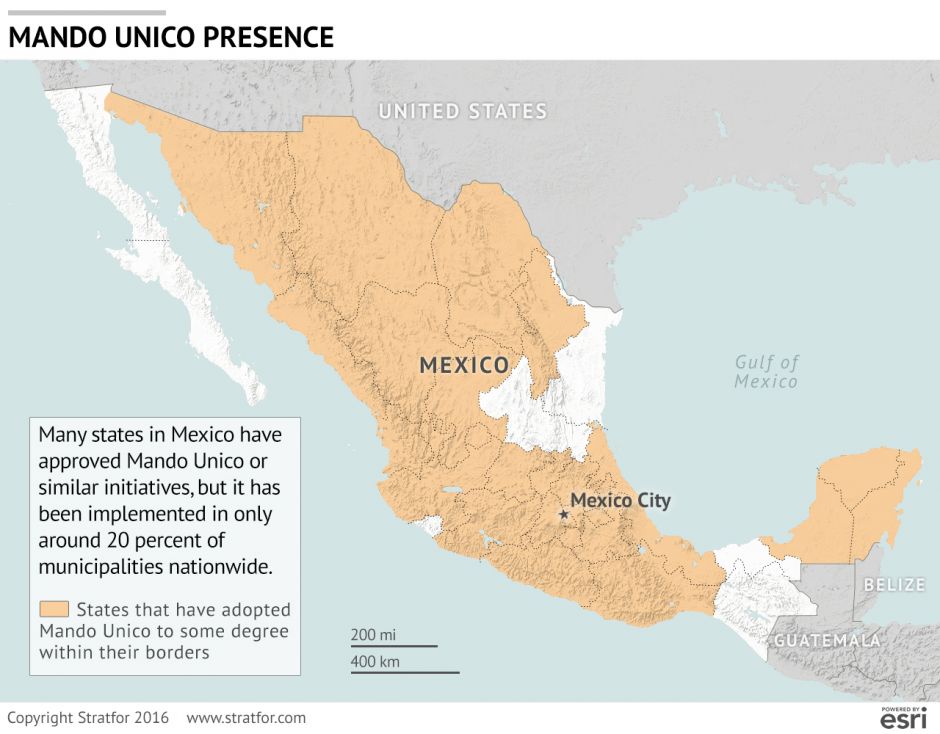
To this end, in 2013 Mexico began expanding a paramilitary police force known as the gendarmerie, formed from an existing body within the federal police. A new federally directed system known as the Mando Unico was also implemented, under the umbrella of the Interior Ministry, and replaced locally controlled municipal police with state-led forces. However, each force is not without its flaws. Financial limitations and concerns over corruption in the gendarmerie will likely limit its ability to expand significantly anytime soon. The Mando Unico model has spread in an inconsistent manner since 2010 as well. Different states and even municipalities have voluntarily approved the scheme on a case-by-case basis, but only about 20 percent of municipalities are currently covered under the model.
Beyond the Current President
Thus, a solution to the issue of poor local security institutions will be a problem for the next president. In December 2014, the Mexican president introduced a constitutional reform initiative that would have placed all public security forces exclusively under federal and state command. More than a year later, discussion on the amendment has stalled. Despite the progress Mexico City has made with the gendarmerie and the states that have fully adopted the Mando Unico, such local forces are either not numerous enough or effective enough to be relied upon entirely.
The pace of implementing Mando Unico across the rest of the country may also soon be subject to Mexico's political calendar. Because Mexican presidential and legislative elections are coming up in 2018, politicians are already forming alliances and jockeying for presidential candidacies, making it more difficult for Pena Nieto to negotiate constitutional reform, let alone to get legislative consensus to pass it through Congress. The opposition National Action Party and the Party of the Democratic Revolution are actively seeking to oppose the ruling Institutional Revolutionary Party in several governor races as well as in the eventual presidential race. And unlike energy reform, which preserves future federal government revenue from hydrocarbons taxation, reforming police forces to combat localized security threats is simply not viewed as an urgent priority for Mexico.
Ultimately, although the current administration wants to reduce violence by overhauling local police forces, it will be the changing patterns of criminals and their activities, along with any institutional buildup, that will largely determine future levels of violence in the country. Mexico is the main land bridge for northbound cocaine and is a major producer of heroin, methamphetamine and marijuana. Consequently, criminal competition in the drug trade and the violence that comes with it will be around for years to come. As criminal groups attack each other in turf wars and are in turn attacked and weakened by the army and police, they will split into smaller units, unable to carry out widespread cartel warfare as they had before. If the spread and success of Mando Unico forces leads to more effective local police, Mexico's overall homicide rate and the prevalence of violence in problem areas will eventually fall. But that is a long-term trend, and one that is likely to play out well beyond Pena Nieto's time in office.
