
The order issued for the arrest of Tompolo is part of a nationwide anti-corruption crackdown led by the government of President Muhammadu Buhari, who is working to cement his political control over the country. The investigation of Tompolo centers on his alleged role in a $65 million Niger Delta land fraud scheme. While the charges of complicity have not yet been proven, the militant leader certainly benefited from the patronage of the previous administration — a legacy that the new government wants to root out. His is also involved in ongoing corruption related to security for the oil and natural gas industry.
At the peak of its campaign in the mid-to-late 2000s, MEND was a loose conglomeration composed of what were essentially criminal gangs led in part by Tompolo. They were provided significant patronage from all levels of the Nigerian government to disrupt the region's energy sector to achieve political prominence for their patrons. Other commanders, such as Ateke Tom, Soboma George, Farah Dagogo, and Ebikabowei Victor Ben, also known as Gen. Boyloaf, were provided space and patronage in other states of the Niger Delta region as well. The commanders maintained rivalries and competed against one another, fighting openly when factions strayed across ethno-political lines. Top MEND leader Henry Okah was arrested in South Africa in 2010, following an investigation into a car bombing in Abuja that had targeted the Nigerian president. After Okah's car bombing and subsequent arrest began the slow process of the rebel group's unraveling.
The region entered a period of relative calm after President Goodluck Jonathan's government supported an amnesty program that doled out cash and favors to the region's militant commanders and soldiers. Tompolo received security contracts to provide river escorts for travelers along the creeks of Delta state as well as to protect oil and natural gas infrastructure. He also gained a great deal of wealth and power in the process. The government also gave Tompolo millions of dollars to disband his gang, the Federated Niger Delta Ijaw Communities. With the change from Jonathan, who hailed from the Niger Delta's Bayelsa state and whose political rise was in part due to MEND's campaign, to Buhari, the Niger Delta region's political elite began to fear that their lucrative patronage ties and largesse would henceforth be lost. Buhari has not ended the militant amnesty program, and some of the Niger Delta elite are part of his government, but concerns remain that their former benefits will be rescinded permanently.
The warrant for Tompolo's arrest has not caused widespread fallout in the region — or even among militants. The Niger Delta's militants are not longer assembled into a coordinated body, and rivals in Bayelsa state and Rivers state are not concerned with Tompolo's apparent fall from grace. The reprisal attacks Tompolo loyalists recently launched against oil pipelines are in keeping with their longstanding technique to discourage government operations against them. They also carried the implied threat of future assaults if the investigation on Tompolo continues. The militant leader does indeed command enough men to launch attacks in the Warri area if need be. Beyond this area, however, his influence wanes and he does not have control over militants in other nearby states. MEND will not resume or be able to maintain a broader coordinated militancy campaign.
Moreover, the Nigerian military's Joint Task Force has reportedly deployed to the Niger Delta region to pursue Tompolo loyalists in response to the pipeline attacks. Tompolo himself has even communicated to the Nigerian president that he wants to avoid further confrontation and make a plea deal.
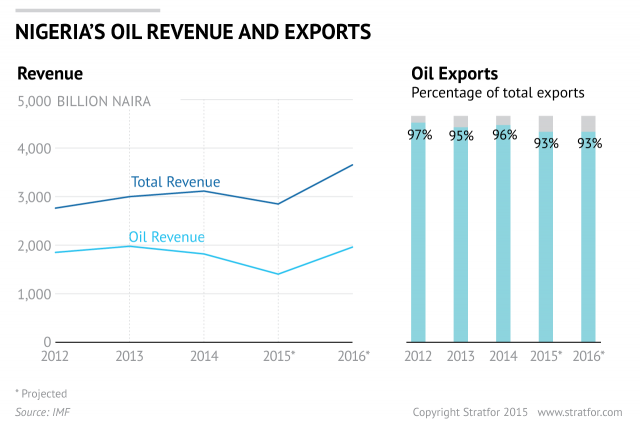
There is always the chance that political elite and militants in the Niger Delta could reignite a militant campaign. But sources among other Niger Delta militants report to Stratfor they are loathe to open a new conflict with the government, and certainly not for Tompolo. Instead, they are watching other militant groups to see how they will respond. In addition, some members of the region's political elite have been incorporated into Buhari's government, with patronage schemes still in place to support the important oil-producing region. Some pipelines may be attacked and damaged to the point that they shut down, but ultimately, the region's oil will continue to flow, and insecurity in the south will be kept at a minimum.
