
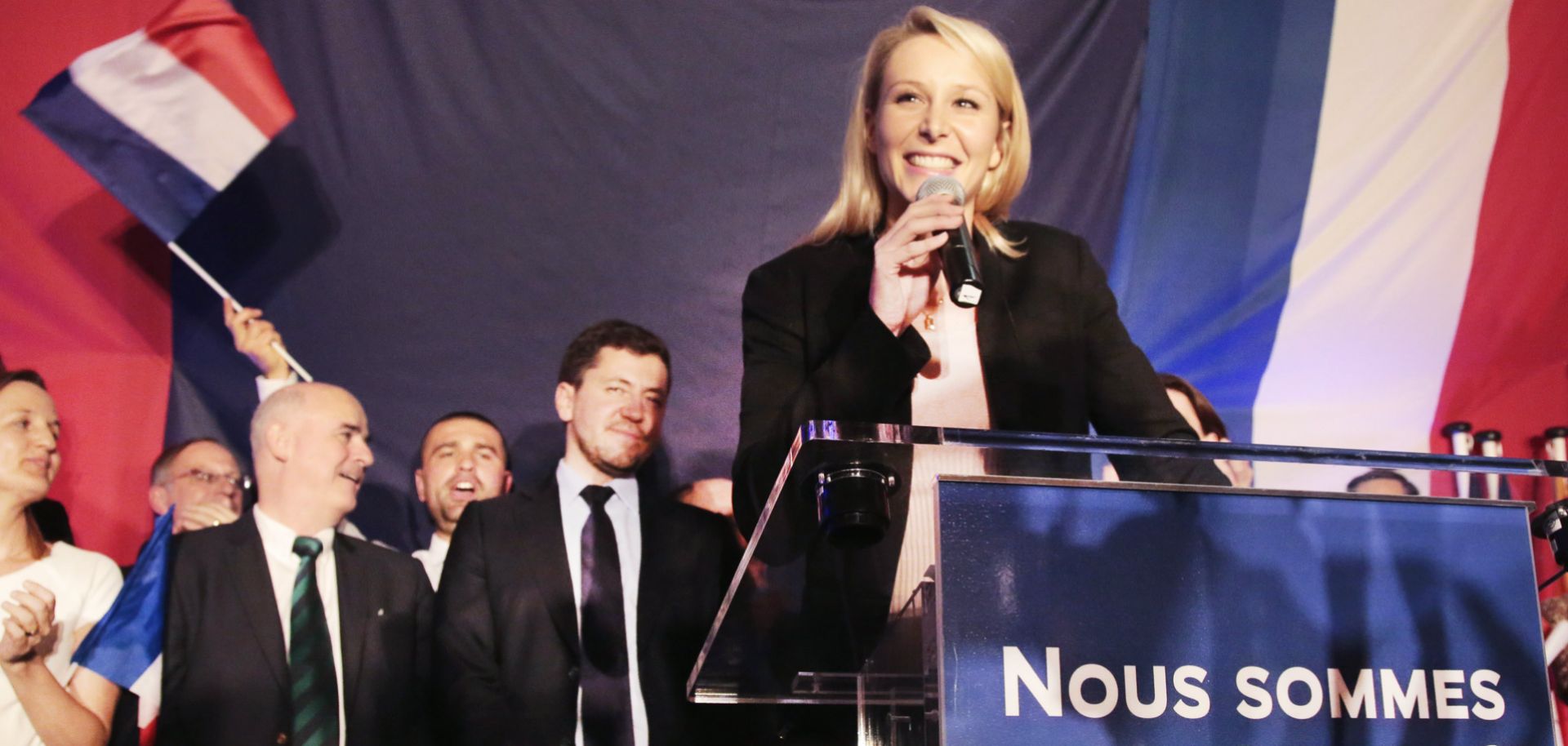
France's National Front has once again claimed a victory, this time in regional elections. The party won in six of France's 13 metropolitan regions in the first round of voting Dec. 6, and it came in second in three other regions. The National Front's most recognizable faces, party chief Marine Le Pen and her niece, Marion Marechal-Le Pen, obtained more than 40 percent of the vote in the densely populated regions of Nord-Pas-de-Calais-Picardie in the north and Provence-Alpes-Cote d'Azur in the south, respectively. The results confirm the nationalist party's role as France's most popular political force and have put the party in a strong position to compete for the presidency in 2017.
At the national level, the National Front garnered 27.7 percent of the vote (more than 6 million votes), nearly three times more than it raked in during France's last regional elections in 2010. This figure is up from the 24.8 percent of the vote it received in European Parliament elections in 2014, as well as the 25.4 percent it obtained in municipal elections early this year (totaling about 4.7 million and 5.1 million votes, respectively). By contrast, former President Nicolas Sarkozy's center-right Republican party gained only 26.6 percent of the vote, while President Francois Hollande's Socialist Party won only 23.1 percent.
The Nov. 13 terrorist attacks in Paris no doubt helped the National Front, but they probably were not a decisive factor in the elections' outcome. The party already had a large political presence in France, and Le Pen was campaigning against immigration and the free movement of people in Europe long before the attacks. If anything, the Paris attacks were a vindication for Le Pen, who had long promised to strengthen French security forces and resist EU integration.
The National Front's strong performance has deeper roots. The French economy is showing only negligible growth and unemployment is still on the rise. Many French voters are exhausted with the country's traditional center-right and center-left forces and see the National Front as the only way to challenge the political establishment. Le Pen is simply the most visible face of a wider European trend: the weakening of traditional parties and the rise of anti-establishment forces that criticize both the European Union and the elite that support it. It comes as no surprise that the National Front's victory happened a mere three days after Danish voters rejected in a referendum a plan to deepen their country's cooperation with the European Union on security issues.
This does not mean that the National Front will ultimately govern the six regions it won. A second round of voting will take place Dec. 13, and many voters who supported moderate forces in the first round will probably support other parties to keep the National Front from winning again. The Socialist Party has already announced that it will not compete in Nord-Pas-de Calais-Picardie and Provence-Alpes-Cote d'Azur to enable its voters to support the center-right. However, Le Pen and Marechal-Le Pen are expected to win in their respective regions, giving the National Front its first regional governments — a milestone in the history of the party, which so far has governed only a handful of small municipalities.
But the act of governing regions will also end the National Front's comfortable position as a protest force. Anti-establishment parties in other EU member states have suffered by assuming governing responsibilities, because making policy decisions tests a party's cohesion and risks hurting its popularity. Additionally, the 6 million votes the National Front obtained in the regional elections are not enough to win the second round of a presidential election, which means the party still has to convince a larger number of voters if it wants to control the Elysee in 2017. The National Front's biggest challenge moving forward will be to preserve its anti-establishment appeal after becoming a mainstream party.
