
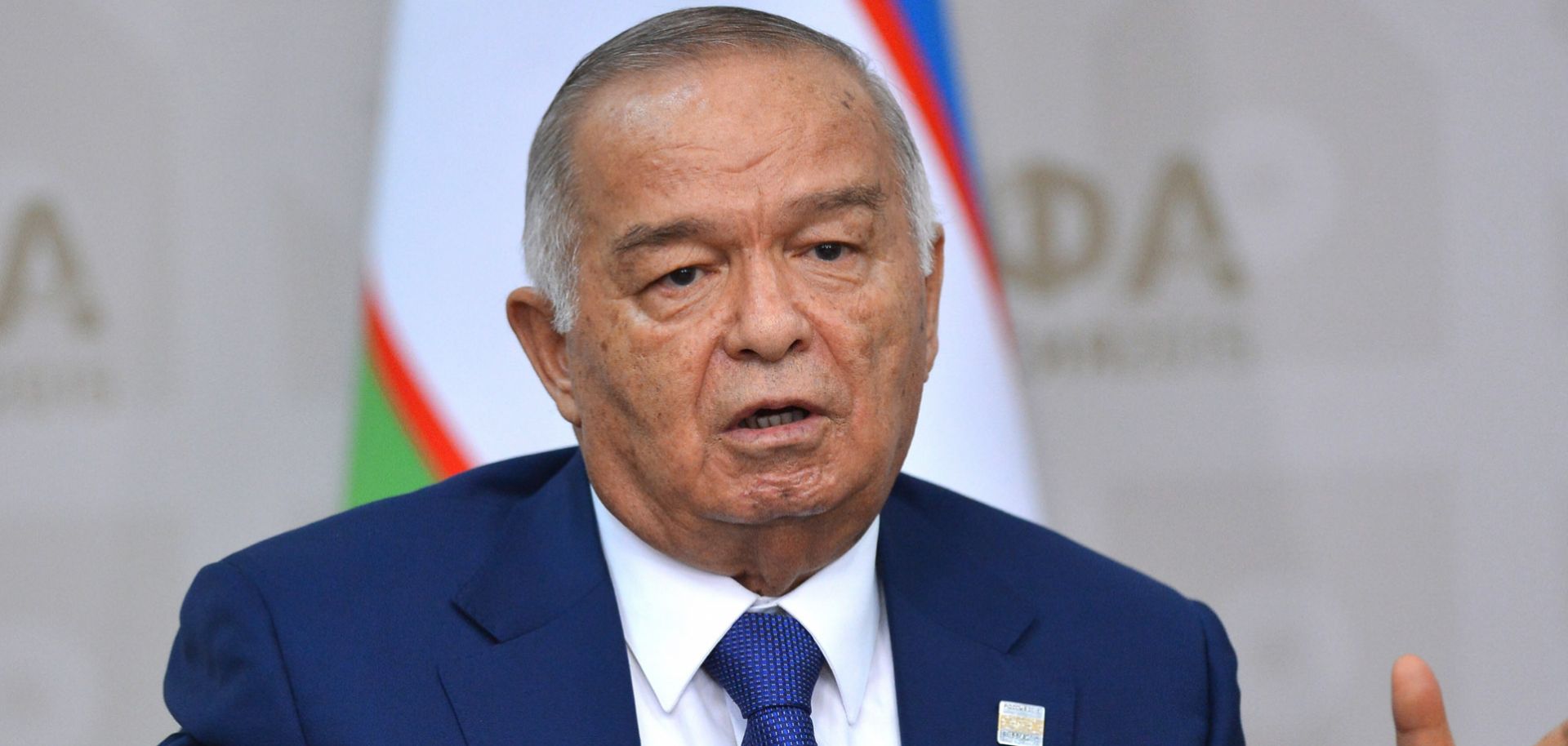
Uzbekistan, like many countries in Central Asia, is a difficult place to understand. Power is heavily centralized under Karimov, who has ruled the country since before the collapse of the Soviet Union, and the government tightly controls the media. Therefore, the presidential succession process, the performance of the Uzbek economy and the severity of security threats in the country are unclear to all but the Uzbek elite. Yet in recent months, it has become increasingly apparent that all of these factors are causing instability to grow.
Along with other Central Asian countries, Uzbekistan is experiencing a major economic slowdown prompted by both a drop in global commodity prices (Uzbekistan is an important exporter of natural gas and cotton) and Russia's economic crisis. Remittances from Uzbek migrants, which make up 9 percent of the country's GDP and come mostly from workers in Russia, have declined significantly, down 14 percent in 2014 and 45 percent in the first quarter of 2015 compared with the year prior. Moreover, the Uzbek currency, the som, has declined by 10 percent to around 2,700 som to the dollar; the black market rate is allegedly much lower, at 6,000 som to the dollar. This makes the government's official GDP growth projection of 7.8 percent for 2015 highly suspect.
The country is also experiencing shortages of natural gas, electricity and hot water, particularly in the Fergana, Andijan and Namangan regions. Although energy shortages are not new to Uzbekistan, it is difficult to assess how serious the current shortages are, though anecdotal evidence shows that rolling blackouts have regularly occurred throughout the country since October. There are also indications that these shortages are creating growing dissatisfaction among the Uzbek population, increasing the potential for more social unrest.
A Wave of Arrests
This could explain, in part, some anomalous attacks and a major government security crackdown in recent months. In early September, a homemade explosive device was reportedly detonated at a bus stop near a mosque in the Olmazor district of Tashkent. A month later, another bombing targeted the Shaykhontohur district police office. No casualties were reported in either attack. During the past two weeks, more than 200 residents in and around Tashkent have been detained on the grounds of having links to the Islamic State, though independent observers have claimed that these arrests have targeted migrant workers who have returned from Russia, Turkey or Europe and who have nothing to do with the Islamic State. The move comes as the Uzbek government, along with other governments in Central Asia, is frequently and increasingly using the threat of Islamist militant groups such as the Islamic State or the Islamic Movement of Uzbekistan to justify security sweeps that target the domestic population.
In reality, the Uzbek opposition is more complex and multifaceted than just radical Islamist groups. Several actors could have an interest in coordinating protests or even in carrying out attacks against the Uzbek government, including disillusioned opposition elements within the country and the large unemployed and underemployed segments of the population that do not factor into the government's official statistics. Uzbekistan could also be facing a situation similar to that in Tajikistan, where a consolidation of power by the government under the guise of counterterrorism operations has reignited regional and clan rivalries within the country. Furthermore, the succession process underway in Uzbekistan is much more opaque than in neighboring Kazakhstan and could also be driving instability within the country.

The Uzbek government's motivation for conducting security sweeps is questionable because there is little direct evidence that Islamist militant groups have operated or have conducted attacks in Uzbekistan since the height of the Islamic Movement of Uzbekistan in the late 1990s and early 2000s. The group was pushed into Afghanistan and Pakistan after the U.S. invasion of Afghanistan in 2001, and although the Karimov government accused Islamist militants of being responsible for the bombings in Tashkent in 2004 and an uprising in Andijan in 2005, domestic opposition elements or other government opponents were more likely the cause than the Islamic Movement of Uzbekistan or other radical groups.
Nevertheless, the Uzbek government has played up the Islamist militant threat, a strategy that has been strengthened by the more concrete and verifiable increase in militant activity across the border in northern Afghanistan. The growing presence of the Islamic State, Taliban and other militants in the region has also attracted the attention of other world powers, most prominently Russia and the United States. Moscow and Washington have competed with each other in Central Asia, courting Uzbekistan, Tajikistan and Turkmenistan to join their border protection programs and other security initiatives. Uzbekistan has used this to its advantage, both as a means to elicit financial and security support (including 300 mine-resistant, armored protective vehicles from the United States) and as a way to justify domestic crackdowns that may have little or nothing to do with Islamist militant threats. This is not to say that Islamists pose no threat to the country, but that the Uzbek government has an interest in playing up the threat to justify taking action against other opposition elements.
However, continued crackdowns could inflame social unrest in Uzbekistan, which will also have to manage serious economic challenges in the coming year and which is keeping the succession plan for the 77-year-old Karimov a closely guarded secret. Given Uzbekistan's strategic location in the heart of Central Asia and the efforts by Russia and the United States to woo Tashkent, rising instability in the years ahead could have significant implications that extend beyond Uzbekistan's borders.
