
The situation on the demarcation line had been relatively calm since Sept. 1, and cease-fire violations were becoming a rarity, but this has changed since the end of October. Independent reports of cease-fire violations in the Donestk sector have started to emerge more frequently, and although they were not initially mentioned in official accounts on the status of the cease-fire, the volume of infractions, which are now rather overt, has continued to increase.
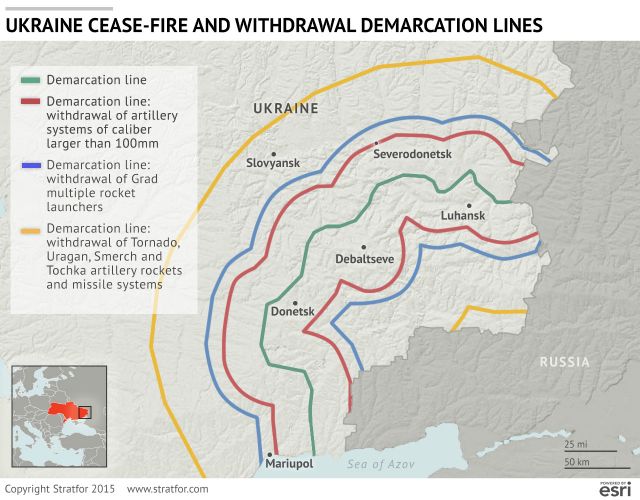
Separatist forces and the Ukrainian army were scheduled to start removing lower-caliber mortars from the front line in the Donestk sector Nov. 6. But mortars are being used once again. Both sides have also started bringing equipment that had previously been withdrawn back to the front line. These movements do not necessarily mean either side is planning to ramp up military activities on the demarcation line — they are a logical consequence of the uptick in fighting — but they are still worrying. Each side will be forced to put into place contingencies to deal with an offensive from the other.
Withdrawals had been taking place on track with the timeline for the implementation of the Minsk agreement, and tanks, artillery pieces and heavy mortars had already been removed. Initially, cease-fire violations involved the use of small arms almost exclusively, including rifles, heavy machine guns and rocket-propelled grenades. As the escalation continued, however, mortar fire began to be seen, and there were a few reports of the use of heavy artillery and tanks. One incident even mentioned the firing of a Grad rocket, which landed in the center of Donetsk. There is no evidence that the rocket was launched from Ukraine-controlled territory, but within the conflict the use of Grad rockets stands as a reminder of the most intense periods of fighting.
There are clear indications that Moscow is still in control of the situation in separatist-controlled areas. A high-level Russian official recently paid a visit to Donetsk, and Russian troops are still visibly present in the cities of Donetsk and Luhansk. It is notable, however, that the escalation over the past weeks has been concentrated only in the area north and west of the city of Donetsk. The Luhansk and Mariupol sectors have been less active. This suggests that Moscow or separatist leaders have not given a general order for separatist militias to engage Ukrainian forces all across the contact line. It could also simply mean preparations for an operation in the Donetsk area are still underway.
No major preparations are visible right now that would indicate offensive operations are looming, but the Donetsk sector is the gateway to towns such as Slovyansk and Kramatorsk — areas the separatists once held. As the prospect of Kiev immediately implementing the Minsk agreement fades — and with it any hope in Moscow for the imminent removal of sanctions — there are fewer reasons for the Ukrainian separatists in the east to clamp down on cease-fire violations. And as violations go up, so does the risk of a return to active offensives.
