
Since Afghanistan's National Directorate of Security revealed that former Taliban leader Mullah Omar died in 2013, the Afghan Taliban have faced a public power struggle over his successor. The group almost immediately pegged Mullah Omar's deputy, Mullah Mansoor, as its next leader. However, this move sowed further discord within the movement. Mullah Omar's family is the most significant among the Taliban political camps that have been withholding their support for Mullah Mansoor's appointment.
Mullah Mansoor is widely thought to be in favor of peace talks with Kabul mediated by Pakistan and supported by regional powers, including India and China. But the Taliban must bring a concerted agenda to the negotiating table, and Mullah Mansoor must be able to guarantee the concessions agreed upon in the talks.
Divisions within the Taliban predate the movement's recent public power struggle. Schisms have produced breakaway insurgencies such as the one led by Mullah Dadullah, which recently engaged in armed standoffs and brief skirmishes with Taliban fighters loyal to Mullah Mansoor in Zabul province. Intra-Taliban fighting has also occurred recently in other areas of Afghanistan, most notably in Herat province.
Now, with support from Mullah Omar's family and the allied Haqqani network, Mullah Mansoor likely holds a strong mandate over a large segment of the Afghan Taliban. But consolidating control over the movement is just one of many critical tasks confronting Mullah Mansoor. Being able to lead the movement to the negotiating table with Kabul will be tricky and could create additional fissures within the Taliban. The likelihood of talks will depend on whether Taliban factions understand that when they chose to support Mullah Mansoor, they also chose to support negotiations. The continued, albeit small, presence of the Pakistani and Afghan Taliban now operating under the Islamic State banner in Afghanistan could lure away Taliban members who are against negotiations with Kabul.
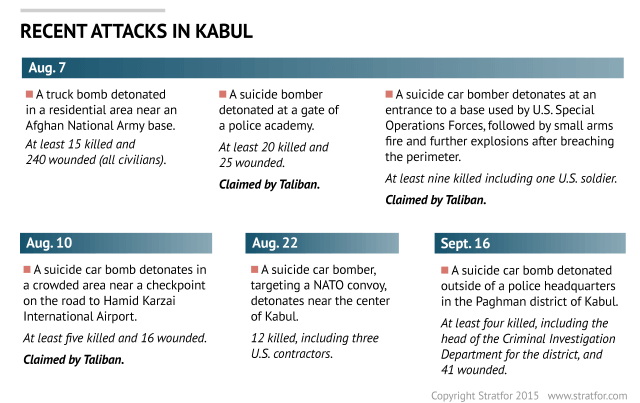
Key players, including Ghani, still support talks between the government and the Taliban. However, the tenuous unity government formed in Kabul following the country's 2014 presidential election could still delay or prevent peace talks. The spate of Taliban attacks in the Afghan capital since August has inflamed anti-Pakistan rhetoric among individuals in Kabul. Afghan Vice President Abdul Rashid Dostum, who recently led a campaign in Faryab province against the Taliban that lasted several weeks, has been particularly vocal about Pakistan's role in the August attacks. Kabul probably still intends to resume efforts for peace talks with the Taliban, but continued attacks in the country's capital and a growing reliance on militias to fight anti-government forces could upset Ghani's hopes for meaningful talks.
Pakistan is key to the prospect of negotiations between Kabul and the Taliban. Though Pakistan fully supports Mullah Mansoor's intent to pursue talks, the Taliban leader's ability to hold the movement together through the painstaking process of peace talks remains to be seen. Furthermore, any future divisions in Kabul over Afghanistan's relations with Pakistan could arrest the peace process.
