
The U.N. Security Council adopted Resolution 1970 in February 2011 condemning former Libyan leader Moammar Gadhafi's use of violence against protestors and imposing a series of sanctions, including the arms ban. Since the fall of the Gadhafi, the U.N. has maintained the ban in hopes of preventing the spread of weapons and the hold over the country of Libyan militias and militant groups. But arms and fighters proliferated anyway, especially with foreign states providing arms directly to fighters in spite of the U.N. arms ban. Their spread has been felt across the Maghreb and Sahel regions, as well as in Egypt and on the Syrian-Iraqi battlefield.
When militants looted Gadhafi's arm depots and state institutional authority largely dissolved following his fall, it left Libya awash with weapons and its army weak, fragmented and outgunned. The Tobruk government has subsequently been unable to quash an Islamist uprising that seized much of Benghazi, and it left an Islamic State outpost in Darnah largely untouched — with only hardline Islamist militias and local tribal groups remaining to root the militant group out from the coastal town earlier this year. Thus, the international community has continued to balk at Libya's request to lift the arms ban, even with Arab League support for Tobruk. The United States in particular has led efforts to keep the ban in place, citing the high likelihood of arms delivered to the government being stolen by, or, as in several cases in the past, distributed to various armed groups outside the government's control. Libya last made a concerted effort to lift the arms ban in February 2015, succeeding only in gaining the opportunity to have requests reviewed by a board on a case-by-case basis with the possibility of granting waivers.
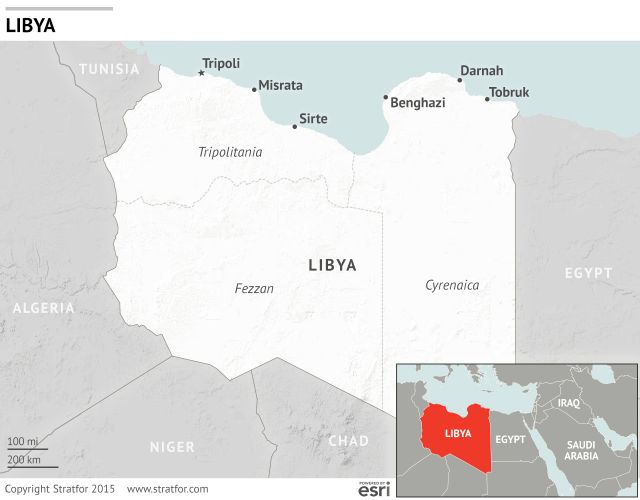
Libya's return to the issue highlights a bigger problem: There are few international partners ready, willing or even able to actively work with the faltering Libyan government to directly address its security challenges. The United Arab Emirates and Egypt have launched periodic airstrikes on Islamist targets beginning in 2014, but Tobruk's initial request was for Arab League air support to attack the Islamic State in Sirte. Saudi King Salman's ascension earlier this year coincided with a pivot in Arab militaries' focus to providing a united front against the Islamic State in Syria and Iraq and containing Iranian expansion — as evidenced by the Arab coalition's deployment in Yemen.
Ultimately, Libya's distance from the Persian Gulf and the Islamic State heartland in Syria and Iraq has removed the country's instability from the shortlist of Arab concerns. Saudi Arabia's engagement with moderate Islamist groups has also constrained Emirati and Egyptian regional actions, especially when it comes to targeting Muslim Brotherhood-type groups in Libya. Consequently, it is the European Union — nearer to Libya and its security woes — that has emerged as the primary interlocutor among the North African country's warring factions. But the European Union, too, has other pressing concerns: the conflict in Ukraine, Greece's economic crisis, and Mediterranean-wide migrant flows, to name just a few. The bloc simply does not have the resources and time to rebuild Libyan institutions.
Thus, Libya's instability has drifted out of focus of Arab states and the West. Even if the Arab League, the European Union or NATO had more resources to secure the country, a possible foreign intervention still risks disrupting the U.N.-mediated peace process between Tripoli and Tobruk governments. If Libyan factions continue to contain the bulk of violence, the international community will avoid intervening directly in Libya.
However, the potential growth of the Islamic State will remain the most troubling aspect of Libyan instability. Signs of the group's expansion from Sirte or increased capabilities are unlikely to go unchecked, though outside governments are more likely to launch airstrikes rather than try to prop up Libya's military to take on the group directly. The United States and others in the U.N. Security Council are also unlikely to lift Libya's weapons ban unless the U.N.-brokered talks resolves the power struggle. Overall, the multitude of competing factions, including jihadist groups, will force even the Arab world to hesitate at the thought of intervening in Libya.
