
Paul Floyd: Hi I'm Paul Floyd and today I'm joined by Scott Stewart, and today we'll be discussing the ideological battle that is happening between both al Qaeda and Islamic State. So Scott, we've seen physical fighting on the ground between al Qaeda affiliates and al Qaeda itself and Islamic State and its affiliates. But that's also spread, that contest or that fight has also spread into the ideological realm, especially with some of the most recent publications that have been coming out from al Qaeda and some of its affiliates.
Scott Stewart: Yeah, really this Ramadan we've seen this campaign that al Qaeda and its, really the whole al Qaeda movement has launched against the Islamic State. The idea is to try to undercut the Islamic State, to undercut their ideology in the eyes of these wealthy donors in the Gulf, of the Muslim on the street, the potential jihadi, the foreign fighters that are going to come and join. So they're really trying to say to these people, listen, the Islamic State is deviant. They're misled. They have a number of things they are doing incorrectly. We're the real jihad. You need to come and get on board with us instead of with these upstarts.
Paul: So what you just said, the competition for both wealthy donors and the militant, potential militant pool out there, it sounds basically like a competition for resources.
Scott: Oh absolutely. And that's really what it's about. Of course we have these ideological differences and how they execute the jihad, the strategy and the tactics behind that. But at the base it really is a struggle for power, for control, for money, for manpower.
Paul: So what are these ideological differences if you will? How are they articulated back and forth?
Scott: Well really, I mean at the big scale at the top is the idea of who to target first. Bin Laden always said that what we need to do is drive the Americans and the crusaders out of these Muslim territories, then we can attack the local regimes, whereas the Islamic State has been no, the caliphate is here and now, we're going to establish it now, and so that's been more of a fighting the near enemy as opposed to the far enemy. There are also a lot of other application issues. Al Qaeda takes issues with the way that the Islamic State has, and this has gone on for a decade now, with the way that they have really employed excessive sectarianism in Iraq and now in Syria, but also this idea of their wide declaration of takfir, or declaring other Muslims as non-Muslims so they can attack. And specifically, they're declaring other jihadists, groups like Jabhat al-Nusra and other range of jihadists operating Iraq and Syria as non-Muslims, and therefore they are attacking them and killing them. And so, basically al Qaeda is saying that this is deviance. This is wrong. You're an extremist. You can't do this.
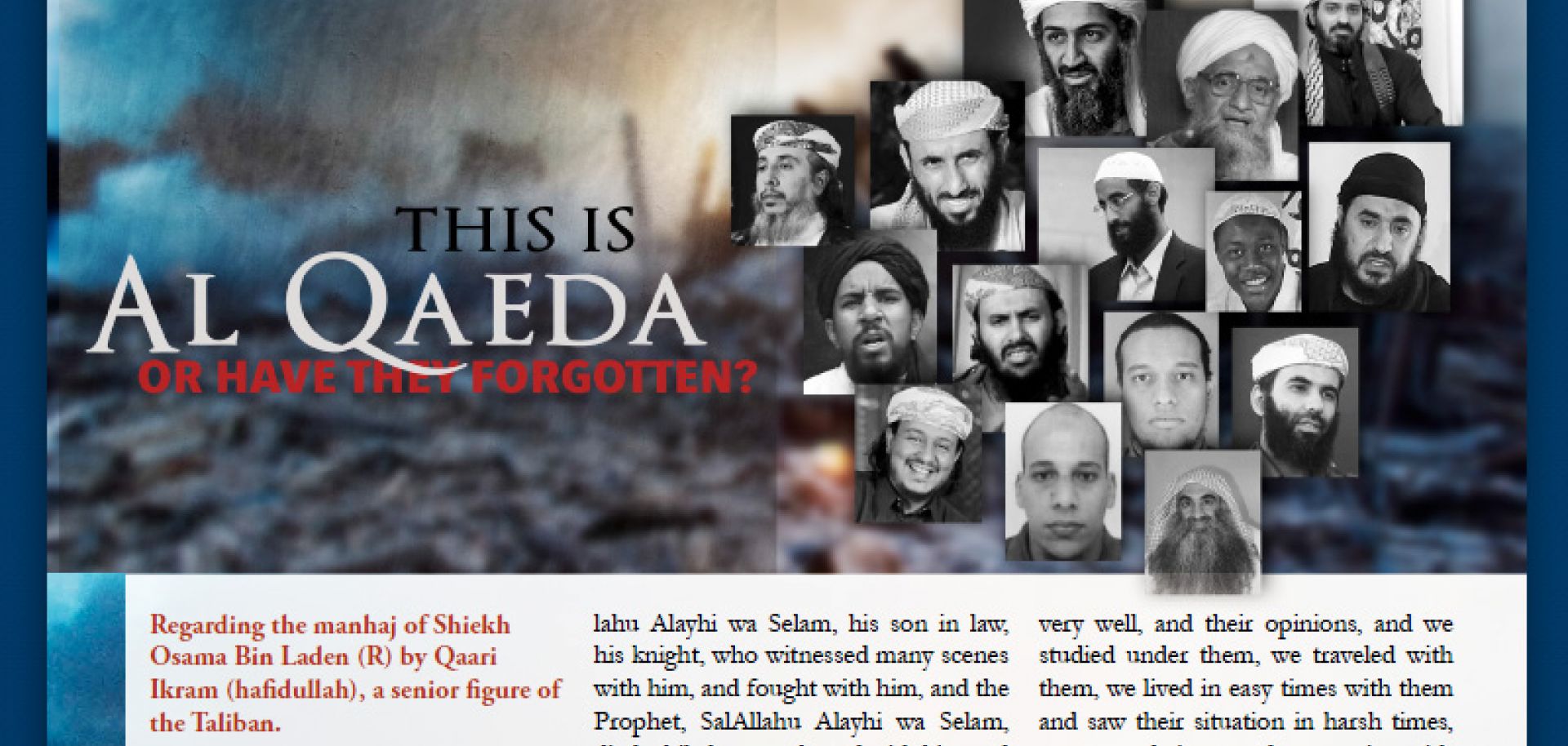
Paul: And so in one of the most recent al Qaeda publications we saw that they said this is who we are and where we're from. And on the front they had pictures, and one of the pictures actually had al-Zarqawi on that photo saying basically he is an original member of al Qaeda and one of our affiliates.
Scott: Yeah that was actually, that was inside of the Al Risalah magazine, and it was actually with an article that was written by a senior Taliban figure. The interesting thing about that article, is he's able to say, listen, I've been in Afghanistan, I fought with bin Laden, I saw him in the good times, I saw him under pressure, I saw what his ideology was, his manhaj, and how he conducted himself. You guys are not bin Laden. You can't claim to be the heirs of bin Laden, and that's one of the things we've seen, for example, in the magazines coming out from the Islamic State, from some of their videos saying hey, we are the real heirs of jihad, of bin Ladenism, and Al-Zawahiri and the rest of the al Qaeda guys have been led astray. This Taliban guy is saying no, I know bin Laden. I was there. I fought with him. I fought with al-Zawahiri, who was with bin Laden. Zarqawi was with bin Laden. He was al Qaeda, and you guys have really deviated from what they were doing. And so I think it's a powerful argument, the thing is though is seeing whether or not these 18-year-old hotheads who want to go fight are going to take time to read these things, or whether they are going to be sucked in by the more social media quick hitters, the ultra-violence of the Islamic State. Those things are very appealing to these young kids sitting in mom's basement on the keyboard being promised a Zaidi sex slave if you emigrate to Syria.
Paul: And that leads me to this next question of what are the consequences of this infighting? Basically on the jihadist and militant landscape we have two big poles of power both fighting physically and ideologically. Is this fracturing a good thing or a bad thing for the fight against jihadism?
Scott: I think it's both. I mean on one term its obviously splitting and dividing and they're killing each other. And whether that is in Syria, whether that's Iraq, whether that's in Libya and now in Afghanistan where we have the Taliban going against the Islamic State's Khorasan wilayat out there, that side of it is good. On the other side though you do have that potential for competition and trying to, for each side, trying to become more spectacular in their attacks. One of the places I think that, I mean we're going to see that within the regions and within these franchises in the regions that have the capabilities to do that. I'm also afraid we're going to see some of that going on with the grassroots in the West, as we kind of have competing claims and camps there. Really so far, within the grassroots movement, most of the deadly, or the most deadly attacks have been conducted by the al Qaeda sympathizers. Things like the Charlie Hebdo attack, something like the Toulouse shootings, things like the Boston marathon bombing, things like the Fort Hood shootings. So they can have this claim to be more spectacular, but I think we're going to see that competition ramping up and Islamic State really trying to encourage their people to match what they've seen by al Qaeda. And of course we'll see the same thing happening at the regional level. We've seen the Islamic State wilayat in Yemen trying to conduct spectacular attacks. Actually, they are kind of failing at this point, they've conducted some suicide bombings at mosques, but they really haven't shown the aptitude for suicide bombings that al Qaeda in the Arabian Peninsula has, for example.
Paul: And that's one of the things we've noted that as the Islamic State has plopped up, that a lot of the, instead of it necessarily growing and sending out its own nodes, that it's basically converting where militants already are. So it hasn't really changed capabilities of militants around the world. But, what it has done is it has changed patterns of violence. So in places where we've seen consistent actors doing consistent tactics, those are shifting slowly but surely.
Scott: Yeah, and that's what we even saw with Ansar al-Khalifa in Algeria. So we had this split off with the al Qaeda in the Islamic Maghreb, one of the first things they do is capture this Frenchman and behead him. So whereas in the old days, we saw al Qaeda in the Islamic Maghreb taking foreigners, holding them for ransom. So it really was a shift in their operations, it really wasn't their shift in their capability. They could still kidnap a westerner, but they just did something different with him.
Paul: Absolutely. Well that's a lot to consider, that you Scott. And for anything else on this topic or something that's related, please join us at stratfor.com.
