
Forecast
- The more liberal of Russia's financial officials will prevent energy company Rosneft from receiving any financial assistance, at least for a while.
- Rosneft will turn to other sources, including China, to cover its debts in the short term, even if doing so creates problems over the long term.
Rosneft's debt burden is too much for the company to bear on its own. Since the beginning of 2015, low oil prices, the consequent drop in revenue, and financial and technical sanctions from the West have kept Rosneft from fully repaying that debt — which currently stands at $43.3 billion — on schedule.
By the end of 2014, with so few options for long-term financing, the company started to get creative in its search for money. In December, it issued a series of bonds just before the ruble collapsed and, in doing so, raised $10.9 billion. (Supposedly it issues the bonds in league with the central bank.) Rosneft was then able to refinance $16 billion and repay $7.2 billion of its debt in February. Notably, some of the $7.2 billion repayment was raised in a deal with Swiss oil trading house, Trafigura, in which Rosneft sold around 500,000 metric tons of oil to Trafigura for an undisclosed amount of money.
After making its February repayment, Rosneft Executive Chairman Igor Sechin said that his company did not need to borrow money and that it could simply service its debts from its own cash flows. But, according to the company's website, Rosneft's first quarter profits fell by 35 percent, dropping from $1.55 to $1 billion. It has tried to offset those losses by lowering operating costs by 3.1 percent and increasing production by 11.8 percent.
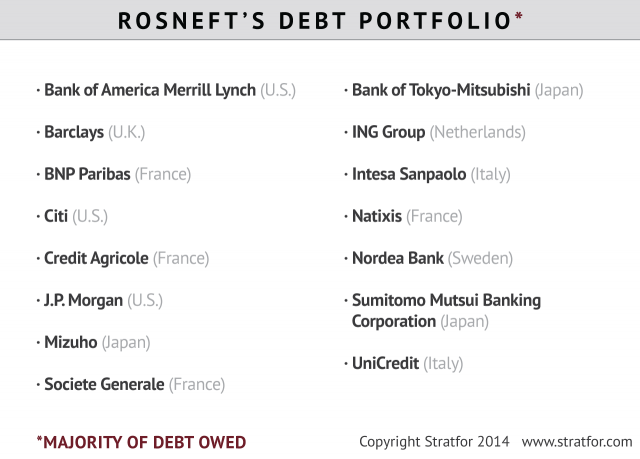
But as Rosneft enters the second half of the year, it must make another payment of $15.5 billion. Strapped as it is for cash, the company has sought financial assistance from the government without success. Last December Rosneft asked for a $42 billion bailout, which the Finance Ministry did not accept. Then, according to an April 21 report from Russian news agency Vedomosti, Rosneft applied for a $25 billion bailout through the National Welfare Fund. Deputy Prime Minister Arkady Dvorkovich, who oversees such deals, rejected the application because Rosneft reportedly threatened to shut down some of its oil fields.
The Kremlin, it turns out, is deeply divided over how to spend the government's cash reserves as well as over how strong an asset Rosneft should be. The Kremlin's financial officials, who include Dvorkovich and Finance Minister Anton Siluanov, have not entirely abandoned Rosneft. In fact, they recently approved a $5.5 billion financial package meant solely for oil field projects. But they will not help to bring Rosneft out of debt and have instead encouraged Rosneft to privatize 19.5 percent of its shares, likely to foreigners. Rosneft Executive Chairman Igor Sechin has refused to privatize, saying that investment sentiment toward his firm was such that it would not get a fair prices for its shares. (Whether or not this is true, Sechin likely does not want to lose any more seats on the Rosneft board, particularly to foreigners.)
The Problem With Prepayments
Rumors abound as to where Rosneft will get the money to pay its debt now that the Kremlin appears uninterested in pitching in. On June 3, Rosneft announced it was forming a business plan without the help of the government's reserve funds. Then on June 25, Vedomosti reported that Rosneft had requested $9 billion in financial assistance from the country's pension fund, something the company later denied.
The newest reports suggest that Rosneft will start to receive its prepayments for oil from Chinese energy firms. In 2013, Rosneft and China National Petroleum Corp. struck a supply deal worth $270 billion over 25 years. That same year, Rosneft reached an agreement with China Petrochemical Corp. worth $85 billion over 10 years. Rosneft is slated to receive $63 billion in advanced payments at some point between 2014 and 2018, but so far it has received none of those payments. According to an analyst at Vedomosti, Rosneft will receive approximately $15 billion from China National Petroleum Corp. this year, something the Chinese firm has not confirmed. If paid, that money would be enough to see Rosneft through to the end of the year.
But large prepayments such as these are not without their own problems. Since Western sanctions remain in place — and will continue to be in place for the foreseeable future — the company will face higher expenses as it upgrades its aging oil fields. Rosneft's search for funds now could leave it with less money in the future. So either the government will have to participate in future investment projects or the Russian oil sector will struggle to maintain production.
