
Since the start of their spring offensive earlier this year, the Taliban have focused on the country's northern provinces, a marked departure from their previous emphasis on their traditional strongholds in the south and east. These efforts have been fruitful: After seizing two key districts adjacent to the vital northern crossroads city of Kunduz over the past month, the Taliban are now positioned less than 7 kilometers (approximately 4 miles) from the city itself.
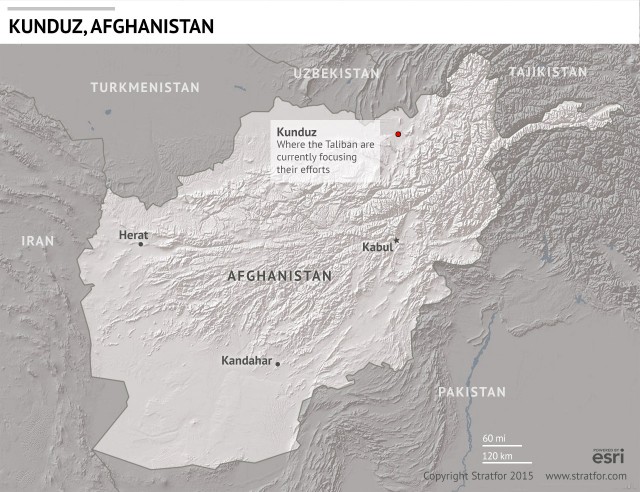
With Afghan military reinforcements from Kabul heading toward Kunduz, it is possible the Taliban may yet be pushed back. Still, the group's gains over the spring and summer thus far have preserved its role as the primary opposition faction in the Afghan conflict, even as concerns about the Islamic State's emergence in the region are growing.
The Islamic State's Afghan Faction
In the months following the January debut of the Islamic State's Khorasan wing, which operates in Afghanistan and Pakistan, the organization has steadily increased its presence in Afghanistan. While the Islamic State still has only small groups of fighters spread across eastern Afghanistan, it has been at least partially successful in attracting new recruits, particularly from the ranks of disillusioned former Taliban. The Islamic State's presence is cause for alarm for the Taliban. They see the group as a potentially powerful rival that espouses a different ideology and vision for Afghanistan.
For the most part, clashes between the Islamic State and the Taliban have been relatively rare. The Islamic State has tried to keep a low profile while it seeks out new recruits, and the Taliban have been concentrating on launching attacks against the U.S.-backed Afghan government. But in the past few weeks the Taliban have begun cracking down on the Islamic State. For example, a large clash on May 24 between the two groups in Farah province left 13 Islamic State fighters and nine Taliban dead, and the Islamic State has vowed to seek revenge for the attack. With the Islamic State looking to cement its presence in the region and the Taliban moving to counter the group, such clashes are likely to continue in the months ahead.
Though the emergence of the Islamic State in Afghanistan has alarmed the Taliban, it has also created an opportunity to raise the Taliban's status. In response to neighboring and foreign powers' reaction against the Islamic State, the Taliban have used their position — as a group that all players are willing to negotiate with — to establish their role as the primary bulwark against the Islamic State.
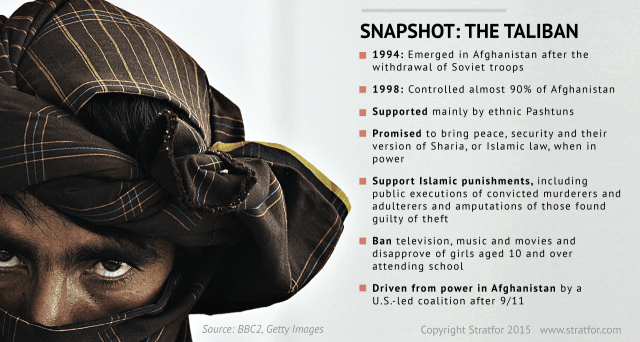
Perhaps more important, the Taliban have been able to leverage the Islamic State's rise to gain greater support from Iran. According to a June 11 report by the Wall Street Journal, Iran has increased its support for the Taliban. The U.S. military has even accused Tehran of providing aid to the Taliban in their war against the United States in Afghanistan. Iran's latest uptick in support, which included the transfer of mortars, small arms and cash, appears to correspond with the Islamic State's growing presence in the country and its success in poaching disillusioned Taliban fighters, in part by offering better salaries.
It is possible that as part of their effort to counter the Islamic State's climb, the Taliban provided Pakistan (and by extension, the United States) with the coordinates of Mullah Abdul Rauf, a key Islamic State leader in Afghanistan. Abdul Rauf, formerly a prisoner at Guantanamo Bay, reportedly broke with the Taliban to join the Islamic State as its deputy governor in Khorasan. A few weeks later, he was killed in a drone strike, though the Afghan National Directorate of Security claims he died during an operation by the Afghan army's special operations forces. Either way, the possibility that the Taliban funneled his whereabouts to the authorities conducting the operation cannot be ignored.
A Manageable Threat
The Afghan Taliban are aware that there is only so much support they can get from neighboring and foreign powers involved in the country's conflict. They will likely continue to try to leverage the Islamic State threat to enhance their strategic position among these powers. As the Afghan government becomes increasingly alarmed about Islamic State aggression in the country as well, the Taliban could attempt to improve their negotiating position by portraying themselves as the more reasonable opposition force.
The Islamic State poses a substantial threat to the Taliban as they continue to wage war against Kabul. Of course, the Taliban have seen much darker days over the course of the 15-year conflict and, at least in the short to medium term, they will likely manage the Islamic State threat successfully. Ideological and tribal differences will continue to impede the Islamic State's expansion in Afghanistan, and the Taliban will use international attitudes against the group to boost their own military capabilities and bargaining power.
