
The post-Soviet order of energy-exporting states surrounding the Caspian Sea, from the Caucuses to Central Asia, has been defined by a continued dependence on Russia: Moscow provides the sole means of transporting their energy to world markets. These countries are working, in various degrees, to lessen their dependence on Moscow. Once a core component of the Silk Road, Central Asian states ironically lack trade routes that would enable them to sell the majority of their oil and natural gas without Russian-controlled infrastructure. Neither can China leverage the Caspian states' limited export options in pricing negotiations, despite being eager to do so. Caught between Moscow and Beijing, exporters such as Turkmenistan and Kazakhstan have few options other than balancing between these two stronger powers when it comes to marketing energy resources.
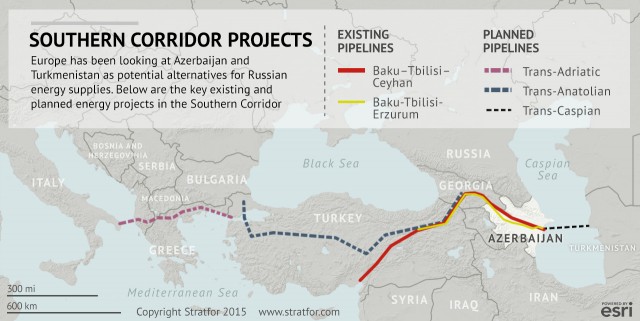
Not all regional exporters face these limits. Azerbaijan uses its ties with Ankara to send energy deliveries westward to Europe through Turkey. A western export route has long eluded other Central Asian states thanks to Russia's effective threats against projects that would create independently controlled export routes across the Caspian. But the ongoing conflict in eastern Ukraine has added new impetus to Europe's search for alternative oil and natural gas supplies: Juxtaposed with the nuclear negotiations between Iran and the West, plans to develop trans-Caspian export routes are being considered with renewed interest.
Numerous obstacles remain, but if Tehran is able to rehabilitate its relationship with the international community, Iran could return to its historical role along the Silk Road and serve as a transit state for Central Asian energy supplies, in addition to marketing its own considerable energy reserves. Piped connections could continue through Turkey and onward into Europe, or load along Iran's Persian Gulf coastline.
Turkmenistan Faces Unprecedented Challenges in 2015
March 24, 2015: Turkmenistan has often stood apart from its neighbors in Central Asia. Unlike Kazakhstan, Kyrgyzstan and Tajikistan, Turkmenistan is not strategically aligned with Russia and has maintained an official foreign policy of neutrality. It has also been spared the instability that has plagued its region since the collapse of the Soviet Union. Kyrgyzstan has experienced two revolutions within the past decade, and Tajikistan still suffers from volatile internal divisions that have lingered from the country's 1992-1997 civil war. Uzbekistan and Kazakhstan have also seen violent protests in the cities of Andijan and Zhanaozen, respectively. With the sole exception of Turkmenistan, all Central Asian countries have been attacked by Islamist militants, who were most active in the Fergana Valley in the late 1990s and early 2000s but launched a string of attacks in Kazakhstan as recently as 2011.
Russia Keeps a Wary Eye on the Trans-Caspian Pipeline
Nov. 19, 2014: Amid a surge of activity surrounding the controversial Trans-Caspian pipeline, Russia chimed in Nov. 18 to once more signal its disapproval of the natural gas project that would link Turkmenistan to European and Turkish energy markets. In his address to the Russian Duma, Foreign Minister Sergei Lavrov reportedly said that every country has a right to choose economic partners, as long as this does not violate the interests of its neighbors. He specified that the project, which would deliver Turkmen natural gas to Europe, affects Russia's interests.
Initially proposed in 1996, the 300-kilometer (186-mile) Trans-Caspian underwater pipeline would stretch from the western Turkmen port town of Turkmenbashi across the Caspian Sea to Baku. From there, up to 30 billion cubic meters of Turkmen gas could travel along the Southern Corridor pipeline system through Georgia to Turkey and on to Europe. The amount of natural gas now transiting the Southern Corridor from Azerbaijan is rather small — 4.7 bcm, with plans to add another 10 bcm once Shah Deniz II, an Azerbaijani natural gas field, comes online in 2018.
Russia: Obstructing The Trans-Caspian Pipeline
June 12, 2014: The Russian Energy Ministry confirmed plans June 11 to stimulate hydrocarbon production in Russia's continental shelf in the Caspian Sea. First proposed in 2012, the plan includes developing logistics for shelf projects, establishing infrastructure in hydrocarbon fields and deploying personnel for the projects. Though Russia has actively pursued such plans for some time, the Ukraine crisis, not to mention Europe's efforts to diversify its energy resources, has given new life to Caspian Sea projects. Central to its development is the Trans-Caspian pipeline.
The European Union recently has tried to expedite the project. Several meetings have been held in recent months in this regard, and EU Commissioner Jose Manuel Barroso is scheduled to visit both Azerbaijan and Turkmenistan this week. But Russia will probably continue to resist the project. Littoral states are legally disputing the maritime borders of the Caspian Sea, obstructing any energy projects in the disputed areas beyond each country's immediate continental shelf. Russia has specifically contested the Trans-Caspian project on legal grounds, but its opposition is mostly strategic: If completed, the project could undermine Russia's energy position in Europe substantially.
The Strategic Importance of the Caspian Sea
May 15, 2014: The Caspian Sea is a landlocked body of water between Europe and Asia. Five countries — Russia, Kazakhstan, Turkmenistan, Iran and Azerbaijan — border the inland sea. The Caspian's strategic importance lies in its abundance of energy resources. The sea contains large volumes of oil and natural gas reserves both in offshore deposits and in onshore fields in the immediate region. It is estimated that the Caspian contains 48 billion barrels of oil and 8.7 trillion cubic meters of gas in proven or probable reserves.
As such, there are numerous existing oil and natural gas projects in the region, and all of the Caspian littoral states are significant energy producers. However, much of the offshore oil and natural gas resources in the Caspian Sea have not been tapped, as there are disputes between the five bordering states over where to demarcate the maritime borders and how to split up the energy resources. Negotiations to establish maritime borders have gone on for nearly two decades. Many proposals and counterproposals have been considered, but these negotiations have not yet produced a solution agreeable to all five states.
Iran's Plans to Export Natural Gas to Europe Face Obstacles
May 10, 2014: Iran has ramped up its rhetoric about possible deliveries of Iranian natural gas to Europe in the weeks following an escalation of tensions between Russia and the West over Ukraine. A partnership between the two would seem well founded: Iran is eager to transit its reserves, as well as those of its neighbors, to new markets, and Europe wants to find alternative natural gas supplies to Russia. But political and logistical constraints will render these plans distant, long-term solutions at best.
A Proposed Pipeline Lends Turkmenistan Greater Importance
April 25, 2014: The crisis in Ukraine has heightened Europe's interest in diversifying energy supplies away from Russia, and the long discussed Trans-Caspian pipeline project is receiving greater attention. If constructed, the pipeline could serve as a significant alternative to Russian supplies via the strategic Southern Corridor route. However, Russia has fiercely resisted the project for this very reason, and Moscow will continue to do everything in its power to undermine the Trans-Caspian project. Although the Trans-Caspian could offer significant economic opportunities for Turkmenistan, Ashgabat will have to weigh these against the numerous political, economic and security constraints the project could face. Therefore, the Trans-Caspian project is not likely to launch anytime soon.
Turkmenistan: Desperate for a Gas Market
April 29, 2010: The president of Turkmenistan is scheduled to meet with Chinese leadership on April 30 in Beijing for talks that will almost certainly center on energy. Stratfor sources indicate that Turkmen natural gas exports have dropped precipitously in the last year, and Ashgabat is hoping that China will agree to increase the amount of gas it imports from Turkmenistan. Though China is interested in acquiring more resources, it may be hesitant to make a deal with Turkmenistan, due to Russia's resurgence in Central Asia and financial over-commitments elsewhere. If Turkmenistan wants to increase its exports, it may have no choice but to turn to Russia — and accept Moscow's conditions.
Turkmenistan: Natural Gas and the European Union
April 16, 2008: Turkmen President Gurbanguly Berdimukhammedov met with EU Commissioner for External Relations Benita Ferrero-Waldner in the Turkmen capital of Ashgabat on April 9, during which the two agreed to have 10 billion cubic meters of natural gas available for export to Europe by 2009. The deal represents a potential watershed in Europe’s attempt to diversify its sources of energy and to gain greater independence from Russian energy — which comes with political strings attached. If Turkmenistan’s natural gas supply is assured, investors will like to get in on the development of a Trans-Caspian pipeline linking Turkmenistan with Azerbaijan, and eventually Turkey and Europe.
Russia in particular is unhappy with the idea of such an EU-Turkmen deal. Until recently, Turkmen energy companies had no choice but to sell to Russia. Turkmenistan's pipelines and rail links left over from the Soviet Union headed toward the Russian market, with Ashgabat's only other option being a small pipeline to Iran. The Russians took advantage of the situation by importing Turkmen natural gas at low prices for domestic consumption, and then exporting their own to Europe at much higher prices.
