
Small contingents of CNTE members continue to demonstrate in Mexico City and areas of Oaxaca and Chiapas states. Though it is unclear how many teachers are still participating in demonstrations, it is clear that the groups are small and unable to cause significant disruptions in their areas of operation.
State governments and Mexico City had been working to quell protests tied to the normalistas' disappearance and education reform via negotiations for months leading up to elections — an effort that substantially reduced normalista-related unrest in Guerrero state in May. Demonstrators did not acquire any long-term concessions from Mexico City. For example, the May 29 suspension of upcoming government-mandated teacher evaluations was lifted a day after elections, and Mexico City officials have been reaffirming that teacher evaluations will proceed.
The unrest that followed the normalista abductions created considerable insecurity in southern Mexico at various times after Sept. 26, with teachers' unions, normalistas and other social organizations frequently carrying out disruptive and violent protests. Until May, the unrest was largely concentrated in Guerrero, where state teachers' union CETEG frequently occupied and ransacked government buildings, hijacked commercial trucks, clashed with security forces and blocked major highways. Though much of the demonstrators' momentum came from outrage over the missing normalistas, the students' disappearance was mostly a pretext for other education-related demands. The demonstrations ultimately arose from unions' anger at federal education reforms, which included controversial provisions such as the mandatory teacher evaluations.
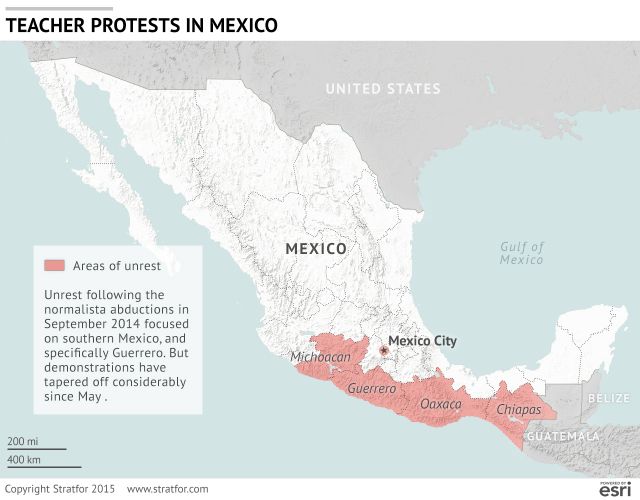
Calls to block elections first emerged in the last quarter of 2014, primarily from demonstrators in Guerrero state. Between September 2014 and June 2015, the teachers' unions intermittently demonstrated the capability to significantly disrupt elections with thousands of protesters willing to block polling stations and face off against security forces. Effectively blocking elections in wide areas of Mexico's south would have significantly challenged political stability in the region, posing a serious problem for Mexico City. The Mexican government's efforts to improve its international image already have been clouded by concerns about its heavy-handed security responses over the past months.
But by May, the intensity and frequency of such demonstrations linked to CETEG had dropped off drastically, and once-supportive organizations such as the National Polytechnic Institute student group stopped participating in protests after having negotiated settlements of their own with the government. The smaller pool of protesters left the CNTE as the primary driver behind the normalista-linked and anti-education reform protests.
By June 1, only CNTE members were carrying out demonstrations in any substantial capacity, intending to ratchet up threats to block elections. Whereas the CNTE had previously amassed tens of thousand of protesters, no more than a few thousand participants showed up in any single area of southern Mexico in June. Ultimately, the group was unable to block polling places because of low protester turnout and the group's unwillingness to confront security forces.
Now that the elections are over and the CNTE teachers have returned to schools, the group is unlikely to mount a significant action to oppose education reform, at least in the coming months. The failure of the teachers' union to force Mexico City to capitulate also means that the security threat posed by protests over the missing normalistas has likely ended after nearly nine months. But given the long history of disruptive demonstrations in many areas of Mexico's southern states, sporadic protests over other issues could still arise.
