
The Democratic Party won elections in Campania, Puglia, Toscana, Marche and Umbria; the opposition won only in Veneto and Liguria. Though the Democratic Party is still unquestionably Italy's most popular party, voters expressed their general discontent in two ways. First, only about half of voters participated in the election. Second, many voters supported opposition candidates.
Combining the results of the seven regions, the Democratic Party won a total of around 23.7 percent of the vote. The Five Star Movement followed with 18.4 percent of the vote, the Northern League received 12.5 percent and former Prime Minister Silvio Berlusconi's Forza Italia received 10.7 percent. However, since elections were held in only seven of the country's 20 regions (containing around a third of Italy's total population), these results only partially reflect voter sentiment on a national level.
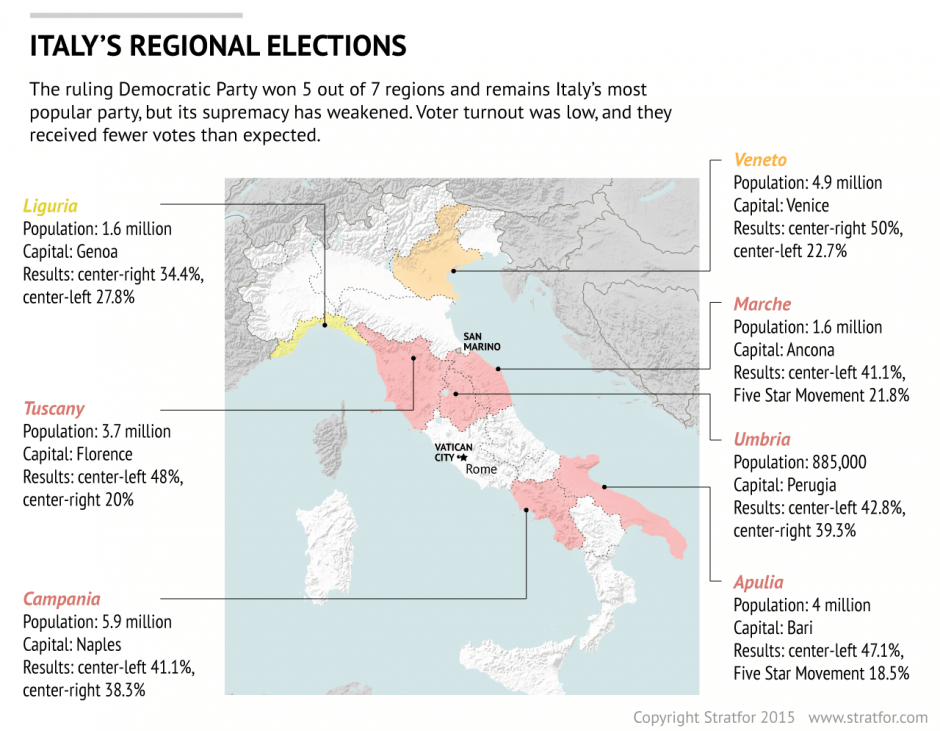
Nonetheless, the results show that the government in Rome is not as popular as it used to be. Only a year ago, the ruling party received 40.8 percent of the vote in European Parliament elections, but conflict within the party has hurt its electoral performance. In Liguria, rebel members of the Democratic Party presented their own candidate, who competed against the party's official candidate. As a result, the center-left vote was split, and the election was won by the center-right.
The Strength of the Opposition
The regional elections also showed that, despite a succession of controversies, the anti-establishment Five Star Movement is still viable. The party did not win a single region, but its candidates still performed well, coming in second or third in most cases. Considering that Italy's new electoral law includes the implementation of a two-round voting system, the next general elections could result in a runoff between the Democratic Party and the Five Star Movement. If voters of other Euroskeptic parties such as the Northern League end up supporting the Five Star Movement, the Democratic Party could be in trouble.
The elections were also important for the right-wing Northern League, led by Matteo Salvini. Unsurprisingly, the Northern League was re-elected in the wealthy Veneto region, but more important, Salvini's party received more votes overall than Forza Italia and performed well in traditionally progressive regions such as Tuscany. These advances position Salvini to be the new leader of Italy's conservatives. But first the Northern League will have to expand its influence to the south, a task that could prove difficult considering the party's traditional criticism of southern Italians. Nevertheless, as Forza Italia leader Berlusconi's popularity fades, Salvini seems well positioned to replace him as the leader of the right.
In brief, Renzi remains Italy's most powerful politician, and the Democratic Party still benefits from a fragmented opposition. Thus, Renzi will probably make progress on his reformist agenda, given that the rebels in his party will not want to destabilize the government in the face of mounting opposition. Still, the internal rifts persist, and the elections proved that Renzi's leadership is not as solid as it was only a few months ago. More important, anti-system and Euroskeptic sentiments are as strong as ever in Italy.
In the coming months, it will be important to watch the Democratic Party's internal politics and Salvini's efforts to consolidate his role as the leader of the Italian right. Stratfor still believes the main challenges for Renzi will come from within, as rebel lawmakers from the Democratic Party oppose his proposals. No early elections are expected this year. But whenever Italy returns to the polls, the country can expect fierce competition between pro-EU forces — including the Democratic Party — and Euroskeptic forces such as the Five Star Movement, the Northern League and smaller right-wing parties. Because Italy's new electoral law will require a runoff if no party wins 40 percent of the vote in the upcoming general elections, the supremacy of the Democratic Party cannot be taken for granted.
