
For the second week in a row, militants associated with the Islamic State attacked a Shiite mosque in Saudi Arabia's Eastern Province, this time in the provincial capital, Dammam. Unlike last week's bombing of a mosque in al-Qadeeh, which killed 21 people, the attack on May 29 resulted in the deaths of three victims in addition to the bomber. Increased security at Shiite mosques as a result of last week's attack helped limit casualties. Had the Dammam bomber been able to gain entry into the packed mosque, the death count would certainly have been higher. Some media reports suggest that the perpetrator may have been dressed as a woman in an attempt to bypass security.
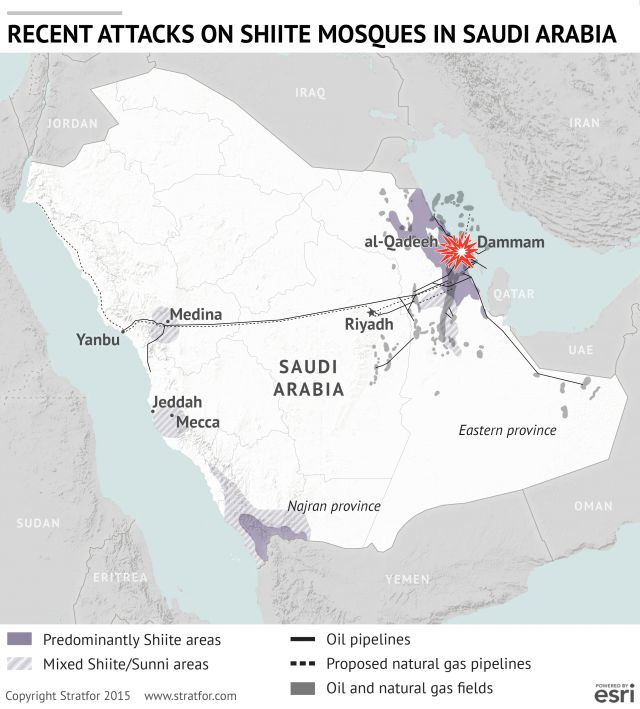
Although the Islamic State claimed responsibility for both mosque attacks, the execution in both was relatively simple, meaning that other groups or individuals would have the capacity to conduct either. The attacks were against soft targets, utilizing modest explosive devices and only one bomber in each case. In Iraq, the Islamic State has employed much more sophisticated tactics and larger devices against Shiite targets — and in many cases, multiple bombers. At this stage, there is nothing to suggest that the Islamic State core group in Syria and Iraq is directly coordinating or supporting the cell conducting these attacks. The resources and sophistication of the mosque bombings to date indicate they could be the work of Saudi grassroots jihadists sympathetic to the Islamic State.
If the cell is actually being directed and supported by the Islamic State, we can expect them to modify their tactics as a result of today's failed attempt. In response to the increased security at Shiite mosques, it would not be surprising to see the jihadist group dispatch multiple bombers — one to breech perimeter security and others to then storm into the mosque — or to employ a much larger device, such as a vehicle bomb. If we do not see such a refinement in tactics, it will indicate that the attacks were, in fact, conducted by grassroots jihadists and not the Islamic State core group.
This distinction will carry some significance for foreign energy companies in Saudi Arabia, who have been concerned about their workers' security in the country since 2003. Because of al Qaeda attacks against foreign energy workers and facilities between 2003 and 2006, foreign workers in Saudi Arabia have fairly substantial security at their workplaces and residential compounds — far more than is present at vulnerable Shiite mosques. Given this level of protection, if the Islamic State activity in Saudi Arabia is being conducted primarily by grassroots organizations, they probably lack the capability to attack harder targets, such as oil facilities and associated personnel. However, if the threat stems from the Islamic State core, there is an increased likelihood of successful attacks against better-protected targets.
Regardless of whether the perpetrators are homegrown or more directly controlled by Islamic State leadership, it is clear that the militants behind these attacks are attempting to foment exactly the kind of sectarian strife that the Islamic State has sought in Iraq and Syria. Even if the attacks remain limited in size and sophistication, if they persist, they may eventually provoke the type of Shiite reaction desired by the Islamic State.
So far, despite the longstanding tension between Saudi Shiites and the government, Shiite Imams and civic leaders have urged calm rather than inciting additional violence. However, it is unclear how many more attacks the Shiites will absorb before they begin to escalate sectarian tensions within the Kingdom. With an active war on their southern border in Yemen, a role in suppressing the Islamic State in Syria and Iraq, and the imperative to root out domestic Islamic State and al Qaeda militancy at home, the last thing the Saudi government needs is for the Shiites to become combative.
Because of this, the Saudis have been actively pursuing potential Islamic State militants for many months now. After last week's bombing Riyadh intensified the campaign, claiming to have arrested some 46 individuals, including the planners of the previous mosque attack.
