
The Andean highlands and the Amazonian tropics, considered two peripheral regions of Peru compared to the country's demographic and political core in Lima, contain substantial mineral and natural resource wealth. Peru's economy relies heavily on investments in and the development of mining and hydrocarbon activities in these regions, which produce about two-thirds of the country’s exports.
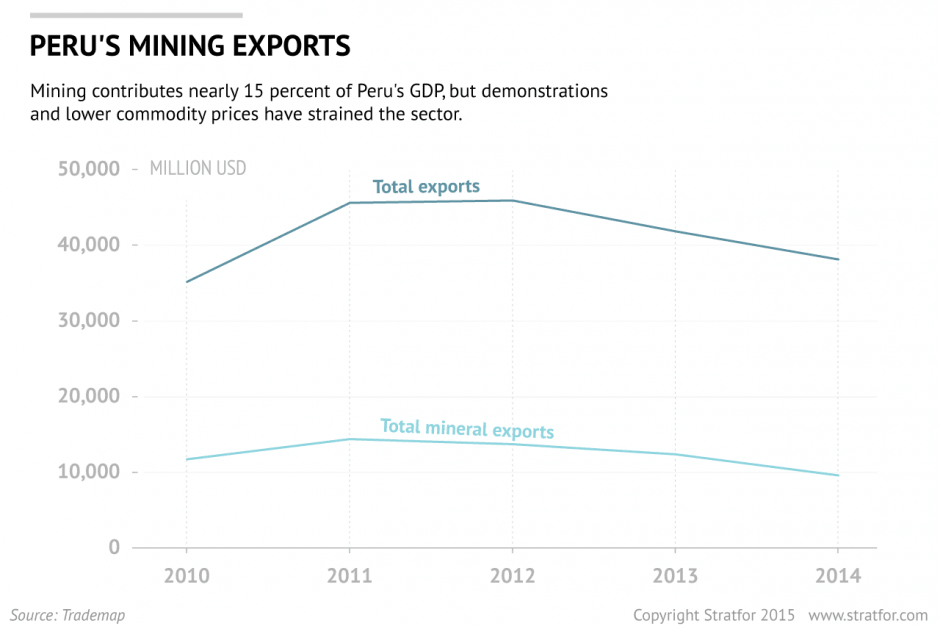
Currently, Peru is enjoying a period of economic stability and relative prosperity. At the start of this decade, Peru’s growth rate averaged 7.25 percent, largely driven by extractive mining industries such as copper. Between 2000 and 2012, investment in Peruvian mining surged from around $300 million to $8.6 billion, accounting for nearly 50 percent of all private investment projects in the country. Mining alone contributes nearly 15 percent of Peru's gross domestic product, generates 10-16 percent of the country's tax revenues and provides more than 200,000 jobs per year.
The Peruvian government's open market and business-friendly policies over the past 25 years have also helped expand the economy. Peru has signed more than a dozen bilateral free trade agreements with major economies such as the United States, the European Union and China. Moreover, the country is part of the Pacific Alliance economic bloc, and negotiations are underway for at least five more bilateral free trade agreements with countries such as Turkey and India. Even though the global economic slowdown has reduced the government's growth estimates for 2015 to 3.5-4.25 percent, Peru is still expected to grow more than other regional countries.
Powerful Opposition
However, between falling metal prices and slowing Chinese demand, there has been a decline in mining and hydrocarbon investments in Peru over the past year. Overall investment into Peru has fallen by 6 percent since 2013, totaling only $5.56 billion in 2014. Subsequently, mineral exports have shrunk by more than $4 billion in value over the past two years. The government of Peruvian President Ollanta Humala has focused on creating ways to attract and retain investor confidence in the country to maintain economic activity. Policies such as streamlining administrative procedures for licenses and offering financial incentives have already been executed, and similar ones are expected to follow throughout the year.
But anti-mining sentiment is powerful in Peru, and local opposition to extractive projects and social unrest from groups opposed to mining activities in the country are threatening investment. Peripheral regions in the Andean interior — rich in minerals but relatively poor compared to the country's core in Lima — harbor resentment about projects that reinforce this divide. In addition, there have long been broad leftist coalitions that have protested environmental damage from and foreign involvement in mining.
While anti-mining protests are not new in Peru, in recent months they have led to more violent clashes between protesters and police. For example, one protester died in marches opposing the mining firm Pluspetrol in Pichanaki district. Another died in protests against Southern Copper's Tia Maria mine near Islay district. Prior to the March 23 start of the Tia Maria protest, this restive environment compelled the government to send 1,500 national police officers to keep order in the expected areas of unrest.
In the past, President Humala has been able to calm social unrest primarily through dialogue, a tactic he continues to rely on. However, more organized protest groups and intensifying demonstrations have made diplomacy more difficult. On May 9, the Interior Ministry promptly sent units from Peru's armed forces to the protest areas as auxiliary forces to support police efforts. On May 23, the government declared a state of emergency in the southern mining areas. Previous such measures have helped Lima re-establish order, though quelling the most recent protests may prove more difficult.
Looking Ahead
Social unrest targeting the mining sector in Peru will intensify for the remainder of the year. Increasingly powerful radical local leaders and more organized leftist parties will confront the strong government-led impetus to move forward with extractive projects, particularly as the April 2016 presidential elections approach. Because of the government's conflicting political and economic goals, negotiations over mining projects will drag out as Lima is pressured to make more concessions to local governments. Such concessions will contradict the central government's efforts to tighten control over the distribution and spending of federal funds by local governments.
Finding an immediate resolution to the conflict surrounding Southern Copper's Tia Maria mining project will be a priority for the government. Southern Copper declared a 60-day pause in activity May 16 to enable all parties to share grievances and concerns, draft solutions, and assign responsibility for agreement implementation. Discussions are expected to include a meeting between the heads of Grupo Mexico, which owns Southern Copper, and the Peruvian government. Despite Southern Copper's calls for a pause in protests, social groups from southern Peru agreed over the weekend to execute a 48-hour solidarity strike in opposition to the Tia Maria mining project. Groups in Arequipa, Puno, Moquegua, Tacna, Cusco and Apurimac will hold simultaneous protests May 27-28.
Overall, protests have yet to significantly hurt the mining sector, and mineral production actually improved 5.3 percent year on year in the first quarter of 2015. However, demonstrations could hamper long-term economic growth, considering Peru's high dependence on foreign investment, which could fall if investor confidence declines. Calming this unrest and demonstrating the ability to rein in local governments will be essential in retaining investor confidence and maintaining the relatively high growth rates Peru has achieved.
