
To walk the streets of Kiev is to walk through layers of history. In the center of the city, at the intersection of Volodymyrska and Yaroslaviv streets, is the Zoloti Vorota, or the Golden Gate. Constructed in the 11th century, the gate served as one of three principal entrances into Kiev at a time when the city was the capital of the medieval kingdom of Kievan Rus, the political and cultural precursor of both Ukraine and modern Russia.
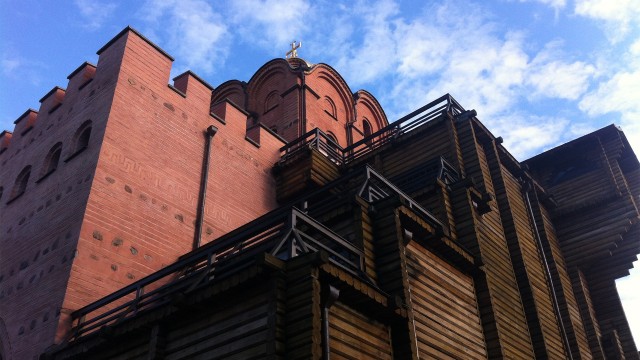
Zoloti Vorota, the Golden Gate.
Eastern Slavic tribes, organized into a federation by Scandinavian Vikings, founded Kievan Rus in the 9th century. At its height, the kingdom encompassed most of Eastern Europe from the Baltic Sea to the Black Sea, and Kiev was its commercial and political center.
The kingdom's ruler, Vladimir the Great, adopted Orthodox Christianity for himself and his empire in 988, binding Ukraine — and Russia — to Orthodoxy. In Kiev, Orthodox churches and seminaries abound, each more intricate and beautiful than the last. Just down the street from the Golden Gate, the Saint Sophia Cathedral, with its golden onion domes and ornately detailed interior dating back to 1037, serves as another testament to the city's long and rich history.
East-West Division
But Kiev's glory did not last. In the 12th century, Kievan Rus began to decline because of internal conflict, only to be annihilated completely by Mongol hordes sweeping in from the east a century later. Kiev and the rest of modern-day Ukraine languished for centuries, eventually swept under the control of the Grand Duchy of Lithuania and later the Polish-Lithuanian Commonwealth. Ukraine subsequently inched toward Europe and Catholicism. Meanwhile, the principality of Muscovy, northeast of Kiev, grew to become the new center of eastern Slavic civilization, shifting the locus of power to Moscow.
It was these powers — Poland and Lithuania to the west and the growing Russian Empire to the east — that would contend over Ukraine for the next three centuries, setting the stage for the east-west division of the country that exists to this day. Kiev was at the center of this dispute. The mighty Dnieper River, where today passenger ferries sail and young couples walk down the waterside promenade, serves as a geographic dividing line flowing through the middle of the city.
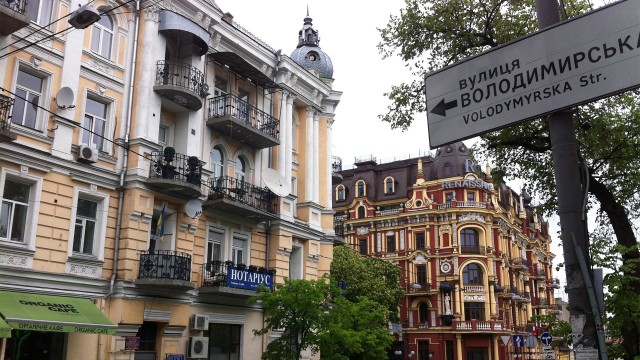
Volodymyrska street.
Adding to the contention between Russia and powers to the west was the rise of the Ottoman Empire, which was influential in the development of another aspect of Ukrainian history and culture: the Cossacks. A frontier people that were constantly at war with Asiatic and Muslim peoples such as the Crimean Tatars, the Cossacks were fierce both in their warrior mentality and in their observance and defense of the Orthodox faith.
The Cossacks were also precursors of Ukraine's modern independence movement, establishing an identity distinct from that of both the Catholic Poles and the Orthodox but distant Russians. Bohdan Khmelnytsky, who was arguably the most famous Cossack, led an uprising against the Polish-Lithuanian Commonwealth and created an independent Cossack state centered on the banks of the Dnieper in 1648. Today, a monument of Khmelnytsky poised triumphantly on horseback stands just in front of the Saint Sophia Cathedral.
Like the kingdom of Kievan Rus, however, the Cossack state did not last. In 1654, Khmelnytsky allied with Muscovy in a war against the Polish-Lithuanian Commonwealth, leading to the integration of Kiev and the eastern section of modern-day Ukraine into Muscovite Russia. While the regions east of the Dnieper became part of Russia, western Ukraine remained under Polish influence, at least until the Austro-Hungarian Empire took over at the end of the 18th century. Khmelnytsky came to be seen as national hero, but his significance was a matter of dispute between Ukrainians, who saw him as their founder, and Russians, who saw him as the man who brought Russia and Ukraine together.
In the meantime, Russian cultural influence in Kiev grew throughout the 19th century with the rise of the Russian Empire, while the city transformed into a prosperous industrial center. However, Kiev was not quick to shed its Western political and cultural influence, as indicated by the Catholic cathedrals scattered among the city's numerous Orthodox churches. Built in a Western Gothic style, cathedrals such as Saint Nicholas and Saint Alexander illustrate the contrast of coexisting cultures not only in Kiev, but in all of Ukraine.
The Tragedy of a Borderland
Ukraine's history during the first half of the 20th century was marked by one tragedy after another. A strong nationalist movement emerged after the fall of the Russian Empire in 1917, but this movement was stronger in western Ukraine than in Kiev. Subsequently, all but the farthest western section of Ukraine was incorporated into the Soviet Union in 1922. Kiev served as the capital of the newly formed Ukrainian Soviet Socialist Republic. Stalin's forced collectivization program soon brought starvation to the Ukrainian countryside in the 1930s, and the Nazi invasion in World War II followed. Collectively, both events accounted for nearly 10 million deaths in Ukraine alone.
The next 40 years were less violent for Ukraine but marked by Soviet domination. Dreary and monotonous Soviet concrete apartment buildings sprang up throughout the city to replace the many buildings destroyed during the war, mingling with the classical architecture of old Kiev. When the Soviet Union collapsed in the last decade of the 20th century, Kiev became the capital of the newly independent state of Ukraine.
The period after the end of the Cold War brought about a degree of sovereignty and independence unprecedented in Ukraine's long history. Nevertheless, the lingering legacy of foreign domination made the country's political situation volatile. Russia continued to influence Ukraine from the east, the newly formed European Union began exerting its own influence from the west, and Ukraine developed competing political parties and factions oriented toward one or the other.
New Period, Same Problems
In the first dozen years after the end of Soviet rule, a weak Ukrainian government attempted to rebuild the country and establish a fragile balance between Russia and the West. But when the 2004 presidential election produced a narrow and contested victory for pro-Russia candidate Viktor Yanukovich over his pro-West opponent, Viktor Yushchenko, mass protests erupted in Maidan Nezalezhnosti, Kiev's central square. In what came to be known as the Orange Revolution, the election results were deemed illegitimate; Yushchenko and his running mate, Yulia Timoshenko, took office instead.
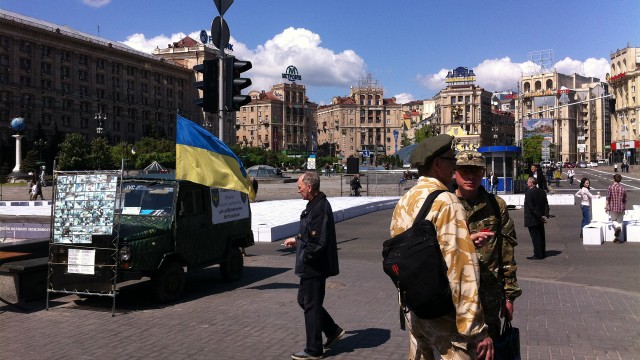
Maidan Nezalezhnosti (Independence Square) in central Kiev.
During the decade of political polarization that followed, Ukraine shifted its focus to the West by formally pursuing membership in the European Union and NATO. The reorientation injected tension into Ukraine's increasingly antagonistic relationship with Russia. Moscow responded with major natural gas cutoffs to Ukraine in 2006 and 2009 and expressed explicit discomfort with Kiev's pro-West policies. But the period's defining feature was infighting in Ukraine's own government, particularly between Yushchenko and Timoshenko and their respective supporters. The conflict prevented meaningful integration with the West and led to a dramatic decline in the government's popularity. By the 2010 presidential election, the tide had turned considerably: Yushchenko barely registered 5 percent of the vote, while Yanukovich won.
However, Yanukovich's victory was still a close one, and an overwhelming majority of his support came from the pro-Russia eastern and southern parts of the country, while barely registering in pro-Europe western and central Ukraine. Still, the president immediately reversed his predecessor's efforts to integrate with the West. He made NATO membership illegal and extended the lease of Russia's Black Sea fleet in Crimea by 25 years in exchange for lower prices on Russian natural gas. Such decisions alienated and angered the pro-West segments of the population, who complained about domestic abuses of power.
Then came the last straw: Just before an Eastern Partnership summit that would strengthen ties with Europe, Yanukovich pulled out of a free trade agreement with the European Union, again in return for lower energy prices from Russia. Frustrated citizens mounted the large-scale demonstrations that became known as the Euromaidan movement and culminated in Yanukovich's ouster in February 2014. The scale and ferocity of the protests were unmatched in Ukraine's post-Soviet history.
With a new pro-West government in power, Ukraine made yet another major swing on the geopolitical pendulum. As in the past, the reorientation resulted in a deteriorating relationship with Ukraine's neighbor to the east. This time, Russia made aggressive moves to counter what it viewed as the growing danger of Western influence near its borders, annexing Crimea and instigating a pro-Russia rebellion in eastern Ukraine.
Although a cease-fire took effect in February, the conflict in Ukraine may continue for several years. The Ukrainian government is seeking closer integration with the European Union and NATO, while the population of the country is becoming ever more polarized over the choice between alignment with the West or Russia. While Maidan Nezalezhnosti is now free of the tents and demonstrators that camped there for months, evidence of the crisis is still plainly visible in Kiev in the damage to surrounding buildings and memorials for those killed during the Euromaidan protests and the war in the east.
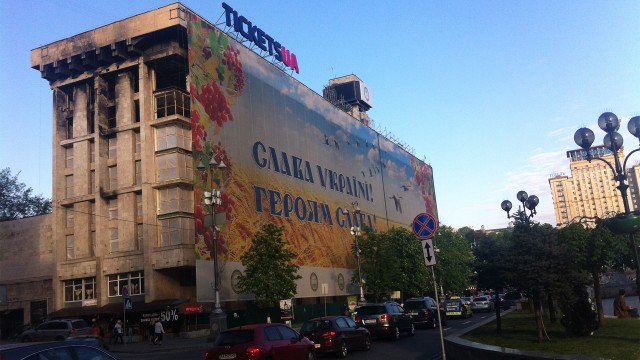
Kiev's Trade Union Building with damage from the Euromaidan movement.
Major shifts in Ukraine's foreign policy are not unique to the 2014 Euromaidan uprising. The country has a long pivoted back and forth between Russia and the West, with pro-Europe sentiment reigning in the western part of the country and pro-Russia sympathies dominating in the east. And Kiev, situated between the two, mirrors Ukraine as a whole: historically at the crux of two powerful civilizations, and today caught between two major power blocs. In the end, to walk through Kiev is to walk through the history of not only a city, but also a nation built on a geopolitical fault line.
