
Located in the central part of the country, with more than 2.8 million people, Kiev is Ukraine's political center as well as its largest city. Kharkiv, the nation's second-largest city, however, lies far to the east of Kiev, only 40 kilometers (25 miles) from the Russian border. To journey between these two cities is to pass definitively out of Ukraine's heartland into a place where cultural and political identity lean much more toward the east and Russia.
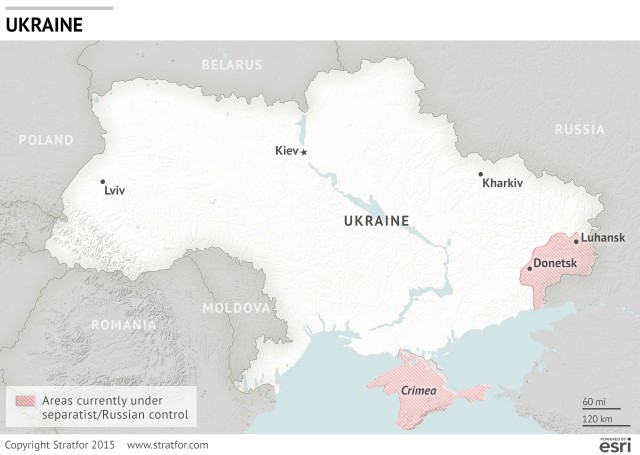
To make this trip to Kharkiv, I took the intercity train from Kiev's central railway station. The government launched the new high-speed line between Kiev and Kharkiv just three years before during Ukraine's joint hosting of the Euro soccer tournament, making my train quite modern by Ukrainian standards. Television screens lined the ceiling of the car, flashing "United Ukraine" signs and showing commercials that urged citizens to conserve household energy for the "good of the country." During my time in both Kiev and the western city of Lviv, I had seen countless Ukrainian flags and donation buckets for the war effort. The train's advertisements underscored that I was traveling through a nation in the midst of crisis and conflict.
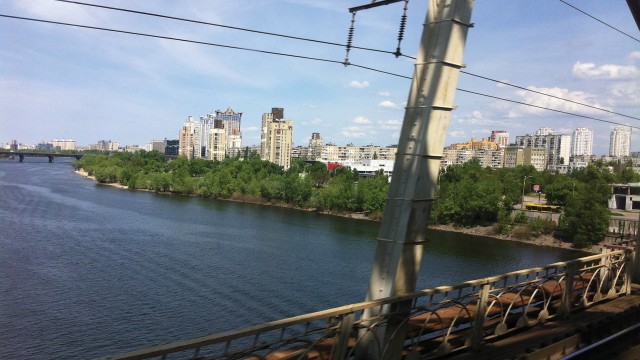
A view from a train as it crosses the Dnieper to Kiev's left bank.

A rural farm plot east of Kiev as seen from a train window.
We spent four and a half hours traveling past farms and small cottages. The few towns situated along the way — Lubny, Mirgorod, Poltava — barely stood out from the surrounding farmland, only distinguished by the presence of some Soviet-era concrete apartment blocks, an occasional Orthodox church and a few rusting factories. During another recent journey through the west of Ukraine from Lviv to Kiev, I had seen yellow and blue Ukrainian flags in every community. Here there were few such signs of Ukrainian nationalism. This was the first indication of the political and cultural differences between the more nationalist and Ukrainian-speaking west and its eastern counterpart, where the Russian cultural influence is much stronger.
When I arrived in Kharkiv, I found a city that was much more Soviet in its appearance than either Lviv or Kiev. The central part of the city had wide avenues, Soviet-era buildings and streets named after Karl Marx and Friedrich Engels. It was more reminiscent of Minsk than of Ukraine's cities to the west. I heard almost no Ukrainian spoken on Kharkiv's streets; virtually all business seemed to be conducted in Russian.
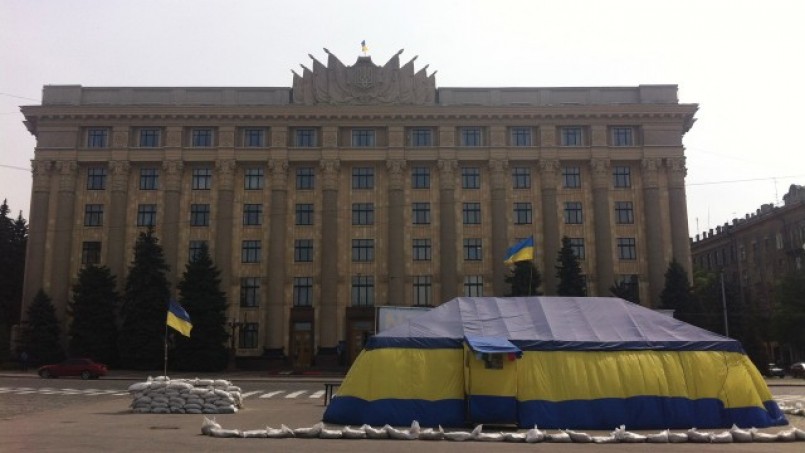
A tent calling residents to support the war effort in eastern Ukraine stands in central Kharkiv.
The city did resemble Kiev and Lviv in one regard. In contrast to the rural areas I had just passed through, Kharkiv's streets displayed numerous Ukrainian flags. They flew in public squares, over street signs and outside apartment buildings. In the city's Maidan Svoboda (Freedom Square) stood a large yellow and blue tent to support the government's ongoing battle with Russia-backed separatists in the Donbas region. Outside the tent stood signs condemning "Putin's occupation of Donbas" and others displaying images of Ukrainian troops and their requirements for the war effort. In this same square, thousands of demonstrators pulled down a statue of Lenin in September 2014 to show that they had broken free from Russia's influence.
Kharkiv's display of the Ukrainian flag and signs of solidarity with Kiev's cause is significant in a time of war. Located so close to the Russian border, Kharkiv was a key city in the contest between pro-Russia and pro-Ukraine groups after the EuroMaidan uprising. Many feared that separatist forces would take control of the city as they had done to cities in neighboring Donetsk and Luhansk provinces. This nearly happened: pro-Russia separatists stormed regional administration buildings early on in the conflict, only to be forced out again by Ukrainian troops. Since that time, Kharkiv has remained under the control of the new Ukrainian government.
This control, however, feels more tenuous in Kharkiv than it does farther west. There is still fear that Kharkiv's loyalty to the Ukrainian government is not definitive. One of the signs near the Maidan Svoboda tent asks residents, "What would you do for Kharkiv not to be next?" This nagging doubt about citizens' loyalty is intensified by Kharkiv's position on the frontier of the war between Kiev and pro-Russia militants. This has seen the city targeted repeatedly by terrorist attacks. On Feb. 22, at a pro-Ukraine independence march marking the anniversary of the EuroMaidan uprising, a bomb killed three and wounded dozens of others. And behind the overt displays of pro-Ukraine sentiment are signs of dissent: during my visit I saw walls bearing pro-Russia graffiti such as "I heart USSR" and nationalist slogans such as "Slava Ukraine" (Glory to Ukraine) pointedly crossed out with angry streaks of spray paint.
Kharkiv public opinion falls somewhere between the nationalism of central or western Ukraine and the far east's pro-Russia sentiments. Recent polls show a city divided into three roughly equal blocs: pro-Ukrainian, pro-Russian and neutral. A Kharkiv-born man in his mid-40s told me that while he did not want Kharkiv to split from Ukraine, he disliked Kiev's war in the east. He said many city residents have family across the Russian border — his brother, for example, lived in Belgorod fewer than 80 kilometers away. He wondered why brother should fight against brother and added, with resignation, that he thought the war would go on for a long time. He saw the best solution in granting administrative autonomy or federal status to Donbas. Otherwise, he said, the fighting would never stop. The war, he noted, had taken a major economic toll on Ukraine, and Kharkiv had been hit especially hard because of its strong trade ties with Russia.
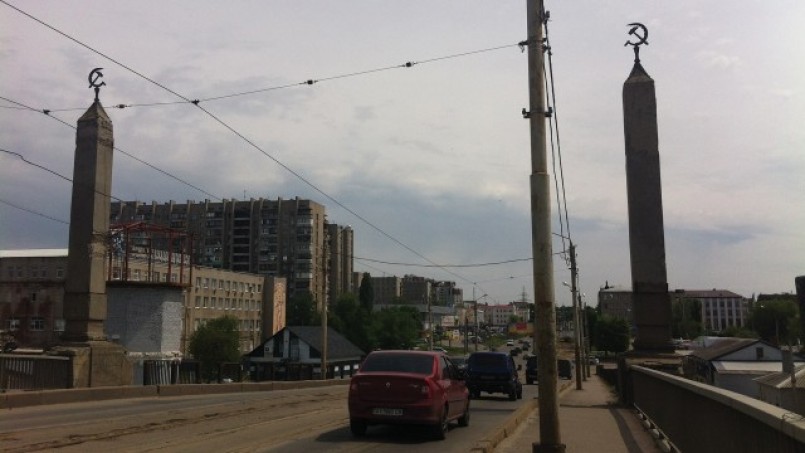
A bridge in Kharkiv's industrial outskirts.
Based on the signs of economic hardship in the city, he seemed to be right. Kharkiv appeared to be struggling more than either Kiev or Lviv. I saw beggars in the streets. Closed stores and shuttered office buildings stood everywhere, even in the center of the city. Farther out, the situation was even more stark. I took the metro to the Zavod Imeni Malysheva stop in the southeast of the city, where Kharkiv's industry is concentrated. This part of the city is home to the Malyshev factory, which produces diesel engines, coal equipment, farm machinery, and, above all, tanks. Malyshev was once a major provider of tanks for the Soviet Union, and it continued to produce tanks for export following Ukraine's independence. Now, the area looked run-down, full of rotting factories and crumbling concrete apartment buildings. In central Kharkiv, yellow and blue had been used to cover up or replace the old Soviet insignia. Here, however, sickles and hammers adorned buildings. One wall still bore a large mural of a Soviet workingman emblazoned with the words, "Glory to labor," contrasting with the "Glory to Ukraine" signs elsewhere in the city. The current conflict has exacerbated the economic troubles faced by this part of city since the fall of the Soviet Union. The inhabitants I spoke to here expressed a strong desire to end the war and rebuild relations with Russia.
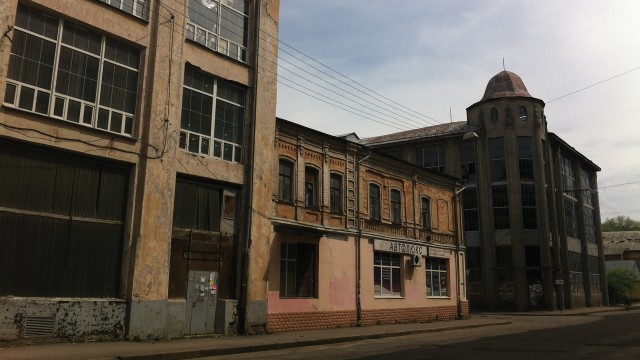
Shuttered buildings stand in central Kharkiv.
During my visit to Kharkiv, the signs of the city's economic hardship stood out most. The yellow and blue draped along the streets to smother signs of pro-Russia leanings only partially obscured this hard truth. Today, Kharkiv is a city of contradictions. There are legitimate pro-Ukraine sentiments in the city, but many also feel substantial skepticism about defining this Ukrainian solidarity in terms of opposition to Russia. Above all, most people I spoke with do not want war or the resulting economic destruction – life is hard enough as it is. As the conflict continues, with Kiev trying to get closer to the West and the separatists resisting Kiev's control with aid from Moscow, Kharkiv will be an important bellwether of the Ukraine crisis.
