
The Colombian government's longstanding reliance on aerial spraying stems from the inherent difficulty of the alternative: sending personnel into fields to manually eradicate coca. The advantages of the aerial technique contributed to its dramatic rise in the total area of coca sprayed from around 60,000 hectares in 1998 to over 170,000 hectares in 2006. After this point, a drop-off in overall cultivation and in U.S. counternarcotics assistance led to the tactic's decline. In 2013, total crop area targeted by aerial spraying hit a 15-year low of 47,000 hectares. Today, the government focuses the program primarily on the departments of Putumayo, Narino and Choco.
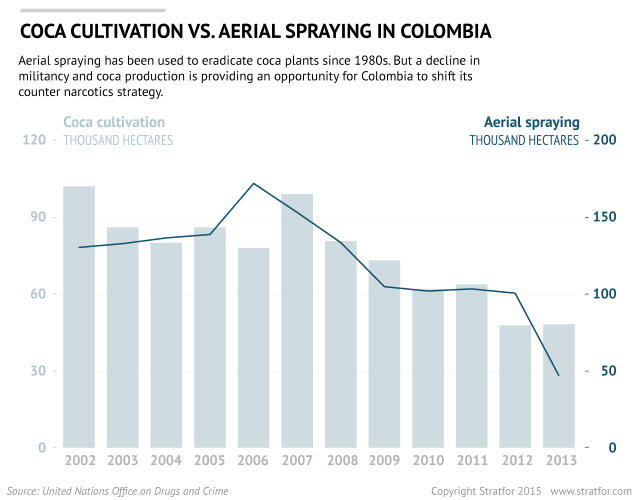
The decision to end spraying reflects the government's evolving priorities. Declining production compared to previous decades means Colombian leaders have room to maneuver on its eradication policies. Spraying has long been a contentious issue in remote areas because the chemicals occasionally eliminate legitimate crops. An end to coca spraying would allow Santos or a successor to begin incorporating these restive and marginalized regions into national development plans.
In addition, Santos is likely responding to 2014 FARC demands that the government halt aerial spraying as part of any peace agreement. The president's recommendation will be followed by a slow phase-out of aerial eradication, which will be replaced by a combination of ground-based eradication as well as the substitution of coca crops with alternate produce. Manual techniques, however, will be logistically complex and could increase security problems for future administrations.
Moreover, peace talks are focused on ending militant violence, not drug trafficking. The government knows the latter issue will take much longer to solve. But if Bogota can strike a deal, it has the military strength to manage a weakened FARC and persistent drug trafficking for the foreseeable future. The government is simply trading a short-term risk for long-term stability.
A New Strategy
By October, the government will decide on the details of the plan that will replace aerial spraying. The nature of this strategy will influence future patterns of coca cultivation. In the near term, spraying will continue. The government will begin phasing it out later this year in unspecified areas where it deems security has substantially improved. Manual eradication will be increased in those areas.
Some areas, however, will continue to be unsafe for ground-based eradication. Several coca-growing regions are under the direct control of FARC, the National Liberation Army, or other criminal groups. Militants often place improvised explosive devices to prevent the destruction of coca fields or cocaine processing infrastructure. In the past, FARC militants have been placed in important drug producing areas to stop police or military incursions. Here a shift away from spraying will prove difficult and parts of Putumayo, Caqueta and Norte de Santander would likely require additional security forces.
In spite of these considerations, Bogota will need to move quickly to devise a new strategy. Following Santos' decision, the government canceled an international tender for new glyphosate purchases. It is now conducting eradication with a diminishing stock of chemicals. Unless the decision is unexpectedly reversed, the government will need to implement its new strategy over the next several years to prevent the resurgence of coca cultivation in specific areas.
Acceptable Outcomes
If the Havana talks yield a successful FARC peace agreement, the government would be able to devote additional forces to counternarcotics. A nationwide drop-off in politically motivated attacks would free up troops to conduct any manual eradication or other interdiction efforts. A successful peace deal would also likely fragment the FARC into smaller factions, some of which will remain involved in drug trafficking. Though these factions could be spread across the country, their combined threat to the government will be minor.
Ultimately, the end of the FARC will likely mirror the demobilization of self-defense forces in the mid-2000s and the resulting rise of criminal groups. But from Bogota's point of view, reducing politically motivated attacks is an acceptable outcome, even if it has to continue counternarcotics efforts against weakened militant remnants for years to come.
