
As Athens runs out of time and money, the Greek government negotiates with its lenders to receive funds as fast as possible. Greek officials met with members of the Euro Working Group in Brussels on April 29 to discuss Athens' proposals for economic reform and will meet with representatives from the EU Commission, the European Central Bank and the International Monetary Fund on April 30. Athens hopes it can convince Greece's lenders to disburse at least part of the last tranche of bailout funds (some 7.2 billion euros, around $8 billion) sooner rather than later.
According to Greek media, the April 29-30 negotiations focus on measures already promised by Athens, including policies to improve tax collection and fight tax evasion, rather than on new proposals. Greece has also allegedly offered to delay the introduction of controversial measures, such as raising the minimum wage. But eurozone ministers insist that Athens introduce further reform, including of pension rules and labor legislation, and that it continue privatizing state-owned companies. Greek Prime Minister Alexis Tsipras' task will be to meet the demands of both Greece's lenders and the more radical members of his government, who oppose pension cuts, privatization of strategic companies and layoffs in the public sector.
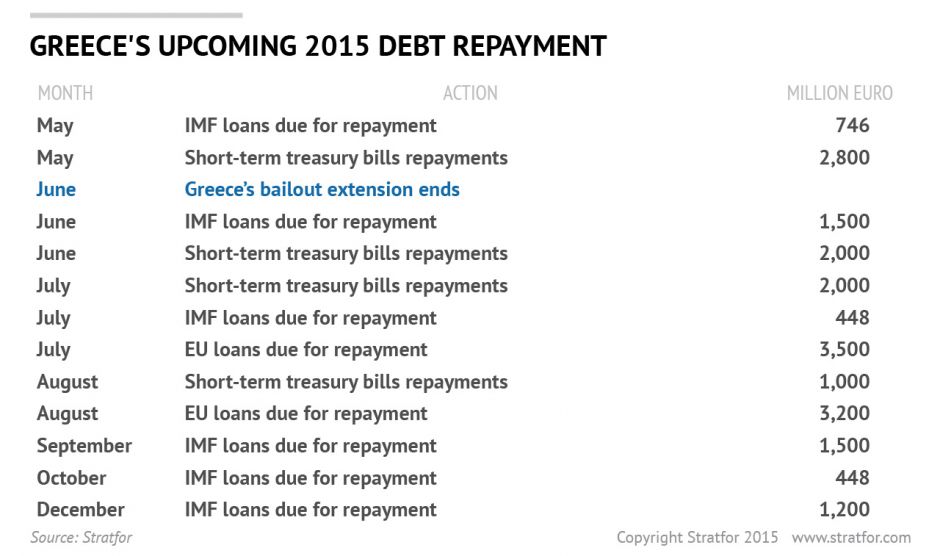
Greece is hoping to reach a deal with its lenders before May 12, when it has to repay 750 million euros to the IMF. Athens also needs funds to pay pensions and salaries. In the meantime, Athens has tried to finance itself through controversial measures such as a decree obliging municipalities to transfer funds to the central bank.
Helping matters a little, the European Central Bank decided April 29 to raise the cap on the emergency liquidity assistance available for Greek banks. Capital had continued to flow out of the Greek banking system the preceding month, albeit at a slower pace compared to February.
Tsipras' Cabinet will discuss its reform package on April 30 and will put it to a parliamentary vote soon after. Stratfor expects Greece and its lenders to reach a deal in May, but this will only buy Athens a few extra weeks. Greece's bailout program expires in late June, pressuring Greece to request a third bailout.
Over the weekend, Tsipras reshuffled Greece's negotiation team to improve its relationship with lenders. Most notably, Tsipras asked General Secretary of Fiscal Policy Nikos Theocharakis to design a plan for the negotiation of "a new agreement" between Athens and its lenders after June. This decision suggests that, once the bailout ends, Tsipras plans to continue negotiations. However, talks on a new assistance program will be even more difficult than the current ones and will strain the Greek government, increasing the probability that a referendum or early elections will be held.
