
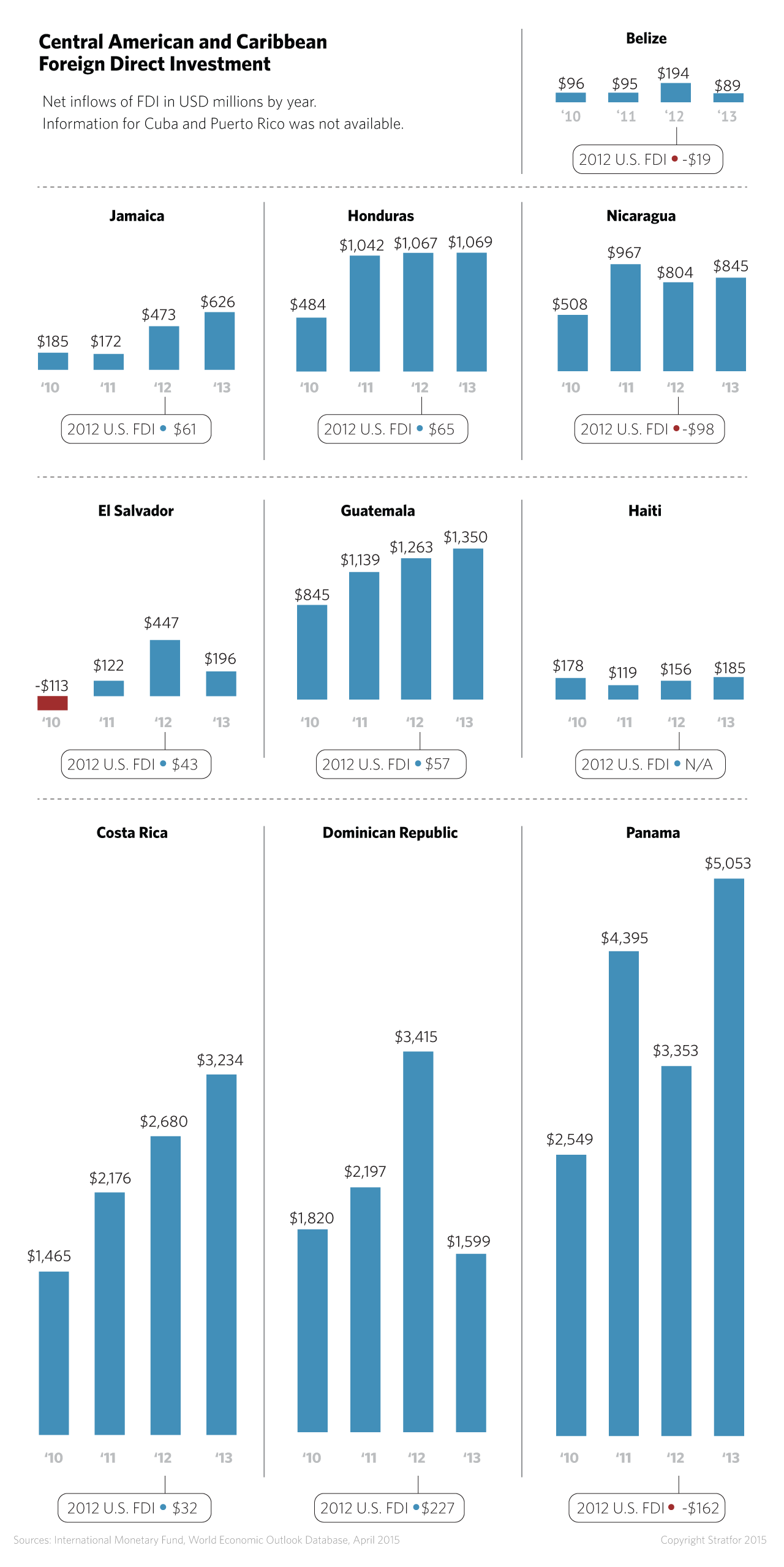
Though Central American and Caribbean countries are geographically and economically small, they are located along a strategic trade route for U.S. agricultural and energy-producing centers. The United States has been a major trade partner and an important investor in the region since Washington signed the Dominican Republic-Central America Free Trade Agreement in 2004.
In terms of exports, the economies of Central American and Caribbean countries are mostly geared toward raw material, particularly agricultural goods such as fruit, coffee and sugar. However, there are also some low-end manufacturing exporters of products such as textiles, processed foods and electronics. The United States is the largest export destination for almost all Central American and Caribbean countries, with two exceptions: Panama, because of the Panama Canal and the country's status as a regional shipping and financial hub, and Cuba, because of its decadeslong political and economic isolation from the United States under the Castro government.
China is also an important trade partner for countries such as Costa Rica and Cuba, though Beijing is more heavily invested in countries outside the region, such as Venezuela, Brazil and Mexico. Of the $61.5 billion in total exports from Central America and the Caribbean, $36.1 billion (59 percent) went to the United States, while $5.5 billion (9 percent) went to China. Mexico and Brazil are also notable export destinations, making up $5.3 billion (8.5 percent) and $1.8 billion (3 percent) of total exports, respectively, but the United States is by far the largest export market for Central America and the Caribbean.
Recent Economic Performance and Outlook
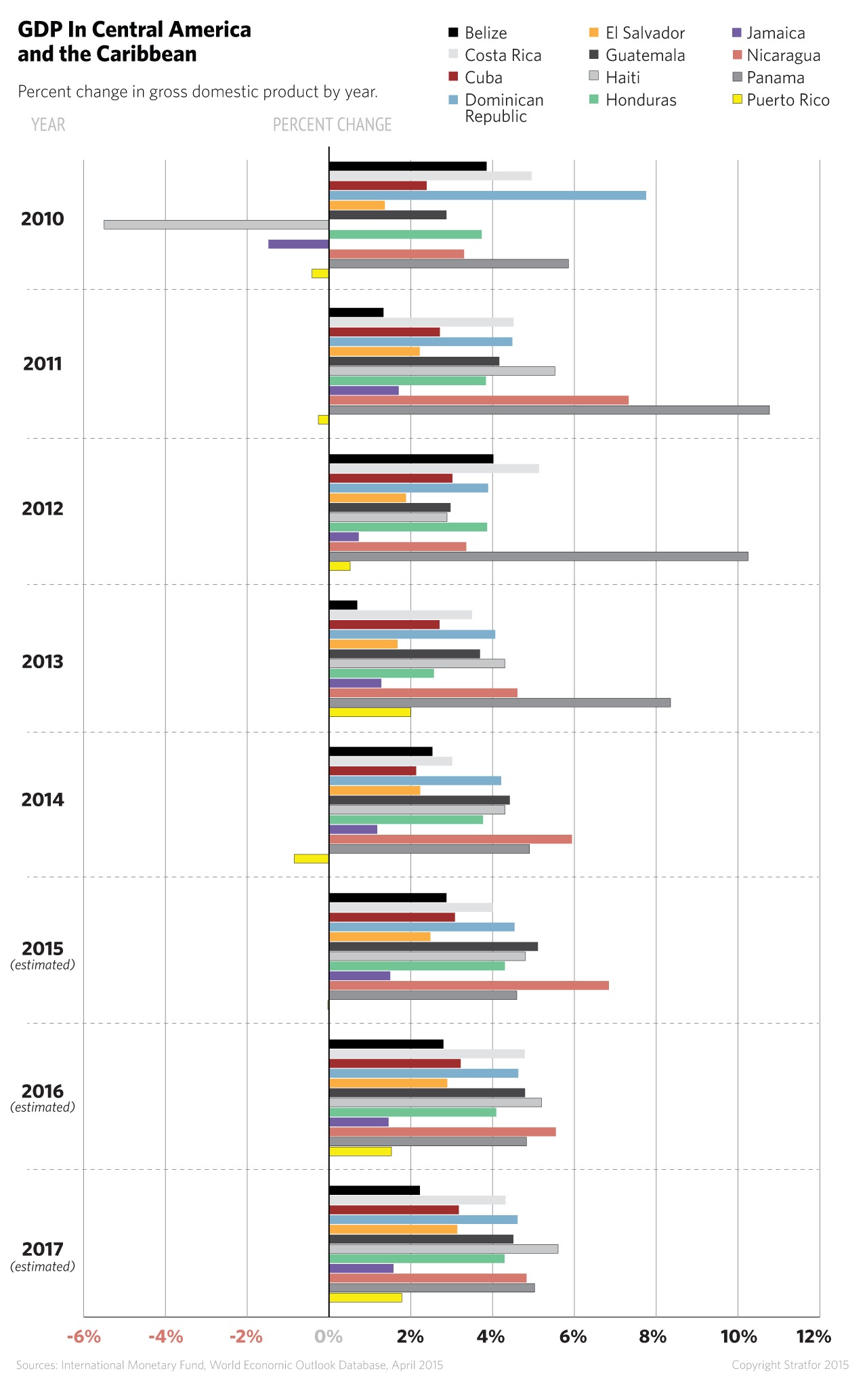
Following a slowdown after the 2008-2009 global financial crisis, Central American and Caribbean economies expanded significantly. The regional gross domestic product grew 2.5 percent in 2013 and is expected to have grown 3.7 percent in 2014. The Dominican Republic and Nicaragua are particularly strong performers. Both have benefited from expanding their export infrastructure under the Dominican Republic-Central America Free Trade Agreement and received sizable investment into their low-end manufacturing industries, making them key alternatives to China. Panama has also seen strong growth and investment rates, though this is primarily because of its canal and associated service industries rather than an expansion of low-end manufacturing.
The World Economic Outlook published by the International Monetary Fund in April foresees strong growth in the region during the next two years. Projected growth in 2015 is 4.2 percent for Central America and 3.7 percent for the Caribbean; in 2016 it remains strong at 4.3 percent and 3.5 percent, respectively. One factor driving this growth is that most countries in the region are net importers of oil. Therefore, low oil prices, which hurt oil-producing countries such as Venezuela and Brazil, have the opposite effect on most of the region. Strong U.S. economic recovery also aids growth in Central America and the Caribbean because of the region's dependence on tourism and U.S. trade.
Challenges and Opportunities
Despite recent growth, Central American and Caribbean economies will encounter certain obstacles — both longstanding and newly emerging — in the years to come. One enduring regional challenge is security-related: Central America and the Caribbean are part of key narcotics transit routes from South America to the United States, and several countries within the region have high homicide rates and drug-related violence. In addition, while low-end manufacturing is expanding in countries such as the Dominican Republic and Nicaragua, most states in the region lack the population and transportation network necessary for significant industrial growth. Whereas Mexico has a large population and diversified manufacturing base close to the United States, countries in Central America and the Caribbean are much smaller and farther from the United States. Lack of easy access to U.S. oil and natural gas makes it harder to meet the electricity demand that accompanies growth in manufacturing and tourism.
A more timely issue is the economic decline of Venezuela and the potential scaling back of its Petrocaribe program. If Venezuela curtails Petrocaribe in response to low global oil prices, many Central American and Caribbean countries may lose the preferential pricing Venezuela currently gives them on oil imports. Cuba is particularly dependent on Venezuelan oil, currently importing around 90,000 barrels per day at highly subsidized rates. Nicaragua is also one of the countries most vulnerable if Venezuela curtails the program. Total assistance in loans from Petroleos de Venezuela to Nicaragua fell from $558 million in 2013 to $435 million in 2014, making it harder for Nicaragua to fund energy imports. This could decrease investment in Nicaragua's electrical grid updates, potentially hindering the country's growth.
But these very challenges have forced certain leftist countries in the region to improve their relationships with the United States. The decline of Venezuela's economic position was a major factor in the recent diplomatic thaw between Cuba and the United States.
Although a full diplomatic normalization is still tentative, economic ties between the two countries have improved. Americans already send $2 billion in remittances to Cuba each year, but recent U.S. legislation will raise the amount individuals can send to family in Cuba from $500 to $2,000 per quarter. U.S. banks will also be allowed to process credit card transactions from Cuba, enabling Americans traveling in Cuba to use their credit and debit cards. Even though the U.S. embargo is still in place, Cuba could see substantial growth if and when the United States lifts trade restrictions.
Nicaragua may also re-evaluate its relationship with the United States, just as leftist governments throughout Latin America have been pushing to increase their political engagement with the United States.
Despite this potential opening, the United States' level of commitment will determine the extent to which these political relationships improve. The death of Venezuela's Hugo Chavez and the post-Castro government in Cuba have created a leadership gap in the region, but the United States will not necessarily fill this gap completely. Central American and Caribbean countries have been trying for years to engage with the United States but have often considered Washington to be unresponsive on certain issues. For example, El Salvador, Honduras and Guatemala have been trying to address joint immigration, security and development concerns with Washington, but so far no program has begun because the United States has not been willing to pay for it. Even as recently as January, when the United States urged countries in the region to decrease dependence on Venezuelan oil by developing renewable energy sources, Washington offered no funding to facilitate a transition to alternative energy. During the latest Summit of the Americas, held in Panama in April, U.S. President Barack Obama did announce $20 million in technical assistance to Caribbean countries to get more private investment in renewable energy, but larger sums will be necessary for any significant expansion in the industry.
Ultimately, the same factors that lead to growth in Central America and the Caribbean will also increase U.S. influence in the region. Recent economic growth is due at least in part to economic recovery in the United States and will continue to depend on ties with the U.S. economy. Meanwhile, the decline of Venezuela may cause leftist governments to re-engage with Washington, opening up new trade and investment opportunities. Whatever challenges and opportunities Central America and the Caribbean face, the region will remain strategically important to the United States in the years to come.
