
The Trans-Pacific Partnership initiative is, in part, Washington's way of increasing trade in Asia. It is also a response to growing Chinese economic ties in one of the few economically vibrant regions of the world. Key to the creation of the trade partnership is the inclusion of Japan, the second largest economy in Asia. Once Japan signs on, other countries are likely to see the benefit of trade incentives with the United States and Japan, finalizing their participation.
As with any trade negotiations, specific economic and social interests in the United States and Japan have complicated discussions, not least of which is the agriculture lobby. Abe has been a supporter of Japan's inclusion in the trade partnership for both economic and political reasons. However, he was unwilling to make a final commitment if the economic concessions he was forced to make did not guarantee benefits from the U.S. side after passage. It is perhaps no coincidence that the Trade Promotion Authority bill comes out of committee only a few days before Abe is scheduled to visit Washington, where there is now the very real potential for an announcement of a final agreement on the Trans-Pacific Partnership. With Japan formally committed, the rest of Asia is likely to follow.
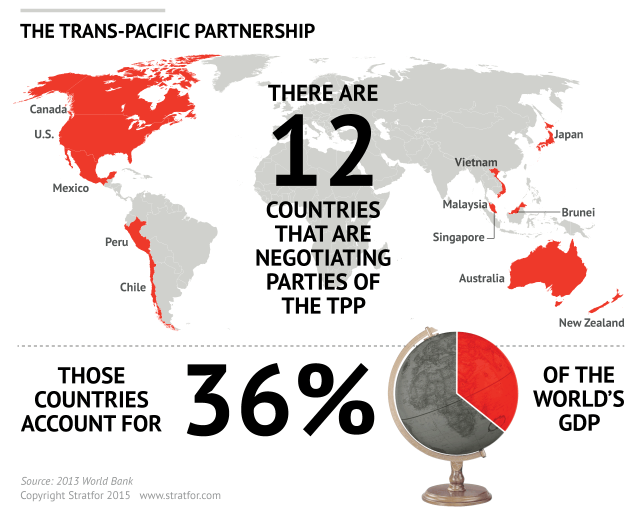
For Asian economies, one of the incentives for joining the trade partnership — despite some of the political and economic concessions — is easier access to the U.S. market, which would supplement Asia's closer economic ties to China. It is a common idea throughout Southeast Asia that Asian countries need to have close security ties to the United States, but close economic ties to China. The Trans-Pacific Partnership does not change that stance, but it does improve the participants' relationships with the United States. The sense of rising Chinese economic dominance in the region is a strong motivation for participation in the trans-Pacific trade group, even if just for political reasons.
In Europe, however, the Trade Promotion Authority will not necessarily have the same lubricating effect on Trans-Atlantic Trade and Investment Partnership negotiations. The trans-Atlantic trade deal could open up an important new market for European exporters. The partnership was likely part of a German plan hatched in the depths of the 2012 crisis to try and grow Europe out of trouble. However, a strong lobby against the Trans-Atlantic Trade and Investment Partnership has managed to make the subject somewhat toxic in parts of Europe, including Germany. Even though the economic benefits are clear to all, many of Europe's politically weak leaders have not been willing to expend the necessary political capital to overcome this obstacle, since their short-term considerations outweigh possible long-term benefits.
Consequently, even if the blockage on the U.S. side might have been cleared, progress on the European side will still be a significant impediment. Trans-Atlantic Trade and Investment Partnership talks will resume April 20 in Washington, but the outlook for the European treaty looks less promising than that of its Asian counterpart.
