
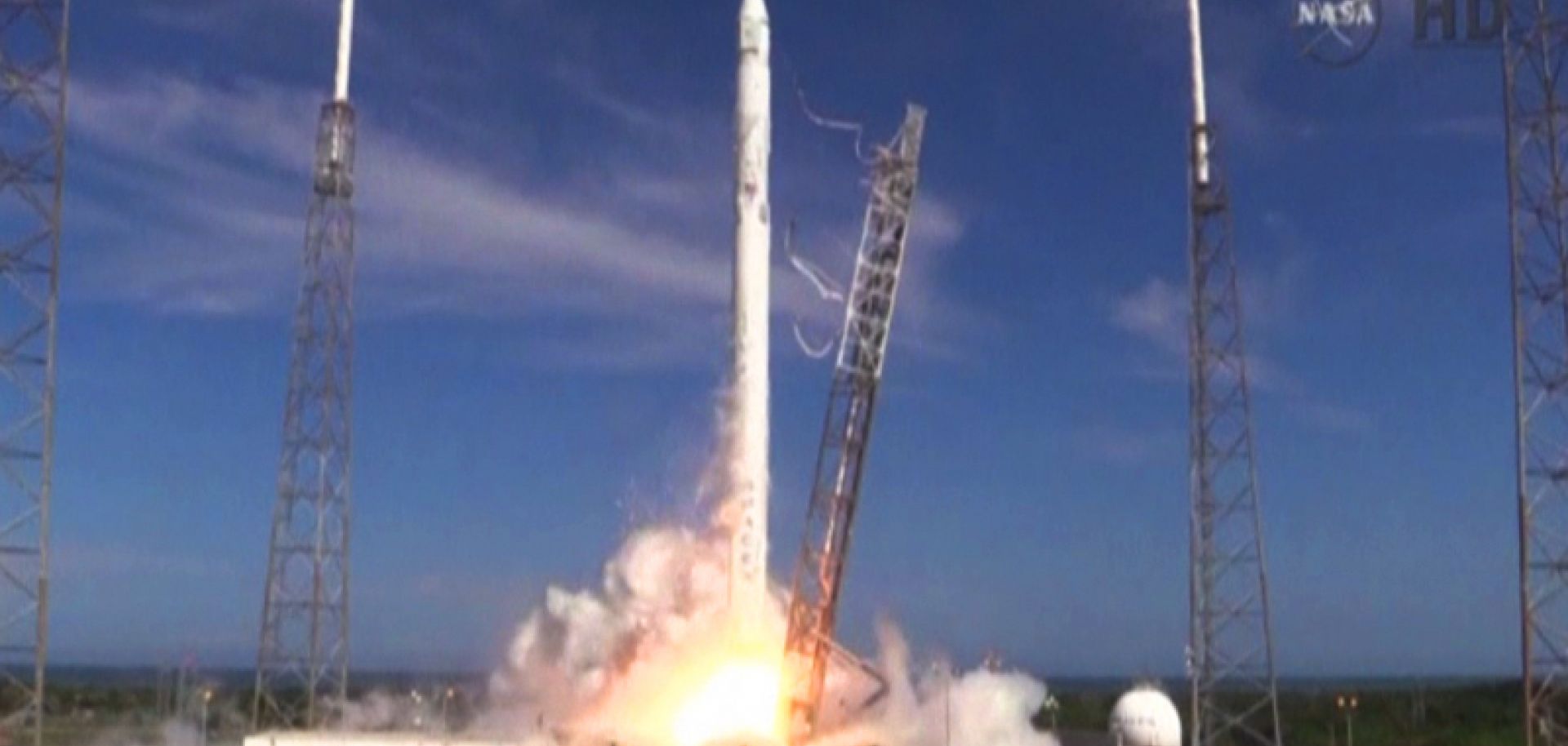
Paul Floyd: Hi I'm Paul Floyd, a military analyst here at Stratfor and today I'm joined by Rebecca Keller, our science and technology analyst. And on April 14, we had a SpaceX private launch of a rocket into space. And we're going to discuss the implications of this private company pursuing launch capabilities into space and what it actually is, what's the objective and what it means for future use of space by states around the world. So Becca, what is the implication of yesterday's test?
Rebecca Keller: So yesterday's launch had two components to it. The first was the more routine where they were sending a payload to the International Space Station. And they’ve done that several times before. The key test from yesterday was they attempted to land the first stage of their Falcon 9 rocket on a floating platform so it could eventually be reused in the future. The implications of that being cheaper launch costs when you can reuse parts of the launch system, it will be cheaper in the future. Unfortunately yesterday they didn’t quite succeed, but they came a lot closer than they have ever before.
Paul: Ok, so as we basically able to recycle parts, that should bring costs down. And I would also assume that using a private company, you know right now its government backed and funded and supported in many ways, but is there a future idea that other companies could be doing this and create some kind of competition?
Rebecca: Yeah you're absolutely right. Right now SpaceX and other companies are backed by NASA to achieve this reusable launch capability as well as returning the United States to being able to have manned missions and manned launches as well. But yes the eventual idea is that if you can support a small number even of companies to compete against each other that competition and that not necessarily free market but close to free market will keep costs down.
Paul: And looking forward what does cheaper costs for access to space mean?
Rebecca: So cheaper costs are essential. Space is becoming more and more important to our on the ground technology. Communications, GPS, and as you well know, there are several military applications to improving and lowering our costs into getting stuff into space. And if you want to talk about that would be great.
Paul: Well the military implications, right now that really applies mostly to the U.S. And I say that because the U.S. military far and away at this moment because of its global footprint is the most reliant on space to basically enable and enhance and facilitate everything that it does. From communications, command and control, all of these things that the U.S. is hugely reliant on. Other countries are in some ways also reliant on space for their militaries, but the U.S. is by far the most dependent. So, in that sense, as this U.S. military reliance on space increases, anything that brings those costs down, as you know there is already a huge military budget in place compared to the rest of the world, anything that can keep costs down especially as we're focused more and more on space will be more advantageous for the U.S. and its use of resources up there.
Paul: Comparatively that bringing costs down also opens the door to space being becoming more and more crowded. It's no longer the race between the Untied States and the former Soviet Union or Russia. China is in the game now. Japan has increasing capabilities, especially in defensive space technology. So absolutely space is becoming more and more important from the military aspect as you said and also from a commercial aspect.
Paul: And that's an interesting implication to talk about actually. As you know cheaper costs will translate to the rest of the world. So it actually helps other countries kind of get that footprint in space to help with their militaries as well. Ok
Becca, well thank you it's very interesting. As this technology progresses we'll continue to address it. And to look into this and other similar issues, please visit stratfor.com.
