
Brazilian President Dilma Rousseff is only three months into her second term, but she is already under siege. Protests are in full swing. Citing corruption and a weak economy, demonstrators took to the streets nationwide in March to call for her impeachment. Since then, protests and counter-protests have taken place across the country. Spurred by Rousseff's unpopular austerity measures and corruption scandals in state-owned energy company Petroleo Brasileiro, commonly known as Petrobras, opposition political parties and non-partisan movements such as Vem Pra Rua will again take to the streets April 12.
But these disruptions are not Rousseff's main concern. To end calls for her impeachment over alleged involvement in Petrobras corruption and to pass fiscal measures aimed at reaching a primary budget surplus of 1.2 percent of GDP, she needs strong political support. In the legislature, Rousseff's Workers' Party relies on the Brazilian Democratic Movement Party, which holds 19 of the 81 seats in the senate and 71 of the 513 seats in the lower house. The party also holds the presidencies of both of these bodies. Moreover, Rousseff's vice president, Michel Temer, also belongs to the Brazilian Democratic Movement Party. The ruling Workers' Party and the Brazilian Democratic Movement Party, however, have been at odds since the start of Rousseff's second presidential term.
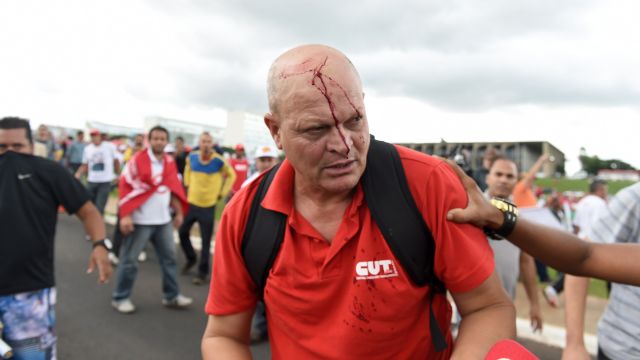
An injured Unified Workers' Central member during a confrontation with the police after a rally in support of Brazilian President Dilma Rousseff in front of the National Congress in Brasilia on April 7. (EVARISTO SA/AFP/Getty Images)
The Brazilian Democratic Movement Party has not held the presidency since 1989. Instead, it has supported successive presidencies regardless of ideological alignment. Though now a key part of Rousseff's administration, the party supported former President Fernando Henrique Cardoso, a member of the opposition Brazilian Social Democracy Party. Despite being out of the executive office, the Brazilian Democratic Movement Party is one of Brazil's largest parties, aligned not around a single leader but around several important politicians in different states. It holds governor's seats in seven of Brazil's 27 states, compared to the five held by the Workers' Party and the Brazilian Social Democracy Party.
Signs of a split between Rousseff and the Brazilian Democratic Movement Party emerged at the end of her first presidential term. During the October elections, several members of the party opted not to support her candidacy. At the core of the split is the Brazilian Democratic Movement Party's perception that, despite holding important ministries such as energy and agriculture, the Workers' Party has not treated it as an equal partner. Party members would like more power in the government's decision-making process.
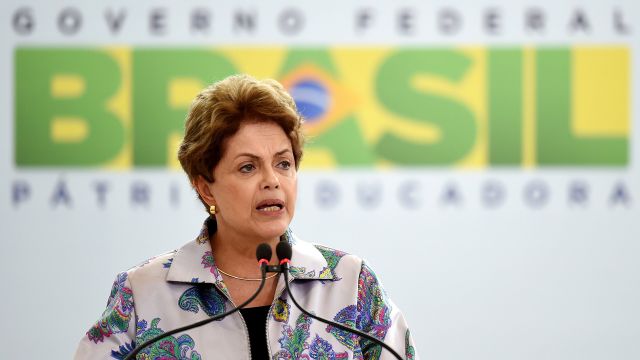
Brazilian President Dilma Rousseff speaks at a project launch at Planalto Palace in Brasilia on April 7. (EVARISTO SA/AFP/Getty Images)
Tensions worsened in 2015, when Rousseff's administration opposed the Brazilian Democratic Movement Party's candidate for the presidency of the lower house, Eduardo Cunha. Cunha eventually won the lower house presidency, but he has since accused Rousseff of trying to implicate him in the Petrobras corruption case to weaken him and his party.
For Rousseff, the Brazilian Democratic Movement Party and Cunha pose a threat. With declining support and mounting protests, her impeachment is on the table, and the president of the lower house has the legal power to begin the impeachment process. The Brazilian Democratic Movement Party holds this position, the presidency of senate and the vice presidency — meaning that it could initiate the process and, ultimately, benefit from the vice president's accession to the presidency.
But the party is also limited. The vice president would inherit the economic problems and low commodity prices that Rousseff is trying to manage. More important, initial investigations suggest that Brazilian Democratic Movement Party members, including the presidents of the senate and lower house, could also be involved in the Petrobras corruption scandal.
The Brazilian Democratic Movement Party would also have difficulty impeaching Rousseff. As of yet, there is no indication of a direct link between Rousseff and the Petrobras scandal. Regardless, the alleged wrongdoing would have taken place during her previous term. There is always the possibility of the Supreme Electoral Court ruling that the last presidential campaign was funded with corrupt money, but this would yield new elections or even the awarding of the presidency to second place candidate Aecio Neves. There is no sign of either outcome at the moment.
The Brazilian Democratic Movement Party, however, has taken advantage of its position to demand greater power. The presidents of both the lower house and senate have returned bills to Rousseff, including legislation on higher income taxes, under the pretext that the government did not consult with them in advance. The party has also added its own issues to the congressional agenda, such as a motion against Venezuela over the arrest of opposition politicians. It has sought autonomy for the Brazilian Central Bank and political reform that does not include ending private companies' funding of political campaigns.
Because of this situation, former President Luiz Inacio Lula da Silva has advised Rousseff to expand the Brazilian Democratic Movement Party's participation in the government. She has already given the role of minister of institutional relations to Vice President Temer, making him responsible for the relationship between the executive branch and congress. Da Silva needs Rousseff to succeed — he is slated to be the main Workers' Party candidate in the 2018 presidential election. But Rousseff must empower the Brazilian Democratic Movement Party while maintaining her own party's interests. She will, however, become more dependent on the Brazilian Democratic Movement Party to maintain political stability and implement the fiscal measures needed to reduce the budget deficit and fight inflation.
