
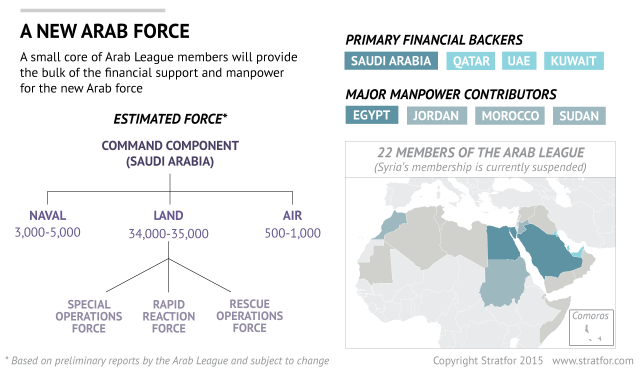
Official details have yet to be released, but initial reports indicate that the joint force would consist of an air component of 500-1,000 service members, a naval component of 3,000-5,000 service members, and a land component of 34,000-35,000 service members. Land forces will break down into three subcommands: special operations, rapid reaction and rescue operations. The energy-rich Gulf states are expected to finance much of the project and fund the force's long-term maintenance. Other less wealthy Arab states such as Egypt, Morocco, Jordan and Sudan will in turn be expected to make sizable manpower and military unit contributions to the force.
Many Reasons for a Force
The participating Arab League states each have their own reason for joining the force. Morocco and Jordan hope that their cooperation will help them maintain close ties to Saudi Arabia and its economic largesse. Egypt needs continued financial assistance from Gulf Cooperation Council states and is also keen to take on the prestigious role as the force's home base and primary contributor. From Sudan's perspective, greater cooperation with the Arab powerhouses is a way to break out of its international isolation. In spite of political differences with other member states, Qatar, a small country with meager military forces, will participate because it needs to be in the Arab security alliance, if only to influence the alliance's direction.
The force already looks as if it will have considerable financial backing from Saudi Arabia and the rest of the Gulf council as well as a serious commitment of elite troops. With these resources at its disposal, it could be a powerful tool to contend with the region's multiple civil wars and insurgencies. It will also help Arab nations contend with a proactive Iran that will soon reach an accommodation with the United States. In spite of these advantages, the force's structure will limit its effectiveness. Moreover, the force will not solve the Arab League's problems.
The Arab militaries that will feed into the force all use different equipment and weaponry and have divergent training and operation doctrines. Gulf Cooperation Council states maintain interoperability because of their earlier combined participation in groupings such as the Peninsula Shield Force. They are also largely equipped with Western military equipment. However, other Arab states, including Egypt, Morocco and Sudan, have vastly different equipment and procedures.
This is a key challenge. Standardization of communications, logistics, procedures, doctrines and even supplies and ammunition is the foundation of the strength of military alliances. There is no such foundation in the Arab League. The new Arab joint defense force will undoubtedly have difficulty mobilizing and sustaining a varied force in joint operations.
As Many Hurdles
Politics will also hamper the force's effectiveness. Arab League member states all have different core national and geopolitical interests. This is true even among Gulf nations — Riyadh and Doha have engaged in a number of long-running disputes. Such disputes will challenge the joint force because the national forces under its purview will each respond on the strategic level to their individual governments, not to the joint force's Saudi operational commander. Before the force can go into action, it will have to reach a consensus on the aims and goals of a campaign.
Considering the range of imperatives, it will be difficult for the Arab League to agree on the campaigns its force undertakes. For instance, Egypt, with the backing of the United Arab Emirates, will likely advocate for a mission in Libya. This proposal, however, would be opposed by Qatar and would cause Saudi Arabia to hesitate. The intervention in Yemen would also be controversial. Stratfor sources already indicate a high degree of hesitation within the hastily assembled coalition around the idea of committing ground forces to a mission inside Yemen. Crises in Syria and Iraq would present similar hurdles.
Potential disagreement on future interventions will undermine the utility of the joint Arab League force. The league's show of unity in creating its own standing rapid reaction force — driven and led by Saudi Arabia — is a step forward. Within the context of the Arab League's political fragmentation, however, its member states' divergent interests will only hobble such a force.
