
While Beijing is amenable to refreshing the policy, central government leaders have framed the issue as a long-term problem within Hong Kong, not with Beijing's policies toward Hong Kong. Following the original Hong Kong delegate proposals, Zhang Dejiang, a member of the Politburo Standing Committee and chief of China's leading committee on Hong Kong affairs, urged the Hong Kong delegates to instead "unleash positive energy." He proposed that they counter youth dissatisfaction with pro-Beijing national education and by highlighting Hong Kong's duties to Beijing and subordinate position under the Hong Kong Basic Law. Zhang also expressed concern about the increasing calls for Hong Kong to become a sovereign entity — the first time a Chinese state leader publicly addressed the issue.
Beijing's uncompromising response is not surprising. China's leaders are aware of rising youth dissatisfaction with the mainland, but Beijing is facing more important challenges: China's economic growth is slowing and the government must establish dominance over all the regional governments. It simply cannot afford to allow Hong Kong greater autonomy at this critical juncture. Beijing will instead continue to undermine Hong Kong's distinctive institutions as it has done for several years. This approach has its tradeoffs. The longer Beijing waits to address the political and economic drivers of anti-mainland sentiment in Hong Kong, the more social unrest in Hong Kong will strain mainland ties. Beijing's challenge lies in doing just enough to take some pressure off of Hong Kong's embattled pro-Beijing politicians without appearing to have made too many concessions.
Two Anti-Mainland Movements
Hong Kong anti-mainland sentiment expresses itself in two movements: the pro-democracy and the nativist movement. The pro-democracy movement is anti-mainland in that it seeks to preserve Hong Kong's civil liberties and autonomy. Between 8,000 and 13,000 people attended a pro-democracy demonstration Feb. 1 in Hong Kong, a significant number but well short of organizers' goal of 50,000 participants, signaling that pro-democracy sentiment is still around but that protest fatigue has set in. Many of the protesters carried yellow umbrellas, evoking the September to December pro-democracy Umbrella Movement. Those protests were sparked by the Standing Committee of the National People's Congress' decision to limit Hong Kong voters' ability to directly elect representatives to that body.
But the pro-democracy movement is about more than electoral concerns. Participants also fear that Beijing's campaign to increase Chinese patriotism within Hong Kong will erode Hong Kong's autonomy. A 2014 Chinese government white paper that identified patriotism as a basic requirement for Hong Kong civil servants and judges sparked protests in June, as did Beijing's 2012 attempt to institute a patriotic curriculum in Hong Kong schools.
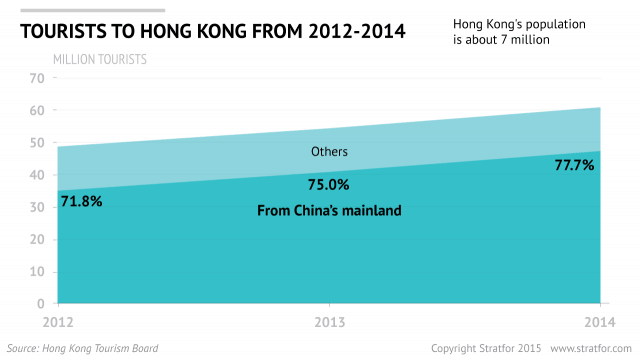
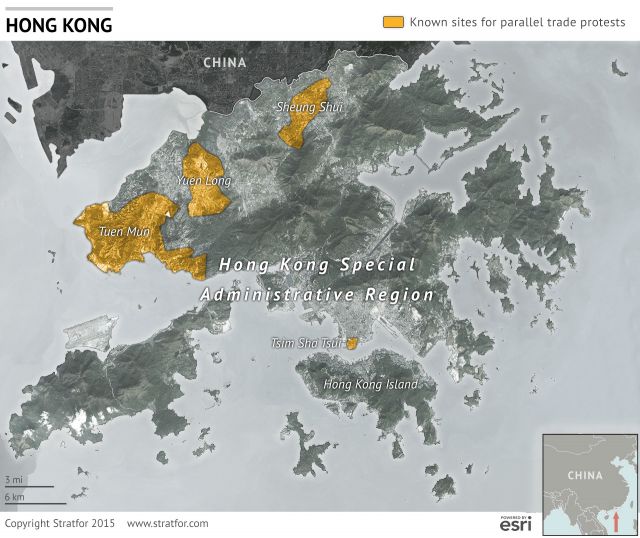
But anti-mainland sentiment comes in another form. In addition to pro-democracy demonstrations, Hong Kong has also seen nativist protests. These express a concern about the strain mainland visitors place on local resources and call for the government to curb the flow of tourists. Since the beginning of February, on several occasions hundreds gathered at malls in the New Territories bordering the mainland and accosted mainland shoppers with demands that they leave Hong Kong. Indigenous Hong Kong and similar groups composed of students organized many of these protests. Some of these groups had originally participated in the Umbrella Movement but turned their attention toward daily friction with mainland visitors. Photos of the protests show college-aged demonstrators facing off against older counter-protesters.
Nativist demonstrators accuse mainland shoppers of engaging in what is called parallel trade — the organized purchase of large quantities of goods in Hong Kong, such as milk powder or luxury items, to sell across the border. Parallel trade is driven by Hong Kong's lack of sales tax and the premium that mainlanders are willing to pay for the perceived quality and safety of Hong Kong goods. For Hong Kong, this flow has yielded shortages of goods such as iPhones and milk powder. Protesters accuse some Hong Kong businesses of favoring mainlanders, who buy in bulk, over the needs of locals. Mainland visitors are also seen as straining public transit, driving up housing prices with real estate purchases, and as being of generally uncouth behavior.
Pro-democracy protesters have prided themselves on their nonviolent methods, but nativist protests have been far more confrontational with occasional outbreaks of violence. On March 1, Hong Kong police squared off with protesters armed with knives, screwdrivers and makeshift pepper spray. Sporadic acts of violence have also targeted mainland visitors and the stores that service them, and on Feb. 5 an unknown assailant lobbed a firebomb into a shop frequented by parallel traders.
The general public, however, does not appear to support such confrontational tactics. A recent survey released by the Chinese University of Hong Kong indicated that only 17 percent of respondents favored confrontations with individual mainland shoppers. The same survey also found, however, that the majority of Hong Kong residents felt unease about the number of mainland visitors. Sixty-three percent of respondents reported that Hong Kong had too many mainland tourists, and many supported restrictions on mainland travel to Hong Kong, especially on the multiple entry permits that make several trips across the border possible in a single day.
What to Look For
Going forward, it is important to monitor Beijing's attempts to quell anti-mainland sentiment without accommodating demands. If the National People's Congress releases reports demanding political loyalty from Hong Kong or further curtailing autonomy, it could spark further protests.
The Hong Kong government will unveil its new electoral reform package in April — a package that will enshrine the Standing Committee's unpopular decision curtailing universal suffrage. Pan-democrat lawmakers in the Legislative Council have promised to veto the reform package, but this is unlikely because the alternative would be the status quo in which Hong Kong residents do not get to vote for their chief executive at all. Instead, the new system will proceed and go into effect in 2017 as Beijing desires. Pro-democracy activists will not be pleased in either case and could attempt to revive the Umbrella Movement.
If protests do break out, the Hong Kong Basic Law charges local authorities with maintaining public order. If violence between Hong Kong activists and mainlanders occurs, especially if there are deaths, Beijing may feel that it has no choice but to make a conspicuous action to tighten its hold on Hong Kong. That action may be more drastic than Beijing would otherwise be willing to take.
For its part, Beijing could unroll further initiatives to deal with its primary challenge of curbing anti-mainland sentiment among Hong Kong youths. Beijing may pursue the "Youth Work" highlighted by Zhang Dejiang. One such strategy may be to open the People's Liberation Army to Hong Kong residents, providing work and also fostering nationalism. Beijing could also attempt to make changes to the educational system to impose a pro-Beijing curriculum and foster patriotism. Unable to placate youth calls for autonomy, trying to change youth attitudes is Beijing's only long-term option. The leaders need to address youth attitudes somehow, but these actions also run a high risk of being perceived as brainwashing.
Any unrest in Hong Kong, however, is unlikely to spread to the mainland. The recent harassment of tourists by Hong Kong nativists — although not expressive of widespread sentiment — has led more mainlanders to see Hong Kong residents as hostile and privileged. Reports of anti-parallel trade protests and the persecution of mainland students at Hong Kong universities have led to calls by some mainlanders that Beijing shut off power and water to Hong Kong. This will not happen, but these calls show that the mainland public has little sympathy for Hong Kong and will not be bothered if the central government takes action to curtail Hong Kong's autonomy.
