
Beijing has not yet released a detailed description of the program or a full list of the counties involved. The pilot project, however, follows and will likely build on a 2013 initiative in Guangdong province. This initiative allowed rural landholders to sell their land directly to other residents of the same township, rather than only to local governments. The Guangdong initiative itself was an extension of prior piecemeal reforms that allowed residents of the same village — the lowest of China's administrative divisions — to trade land, raising that threshold to the second-lowest level, the township. The government's current pilot project appears to follow this pattern by raising the threshold one step higher to the county level — albeit on a highly limited scale.
To date, authorities have identified only three of the 33 counties selected for the trial program. All of these are on the outskirts of politically vital and fast-growing cities — Beijing, Shanghai and Lhasa — where demand for rural land is highest. This makes it difficult to assess whether and to what extent the pilot will prove relevant to the hundreds of millions of rural landholders not situated near top-tier cities. It is also difficult to assess its possible impact on other long-running reform initiatives such as agricultural modernization. For the pilot to succeed, some counties must be located further from major cities or in major agricultural production areas.
The miniscule scale of the pilot — covering just one percent of China's county-level regions — is a testament to the immense structural constraints facing rural land reform. Although the central government has long recognized the need to expand farmers' rights to own and trade the land they live on, it has been unable to embark on significant land reform for fear of the impact it would have on local government revenues. Local administrations take home only about 50 percent of total government tax receipts, even though they account for nearly 90 percent of total government expenditures. Localities have traditionally covered this gap by expropriating and selling rural land for urban development. These financial pressures have become especially acute in the past six years, as housing-related construction replaced exports as the driving force of national economic growth. At the same time, local governments took on ever-rising levels of debt to fuel urban construction activity. This significantly elevated the stakes of any move to circumscribe localities' ability to generate new revenue through land sales. In this context, rural land reform, which enabled land-holders to bypass local governments and to sell directly, was anathema not only to the political interests of local governments but to China's entire political-economic structure.
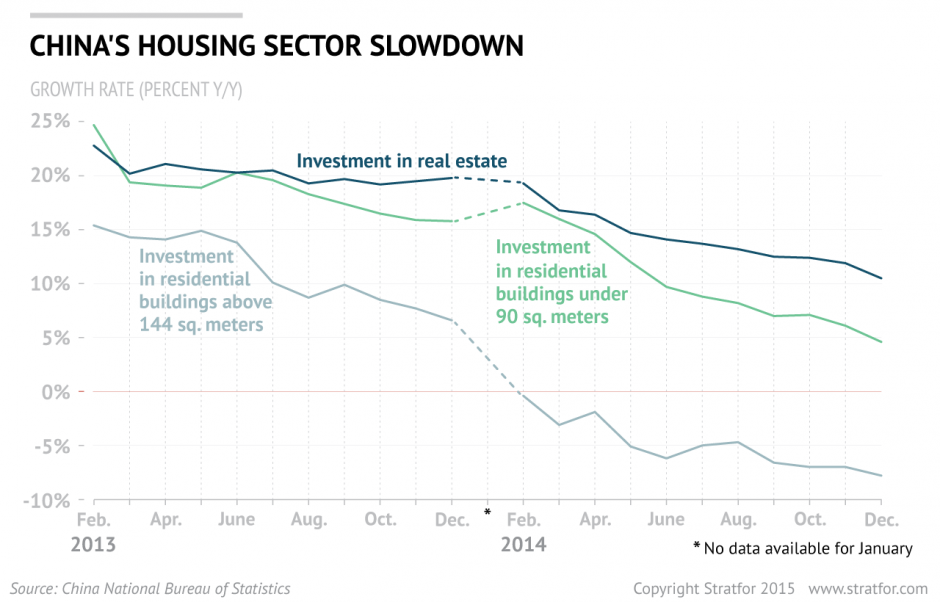
But China's decadeslong housing construction boom began to decline in early 2014 and will continue to do so for the next several years. This changes things. With home prices and sales falling, demand for land is declining. So, in turn, are land sales volumes and values — a dynamic that will profoundly affect local government revenues in 2015. The effects will be especially profound if Chinese authorities successfully stop local government-affiliated companies from buying land from their own governments to artificially prop up demand and prices. In this new economic environment, China's leaders are pushing through a set of reforms aimed at rebuilding the fiscal foundations of local governments around new local taxes and municipal bond sales rather than land sales.
This change makes creating rural land markets and strengthening farmers' land ownership rights politically feasible for the first time. For China's leaders, these reforms will mean two things: First, they will help alleviate rising tensions between farmers and local governments and solve the underlying problem of widening income gaps between rural and urban regions. Second, they will facilitate the next phase of urbanization by better ensuring that rural residents moving to cities receive adequate payment for their land.
Nonetheless, as the small scale of the newly-announced pilot makes clear, strengthening farmers' land-use rights and creating rural land markets in which landholders can sell to each other or to urban buyers without first selling to local governments will take time — years, not months. For starters, reform cannot be implemented on a significant scale until Beijing is confident that local governments' revenue streams are adequately diversified to absorb the loss of revenues from land sales. That process will take years and, more important, require a thorough reworking of the fiscal structure that has shaped the Chinese political economy since the mid-1990s. Rural land reform comes in response to deep-set forces in Chinese society and the economy — from rising rural social unrest to the need to modernize agricultural production — and thus will continue in the years to come. Like the other key components of Beijing's "reform and rebalancing" plan, however, it will proceed neither quickly nor cleanly.
