
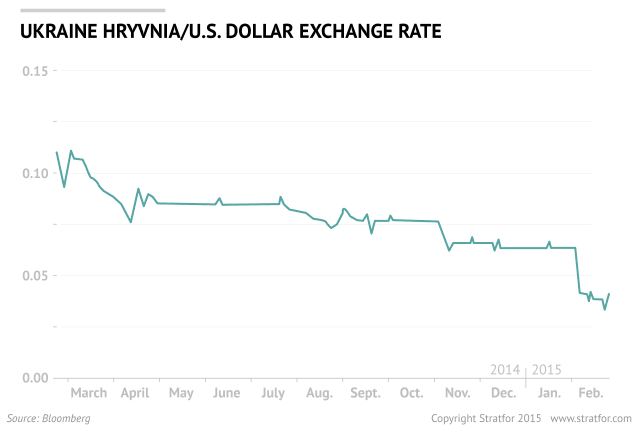
The National Bank of Ukraine recently introduced a series of measures tightening control over foreign exchange transactions to stabilize its currency, the hryvnia, which had fallen by about 50 percent since the beginning of the year. The first set of measures, approved Feb. 23, targeted importers by banning banks from purchasing foreign exchange on behalf of clients if the institutions also gave loans for imports. The changes also included provisions requiring the national bank's approval for import payments exceeding $50,000. On Feb. 25, the national bank increased the restrictions by banning banks from purchasing foreign currencies on behalf of clients altogether, a move that temporarily stopped the majority of currency transactions in the country.
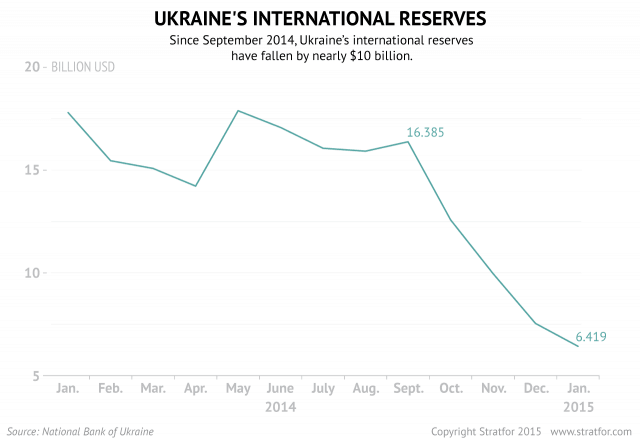
Ukrainian Prime Minister Arseniy Yatsenyuk criticized the national bank's reforms, and President Petro Poroshenko's office announced that it was working on new, different measures to help stabilize the currency market. The government's negative reaction likely pressured the national bank to reverse course. However, Ukraine's dwindling international reserves limit the country's ability to intervene in the currency market, and the country's agreement with the IMF — a deal Ukraine needs to avoid bankruptcy — largely prohibits currency interventions anyway.
Dwindling Confidence
Relations between the government and its monetary and fiscal bodies have deteriorated as the institutions have become mired in corruption scandals. On Feb. 24, Yatsenyuk announced that an investigation would be launched into the alleged corruption in the State Fiscal Service of Ukraine. On the same day, the Kiev prosecutor's office confirmed it is investigating cases regarding abuse of office and forgery by national bank officials; allegations of corruption have encircled the bank for the past several months. In December, the Pechersk District Court of Kiev ordered an investigation of national bank chief Valeriya Gontareva after a Ukrainian lawyer said she had damaged Ukrainian state interests through currency manipulation. More than 100 members of Ukraine's parliament — including members of the ruling coalition — have signed a petition calling to remove Gontareva from office.
Poroshenko appointed Gontareva to her post in June 2014. Previously, she served as deputy head of ING Bank Ukraine and as chair of an investment and asset management company. When she was appointed to a seven-year term as head of the national bank, she was regarded as a respected member of the banking community who could inspire the confidence of the private sector and work closely with the IMF.
Like Gontareva, the chief of the State Fiscal Service of Ukraine, Ihor Bilous, is a former banker appointed to office following the fall of President Viktor Yanukovich in the hopes that he would bring change and reform to the organization, which is responsible for customs and taxes. But charges of corruption have damaged his ability to manage as well. Yatsenyuk suspended the agency's management for the duration of the investigation, which he says will focus on money laundering, bribery and corruption schemes. Significantly, Yatsenyuk announced that the investigation would also focus on reports that officials from the Ministry of Internal Affairs and the country's security services colluded in an illegal tax scheme. Regardless of what the investigation ultimately finds, allegations of corruption inside the national bank and the State Fiscal Service of Ukraine are contributing to an erosion of public trust in the country's economic policies at a time when Kiev is facing growing defense costs and is dependent on international partners to help it avoid bankruptcy.
Turning West
When the IMF board meets March 11, it will focus on Ukraine's dire financial situation, the war in the country's east and the currency devaluations impacting all former Soviet countries. But it will also consider the discord between the Ukrainian government and its national bank in addition to the corruption allegations surrounding the country's top monetary and fiscal institutions. Ukraine's parliament has yet to approve several measures the IMF has set as preconditions for approving the rest of Ukraine's $17.5 billion aid package. Should it fail to approve the measures before the IMF meeting, the group will take that into consideration.
In addition to the IMF aid package, some $22.5 billion in other international aid is expected for a total package of $40 billion over the next four years. Ukraine's government also wants to restructure a total of $15 billion out of its $20 billion in existing bonds and loans. Nevertheless, discord between the national bank and the government coupled with uncertainty over the future direction of monetary policy could jeopardize the IMF program and lead Ukraine's bondholders to decline to participate in restructuring plans. There are already indications that Ukraine's new IMF package would have to be renegotiated later this year because of policy challenges and an increasingly dismal economic outlook.
Without IMF money, Ukraine would be forced to implement even deeper budget cuts, contributing to potential social unrest and limiting the government's ability to finance military operations. Cuts would reduce Ukraine's ability to pay for natural gas imports and generally undermine the credibility of the pro-West government. Such a scenario would please Russia, which strives for a weak and divided Ukraine.
There have already been several small protests — ranging in size from a few dozen to a few hundred demonstrators — against the government's monetary and fiscal policies, including one on Feb. 25 that called for Gontareva's resignation. Tension between the national bank and the government, corruption allegations that undermine the credibility of the county's institutions and increasing public discontent with fiscal and monetary institutions could hamper Ukraine's ability to access much-needed funding and reach agreements to avoid bankruptcy by restructuring existing loans. Lack of access to international funding would greatly weaken Ukraine's negotiating position with Russia and force the country to adopt far-reaching budget cuts, which would severely limit its ability to fund military operations in the east. While most of the West focuses on Russia's next moves, it may be Ukraine's internal politics that determine the future of the region.
