
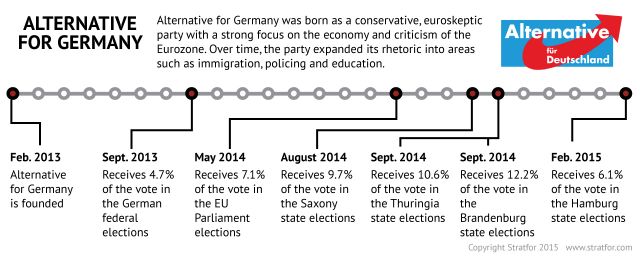
As expected, the center-left Social Democratic Party won the Hamburg elections with 45.7 percent of the vote, while Angela Merkel's Christian Democratic Union came in a distant second with 15.9 percent. But the most important result of the elections was that Germany's largest parties lost votes to smaller groups on the left and right. The Greens earned 12.2 percent of the vote, left-wing party The Left won 8.5 percent, the center-right Free Democratic Party got 7.4 percent and the Euroskeptic Alternative for Germany earned 6.1 percent. The turnout for these parties shows a rise in their popular support at a time when Germany's grand coalition is facing political challenges.
Hamburg's ruling Social Democratic Party, although victorious, lost 2.7 percent of the vote compared to the last elections, held in 2011. The result was worse for the Christian Democratic Union, which saw its share of the vote drop by 6 percent compared to 2011 — its worst performance since the end of World War II. By contrast, the Free Democratic Party, which had been on the verge of collapse after failing to win a seat in the federal parliament in 2013, showed renewed health. This is not necessarily a negative for Merkel — her party and the Free Democratic Party were allies in the previous German government. But the most important result of the Hamburg elections was that Alternative for Germany managed to win its first seats in western Germany after strong performances in eastern regions in 2014.
This was the first electoral test since anti-Muslim protests broke out in Dresden and other German cities between late 2014 and early 2015. The Hamburg polls were also the first elections since the European Central Bank announced a program to purchase debt from eurozone countries in late January, a policy many Germans oppose. Finally, the Hamburg elections took place at a time when both Berlin and Athens are undergoing tough negotiations regarding Greece's debt.
Usually, national or international issues do not have as much of an impact on regional elections as much as they do on federal ones, and Hamburg's residents may have based their votes mostly on local issues. Even so, the elections were held at a significant moment for German politics. For the first time since becoming chancellor a decade ago, Merkel is simultaneously dealing with domestic and foreign threats. At home, anti-EU and racist sentiments are slowly emerging. Abroad, Germany's leadership of the European Union is being seriously challenged as France and Italy defy Europe's deficit targets. Greece is also pushing for debt relief, and Central and Eastern European countries have conflicting views on how to react to the crisis in Ukraine.
This makes Alternative for Germany's rise a serious issue for the future of Europe. Over the past few months, the party has been dealing with internal friction stemming from leadership disputes and ideological conflicts. Some factions believe the party should focus on economic issues, while others push for a greater move toward social issues linked to immigration and identity. This friction threatens the future of the party, but it has not affected its popularity so far. A recent survey showed that seven out of ten Alternative for Germany voters support the party because of disappointment with the country's traditional political forces, confirming the group's role as Germany's main protest party. But the survey also showed that most Alternative for Germany voters believe Germany has too many immigrants and that anti-Muslim protesters were correct to express concern about radical Islam.
So far, Alternative for Germany has had most of its success with voters in eastern Germany, where unemployment tends to be higher and resistance to foreigners tends to be stronger. The Hamburg elections marked the first time the party entered a regional parliament in the west of the country, where economic prosperity tends to weaken anti-immigrant sentiments. The fact that support for the Christian Democratic Union fell by around 6 percent between 2011 and 2015, almost the same level of support Alternative for Germany received in its electoral debut in Hamburg, suggests that the Euroskeptic party was successful at stealing a significant number of voters from the conservatives.
For the first time since taking over, Merkel is facing persistent opposition from the right. This happens at a time when some members of her own party believe the Christian Democratic Union has moved too much toward the center because of its alliance with the center-left.
This situation will impact the government's domestic and foreign policies. At home, Berlin will be under greater pressure to introduce additional reforms to its immigration policy that will make it more difficult for asylum seekers to be granted asylum in the country and discourage non-EU citizens — especially those without professional skills — from immigrating. So far, Merkel has ignored the voices within her party calling for her to take a tougher stance on the Schengen agreement and accept more limits to the free movement of people within Europe, but these voices will likely grow stronger. The rise of Euroskepticism will also reduce Berlin's room to maneuver when dealing with Greece. Athens will probably reach a short-term agreement with its lenders in the coming weeks, but the problem will not go away and will generate further friction later in the year when Greece tries to negotiate a permanent settlement.
These elections do not challenge Merkel's leadership in the short run. Germany will not hold federal elections until 2017, and Merkel is still Germany's most popular politician. But if the powers in Berlin were hoping for Alternative for Germany to fade away, the Hamburg elections have proved them wrong.
