
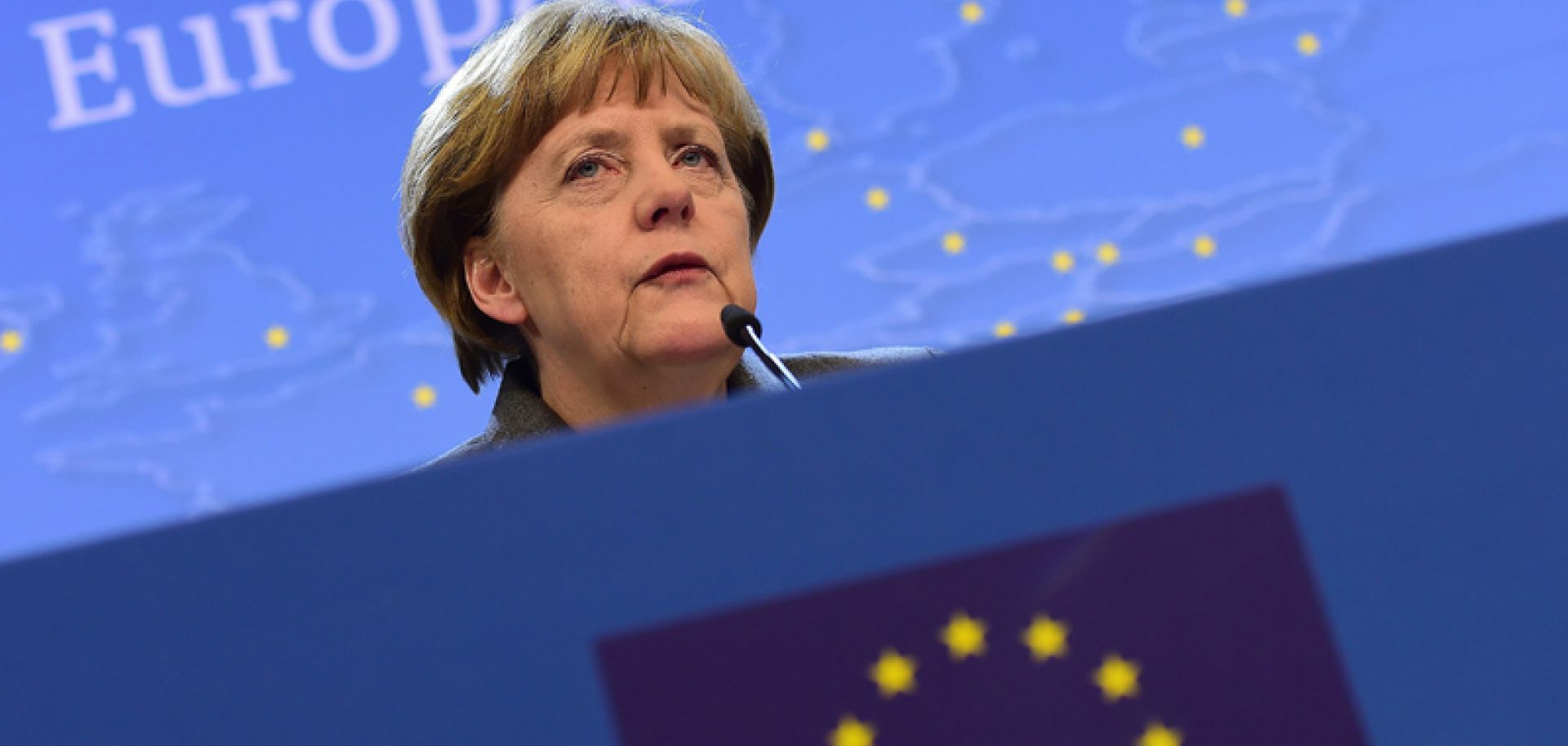
Reva Bhalla: Hello my name is Reva Bhalla and today I'm joined by my colleague Mark Fleming-Williams to get into the mind of German Chancellor Angela Merkel, given the number of priorities that are on her plate. So Mark, poor Merkel. She has been flying around from DC to Minsk to Brussels. I hope she's home by now in bed. But wracking up what, 20,000 air miles I believe you told me? So at this point she has a lot on her plate and coming from Minsk I think the priority there was for her to do what she could to neutralize a confrontation with the Russians. And I think she bought some time there. There are a lot of questions when it comes to the negotiation itself. But her real priority has to be on keeping the eurozone together. And what do we have now coming up Monday, right, the next big meeting in the standoff between Greece and Germany?
Mark Fleming-Williams: Yeah absolutely. So Monday is the next meeting of the Eurogroup, which is all the finance ministers of Europe. What we saw in the previous meeting, which was on Wednesday, was an impasse essentially. The German-led Europeans refused, seemed to refuse to budge at all on granting any concessions at all to Greece. And one must think that this comes largely from Merkel as well. It's not just Schauble, the German finance minister, out on his own. So to understand this, I mean from the German perspective obviously she's got the problems in Minsk. But within Europe she's had very difficult last couple of months. Looking at the bigger picture we've got a big reverse going in Europe. So Germany for the last three years has very much dominated the message coming out of the European institutions. And then on Jan. 22 we saw the quantitative easing being announced by the European Central Bank, which Germans have been against for at least a year.
Reva: But had to concede a bit there as well.
Mark: Obviously there was a bit of a compromise, but at the end of the day QE happened and the Germans had not wanted QE to happen. And we've seen the German central bank continue to talk against it since the announcement. And then on Jan. 25 then Alexis Tsipras, the Greek prime minister, the new prime minister wins the election to become prime minister. So suddenly everything is not going the German way from a political perspective.
Reva: And when we look at the players in this negotiation, so even Greek Finance Minister Yanis Varoufakis, who himself in his own writing has said that Germany doesn’t actually want to resolve the debt of the periphery because then it loses political control over the eurozone. In a sense maybe that's true, you know of course Germany has clout in making sure that it is the key creditor to the peripheral countries. But at the same time, there's a lot of political pressure adding up in Germany to where it can't allow the status quo to continue.
Mark: Yes. I mean so Varoufakis has got a conspiratorial, conspiracy theory kind of view of things. I would say the German position is clearer that if everyone was a bit more like Germany then we wouldn’t have these problems. I think that's what drives them more than a Machiavellian desire to control everything. From a political perspective, I mean one of the reasons that Germany first got involved in Europe, and one of the reasons that Europe makes sense to Germany are the economic benefits. I mean we've got the fact that Germany export-led. 50 percent of GDP comes from exports. You’ve got a trapped market there. The euro's great because it makes the currency cheaper, which helps their exports. These are the reasons why Germany likes Europe and these reasons are still going strong. This week news came out that the German exports for 2014 were record breaking. The unemployment at the moment is record breaking since reunification and record breakingly low I should add. And today we had incredible results out of, double expectations in terms of German GDP in Q4 of last year. So the economic situation for Germany remains strong within Europe.
Reva: So they have the economic security, and that obviously gives Merkel some room to maneuver. But what about the political pressure that she faces, especially from groups like Alternative for Deutschland and how they perform in the elections?
Mark: Yeah, I mean Alternative for Deutschland are a very different problem for Merkel to fix. They’ve always said that CDU, her party, has always said there can be a party to the right of CDU, further on the right wing. So the AFD has emerged. We have an election this weekend in Hamburg. We don’t expect an incredible result from AFD this weekend because its Hamburg, and Hamburg is a nice well-to-do...
Reva: big difference between east and west.
Mark: Absolutely, AFD do very, like UKIP in England, do very well in the poorer areas of the country. So we're expecting 5 or 6 percent. They'll get into the parliament. This will be another statement. It will be another rung on the ladder for the AFD on its progress in creating problems for Angela Merkel.
Reva: So it's creeping political pressure on the German side. But in Greece you have a party that has campaigned on the idea that they will end austerity, that they will end the bailout terms. What are we to expect then this coming week in the lead-up to Feb. 28 when the bailout expires? Is there room for a negotiation? Are we seeing signs for some sort of compromise?
Mark: Look, there has always been room for negotiation. The two parties have come a little bit clearer as to exactly where they would do a deal. Obviously nothing came out of Wednesday. We've got officials from both sides meeting in these few days to try and build up a framework for agreement. Monday is supposed to be D-Day. There is definitely possibility for a compromise to emerge from that meeting.
Reva: And so we'll see some short-term buying time, which the Europeans do best. But still, there is that underlying problem here that Greece is still facing. You just said Germany's GDP numbers, Greece's GDP numbers were not looking good at all. Obviously will all the uncertainty that's continuing, still very high unemployment. And so the fragmentation of Europe continues, albeit at a slow pace, not at the big bang that many people may be expecting this week. But I think we still have some time.
Mark: Indeed.
Reva: Alright. Well Mark, thank you for joining. And thank you all for joining us. We'll see you next time.
