
Hungary is a small country dependent on Russia for energy, the European Union for funding and investment, and NATO for security. After coming to power in 2010, Orban began implementing an "Eastern Opening" policy aimed at boosting economic ties with countries to Hungary's east, especially Russia. The policy was meant not only to bring new jobs and investment to Hungary, but also to lessen the country's dependence on the European Union. These efforts culminated in a January 2014 agreement with Russia's Rosatom for the expansion of Hungary's nuclear power plant at Paks. Russia agreed to provide Hungary with a 30-year, $13.65 billion loan for the project, which is scheduled to begin in 2018.
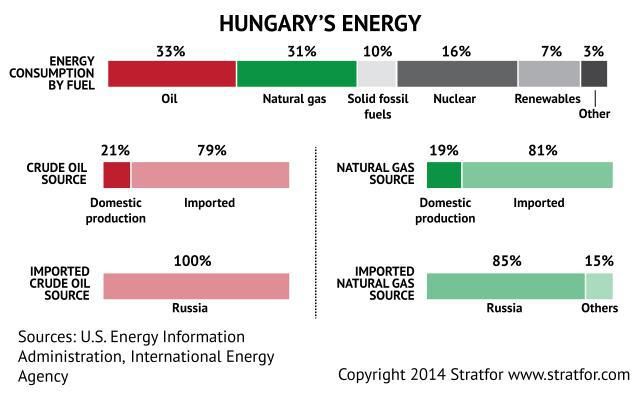
Hungary has three main avenues of influence in shaping its relations with Russia and Europe. Its position on NATO's eastern edge, bordering Ukraine, would make Hungary a strategic location to place NATO rapid response forces, although there are no official plans yet for such a deployment. Hungary also can pump 16 million cubic meters per day of natural gas to Ukraine. Although this is a small quantity compared to Slovakia's reverse flows to Ukraine — and insufficient to meet Ukraine's total natural gas needs, particularly in winter — Hungarian reverse flows are useful whenever Russia's Gazprom cuts off natural gas supplies to Ukraine. Moreover, Hungary's membership in the European Union — which requires unanimous votes on foreign policy decisions — gives the country the power to veto Russia-related sanctions, making Budapest a crucial ally for Moscow.
In the weeks leading up to Merkel's visit to Hungary, there were indications that Budapest wishes to mend ties with the West. In early January, Hungary resumed reverse natural gas flows to Ukraine, which it had halted in September. Later that month, Hungarian Defense Minister Csaba Hende announced that his government would make a decision soon regarding its procurement of new helicopters. Hende also met with new U.S. Ambassador to Hungary Colleen Bell during her first week on the job, prompting speculation that Hungary is considering buying helicopters from the United States. Moreover, a day before Merkel's visit, German paper Frankfurter Allgemeine Zeitung reported that NATO is considering placing rapid response forces in Hungary, though any such deployment would occur after NATO's planned deployments of the forces in Poland, Romania, Bulgaria and the Baltic states. Hungary wants to appease the West, particularly the European Union, in order to secure investment and funding despite a slew of domestic policies that the European Union might find objectionable.
Nevertheless, Hungary's efforts to rebuild ties with the West have been accompanied by nearly parallel signals to the Kremlin as Orban shifts focus from Merkel's visit to the talks with Putin. On Feb. 3, a day after Merkel's Budapest visit and less than a month after Hungary resumed sending natural gas to Ukraine, Hungarian natural gas transportation system operator FGSZ confirmed that it is no longer providing Ukraine with reverse flows. The company indicated that the cessation is related to a lack of demand in Ukraine. However, the reverse flows stopped just as Merkel praised Hungary's decision to restart them and as negotiations stalled between Ukraine and Russia on the terms for natural gas deliveries after their current agreement expires at the end of March.

Moreover, Budapest has promoted the construction of "Turkish Stream," the Russia-led initiative to replace the defunct South Stream pipeline project with a pipeline to Turkey. Hungarian Foreign Minister Peter Szijjarto visited Serbia on Jan. 14 and Turkey on Jan. 26 to promote plans for the construction of a pipeline connecting Turkish Stream to Greece, Macedonia, Serbia and Hungary. Construction of Turkish Stream remains economically unfeasible, but Hungary's public support for the Kremlin's project indicates that Orban's government is still committed to close energy cooperation with Moscow.
Putin's Feb. 17 talks with Orban will focus on energy and Ukraine. On the energy front, Russian and Hungarian officials will negotiate a new long-term natural gas contract, with Hungary seeking a reduction in natural gas prices. Negotiations also will cover possible plans for an extension to Turkish Stream, as well as an agreement for Russia to store more natural gas in Hungary. Regarding Ukraine, Putin will work to ensure that Hungary's decisions about reverse natural gas flows support Russia's negotiating strategy.
In addition to these issues, the Kremlin is lobbying Hungary and other EU members to block the imposition of new, more significant EU sanctions on Russia expected later this year. Thus far, Hungary has cooperated with the Europeans on sanctions. Russia will also work to dissuade Hungarian authorities from allowing NATO rapid response forces to be deployed in Hungary.
Orban's goal for 2015 is to avoid international isolation and maintain his authority domestically. The prime minister's popularity at home is declining, and his opposition is beginning to rally enough support to organize large-scale protests. Economic concessions from the European Union and Russia could help Orban improve his domestic standing. Hungary can use its location, its EU membership and its ability to send natural gas to Ukraine to get those concessions.
