
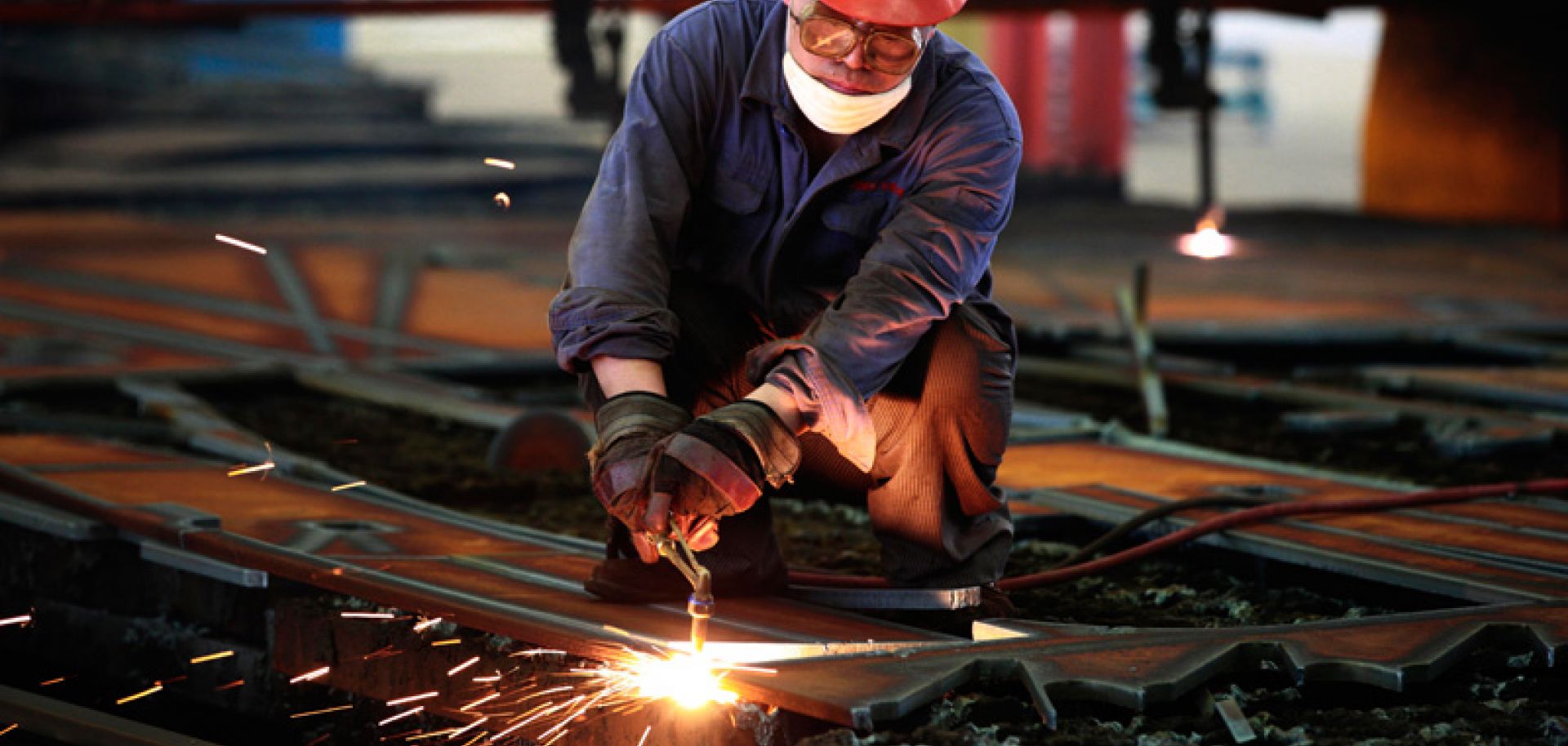
Ben Sheen: Hello and thank you for joining us. My name is Ben Sheen. I'm a managing editor here at Stratfor, and I'm joined today by John Minnich, East Asia analyst. We'll be talking a little bit about China in 2015 and what to expect. So John, what do you think the big trends are that we're going to see from China going into this year?
John Minnich: Well there are three things, really, that we're watching for in China this year. The first is clearly the housing sector slowdown and the deflationary impact that's going to have on the economy as a whole. The second thing is the government's attempt to use the housing sector slowdown as a window of opportunity to push for a set of reforms they hope will put china on the path to a more sustainable long-term economic growth model. The third is the anti-corruption campaign, which for the Chinese government serves two key purposes. One is to re-affirm the public support for the party, the public's faith in the party's leadership capacity and that the party knows what it's doing, that it has the right vision. The second is to clear away obstacles to reform from within the government and party apparatuses.
Ben: Okay, so there's quite a bit there. Looking first at the slowdown in the housing market, how does this affect what the central government is doing and also the provincial economies?
John: The economic slowdown is not entirely centered on the housing sector, but the housing sector is the heart of it. This is a sector of the economy that plays an incredibly significant role. It's 15-35 percent of the economy depending on how you measure it. It's such a huge chunk of the economy, and as that slows, the economy as a whole will be affected, but certain regions and certain industries are going to be hit very hard. Industries that we are looking at would be coal, steel, iron ore, extractive industries and building materials industries. Those are the ones that are most directly reliant on the housing construction sector that are going to be hit very hard. Of course, regions that are more reliant on those industries are going to suffer. So those are areas where we are going to see pretty significant potential for corporate debt crises, for local government debt crises and unemployment crises, things like that. This plays out in particular in the relationship between the central government, which has these reform goals, and local governments that look at those reform goals and say, "well those don’t match our goals, which are to maintain high employment, to keep social stability and to keep high economic growth."
Ben: So how might the central government and local governments use the economic slowdown to push through certain reforms they've been thinking about in response?
John: Right. There are three sets of reforms the government is looking at this year. The first, and by far, the most important — but also in a lot of ways, the trickiest, the most delectate — is fiscal reform. This is another topic for another discussion, but very briefly, fiscal reform is the central knot holding together Chinese political economy today. It's all about the fiscal relationship between the different levels of government, and the key thing here is that local governments are very deeply dependent on land sales for revenue generation. Local governments cover the vast majority of government expenditures in China, and they make the money to pay for those expenditures through land sales. The dependency on land sales is one of the things that has driven China's housing construction boom over the course of the last six-seven years. So now as that sector is sliding, the central government is in a position where it has to find a way to create new avenues to raise capital. That's where the fiscal reforms come in. The problem with fiscal reforms though, and by fiscal reforms we mean primarily creating new taxes, adding new taxes to the economy, is if you move those through too quickly, if you put too many new taxes too quickly, then you're going to have a very dramatic effect on the economy. So the government is in a position where it wants to implement these reforms urgently. It needs to implement them, but by virtue of what these reforms will do to the economy, it has to proceed slowly
Ben: It doesn’t want to create a shock to the system.
John: Exactly. So other key reforms we're looking at would be financial reforms, and the main goal of financial reforms is to find a way to give ordinary Chinese the opportunity to turn their savings into capital so that ultimately you're laying the foundation for them to become the domestic consumer base the government hopes will five or 10 years from now be the driving factor of the economy. Finally, we have state-owned sector reforms. The idea behind this is twofold. One goal is to take industries like coal and steel that have been extremely fragmented, where you have 5,000-10,000 businesses in these industries operating, many of which are not cost-effective producers, many of which are closely connected to local governments that are being sustained on debt. The government's goal here is to consolidate them under the control of integrated state-owned conglomerates. Another element of state and sector reform is to subject the state-owned conglomerates to market forces, so it's kind of to create an environment of controlled competition in a sense. They do want these industries to be operating under the control of ultimately large, integrated companies that are more cost-effective, but they want to subject these companies to some element of market competition. Of course, that in some ways is one of the more politically volatile reforms we are looking at because, when you take these state-owned conglomerates and you subject them to market forces, that brushes up against a lot of the vested political interests within these state-owned conglomerates that have enjoyed implicit subsidies in the form of low taxes — and vast amounts of corruption, to be honest.
Ben: Completely. Looking at this potential possibility of friction when actually bringing the reforms though, how do you think China is actually brining them to pass? Obviously, the reforms might be good for the economy and good for the country, but they're not always going to be popular, especially for people with vested interests in some of the cliques we've seen emerging in the central government. Now there's been a fairly expansive anti-corruption campaign. How is the central government going to use this to its advantage to push through these reforms?
John: This goes back to the multi-dimensional purpose of the anti-corruption campaign, the functionality of the anti-corruption campaign. One thing we have highlighted before is that it does play an important role in mobilizing popular support among the people for the party, especially central leadership. It gives people faith that the central leadership knows what it's doing, that it has a legitimate claim to rule China, that this is a legitimate dynasty in some sense. Another important component of that is a way that the central leadership — Xi Jinping and his close associates — can go through and weed out, extricate and eliminate potential barriers to obstacles or reform from within the party, from within the government apparatus, from within the state-owned sectors. The anti-corruption campaign plays back into both the economic slowdown in the way that the government is trying to manage the social disruptive effects of that slowdown, but also the idea of pushing through reforms. How does a government make reforms politically viable? It eliminates opposition to those reforms to begin with.
Ben: John, thank you for sharing this insight with us today. For more on China, read Stratfor.com.
