
Basra is no stranger to conflict. Arabs, Persians, Mongols, Turks and Europeans have fought for it over the course of its 1,400-year history. Today it is Iraq's southern power center and second-most populous city.
Basra's prominence is very much tethered to its location. The city sits on a flat alluvial plain, nestled beside the Shatt al-Arab River, a waterway itself formed by the convergence of the Tigris and Euphrates rivers 65 kilometers (40 miles) to the north. Moving away from the great Mesopotamian marshlands, the Shatt al-Arab flows south to the Persian Gulf, through roughly 100 kilometers of subtropical desert. As well as serving as the portal to the gulf, and the maritime infrastructure that serves it, Basra grants access to Iraq's southern oil and natural gas fields, estimated to contain 80 percent of the country's energy reserves.
The confluence of these factors is what makes Basra so strategically significant, from a military, industrial, energy and commercial perspective.
A World Preparing for War
Going into World War I, the Ottoman Empire was in a state of decline, having been expunged from most of Europe and North Africa, though it still held the geographic landmass of modern-day Turkey as well as much of what is now Syria, Lebanon, the Palestinian territories, Jordan and Iraq. Keen to establish powerful alliances for the war to come, on Aug. 1, 1914, the Ottomans signed a secret alliance treaty with Germany. Exactly three months later, Russia declared war on Constantinople, with Montenegro following suit two days later, and France and Britain opening hostilities on Nov. 5.
In a calculated move by the British, forces were readied for action in the months preceding outright war. In the last days of September, a small flotilla of ships entered the Shatt al-Arab, ensuring a British presence and proximate security of the waterway and nearby oil refinery. In mid-October, a convoy containing what was to become the Mesopotamian expeditionary force departed from Bombay, destined for friendly Bahrain. Such composite forces were by their very nature designed to be highly mobile and rapidly deployable, but prior to the advent of air mobility, movement by railway or sea was the only method of transporting military might swiftly. Although steam facilitated heavy tonnage, sea travel was slow.
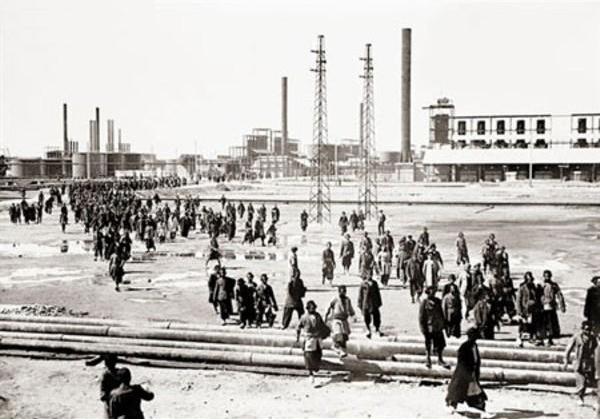
Workers at the Anglo-Iranian Oil Co. refinery at Abadan in 1913.
The Indian Expeditionary Force "D," commanded by Brig. Gen. W.S. Delamain and comprising British and Indian troops, moved quickly upon arrival at the Persian Gulf, the fires of war already well lit. Under orders to secure and protect the oil refineries, storage tanks and pipelines at Abadan Island — the strip of land south of Basra, sandwiched between the Shatt al-Arab and Bahmanshir rivers — the first step was securing an embarkation point on the Al Faw Peninsula. The intent was to drop off a battalion-sized group to clear the southern tip of Al Faw before sweeping north. The remaining force would move up to Sanniyeh, halfway between Al Faw and Basra, and disembark. From there the consolidated force could eradicate any further resistance, secure Abadan and then sweep north to Basra if required. All the while, a small contingent of gunboats would reduce any Turks along the banks of the Shatt al-Arab and clear the waterway for troop transports.
Opening Salvos
At least in the beginning, the British strategic imperatives for securing lower Mesopotamia far outweighed the Ottoman Turks'. Protecting Abadan and the Anglo-Iranian Oil Co. refinery was critical not only to the war effort but to the British Isles in general, being largely dependent on seaborne trade. The Germans were challenging the Royal Navy for control of the oceans, and the modern Dreadnought-class battleships used oil-fired turbines. Britain was coal-rich but had no oil reserves, hence the investment in south Persian oil. More pressing concerns — namely, the Sinai campaign, events in the Caucasus and control of the Balkans — also distracted the Ottomans. Mesopotamia was not a main effort, as was reflected in the low state of readiness and comparatively meager forces in the region.
If the defending Turks needed a reminder of British naval power, it came in the form of a small flotilla of Cadmus-class ships that proceeded to wreak havoc in the Shatt al-Arab. Compared to the latest warships, the 10-gun sloops that began harassing Turkish positions along the Shatt were anachronistic to say the least. They were the last vestiges of the Victorian navy, gunboats built to the colonial style with steel screw propulsion and a full rig of sails. Beginning in October, HMS Odin and HMS Espiegle presided over Abadan's oil refineries, supported by HMS Dalhousie, a troopship of the Royal Indian Marine. The flotilla's presence made the Turks uncomfortable, but a truce was sustained until early November, when war was officially declared following the Ottoman shelling of Odessa.
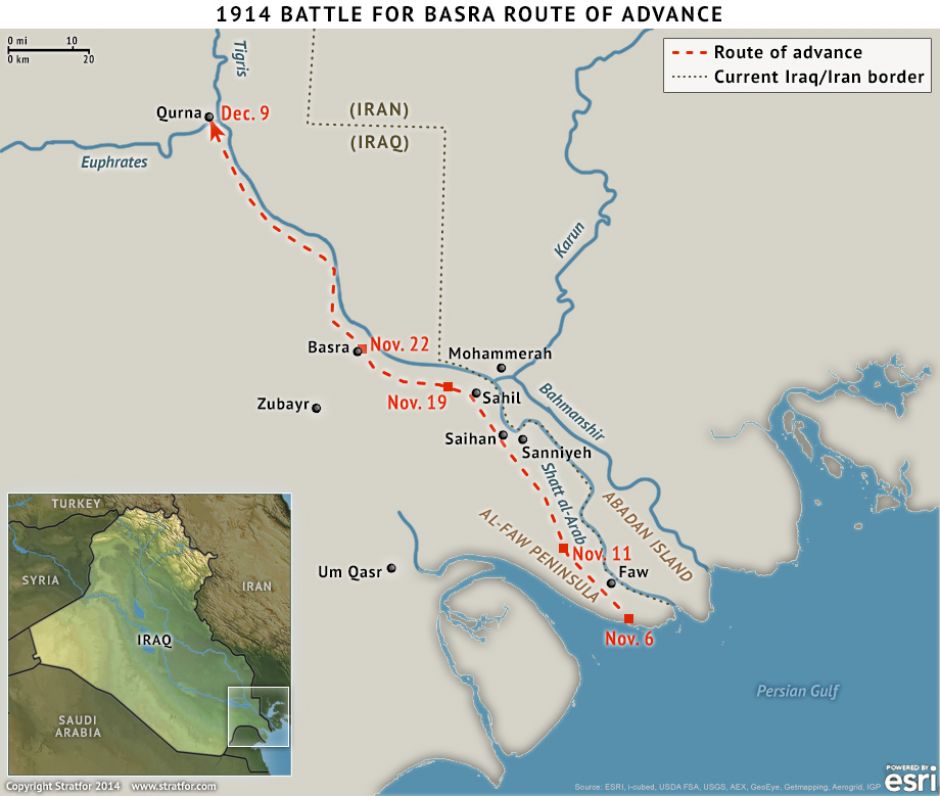
On Nov. 12, a reconnaissance in force probed the Turkish position at Saihan, just north of Sanniyeh, where the remainder of the 6th (Poona) Division was waiting to land. As well as identifying the Turkish positions and inflicting casualties, the reconnaissance prevented any interdiction of the landing of the remainder of the expeditionary force. Saihan was fully routed on Nov. 15 and the Ottomans were forced to retreat from Mohammerah at the Karun River junction two days later. By Nov. 19, the British 16th and 18th Brigades were formed up to assault the last enemy stronghold before Basra: Sahil.
The Fall of Sahil
The Ottoman defenders had occupied a defensive position in and around a dilapidated fort beside a palm-shaded grove. Around 4,500 personnel, including artillery, dug in and awaited the British. Thus far, the expeditionary force had found the elements to be inhospitable, contending with billowing dust storms that clogged weapons, heat mirages that obscured targets and marshy ground that made advancing difficult for both man and horse. On the morning of Nov. 19, a severe rainstorm set in, worsening the conditions underfoot and hampering the advance of the British over roughly 1.8 kilometers of open ground.
Advancing at a walk, the commanders and the men cursed alike, but what had seemingly damned the British also hampered the Turks; their fire, both direct and indirect, went wildly askew. Slightly over 350 British infantrymen fell on the advance, but when the guns of the Royal Field Artillery found their range, the effect on the Ottoman positions was devastating. Under accurate and incessant fire, trenches collapsed and shrapnel tore through the Turkish ranks. When the walls of the fort finally crumbled, the Ottoman defenders turned and ran as one. Ironically, the conditions that had prevented them from attriting the British on the advance saved the Turks from being cut down by the cavalry, which was slowed by the thick mud.
The following day, a local sheikh dispatched message by skiff to the British gunboats dominating the Shatt al-Arab. The Ottomans had abandoned Basra, retreating farther north to Qurna. The British were welcome in the city. Gen. Sir Arthur Barrett, commander of the 6th (Poona) Division, immediately dispatched two battalions by boat. On the evening of Nov. 21, the 104th Wellesley's Rifle and 117th Mahrattas occupied Basra. The British were in full possession of the strategic city by Nov. 23, but it was not until Dec. 9, when the remaining Ottoman stronghold at Qurna was taken, that the expeditionary force could claim to have established a Mesopotamian frontage and full protection of the southern oil reserves.
