
Once boasting scores of powerful warships and a large number of submarines, the Russian Black Sea Fleet has been severely degraded since the end of the Cold War. A substantial portion of the fleet and naval infrastructure was left in Ukraine and Georgia when the Soviet Union dissolved, and a lack of funding made it increasingly difficult to maintain and operate the remaining vessels. Only since the recent seizure of Crimea has Russia begun to build up the necessary infrastructure to support a growing fleet.
Today, the vast majority of the Black Sea Fleet has been in service for more than 30 years, and a number of aging vessels will inevitably have to be decommissioned. The only submarine already in service with the Black Sea Fleet, the Alrosa, was commissioned in 1990 and has since witnessed numerous accidents and malfunctions, including an embarrassing failure of its propulsion system in 2009 that forced it to be towed back to its naval base.
On paper at least, the Black Sea Fleet still appears to be quite impressive. Despite its lack of submarines, the fleet operates some very large and powerful warships including a Kara-class large anti-submarine warfare ship, a Kashin-class destroyer and a Slava-class guided missile cruiser, the capital ship of the fleet. The rest of the fleet is made up of two frigates, 10 corvettes and a half-dozen or so landing ships. Much of this fleet is old, and the Kara-class vessel in particular has been in service since 1974. However, when compared to the fleets of other minor Black Sea naval powers such as Ukraine, Romania, Bulgaria and Georgia, the Russian Black Sea Fleet is still overwhelmingly dominant.
As was the case historically, the Turkish navy remains the real nemesis of Russia's Black Sea Fleet. Because it controls the key Dardanelles and Bosporus straits, Turkey can rapidly concentrate its naval power by shifting vessels from the Aegean to the Black Sea, or vice versa. This gives Ankara a key advantage that the greater Russian navy's numerous and widespread fleets do not enjoy. While the Turkish navy may not operate the largest vessels in the Black Sea, its fleet is the most numerous, its warships are the most modern and its crews are the most experienced due to consistent training. In fact, the combined Turkish navy dwarves the Black Sea Fleet with its 14 submarines, 16 frigates and eight corvettes.
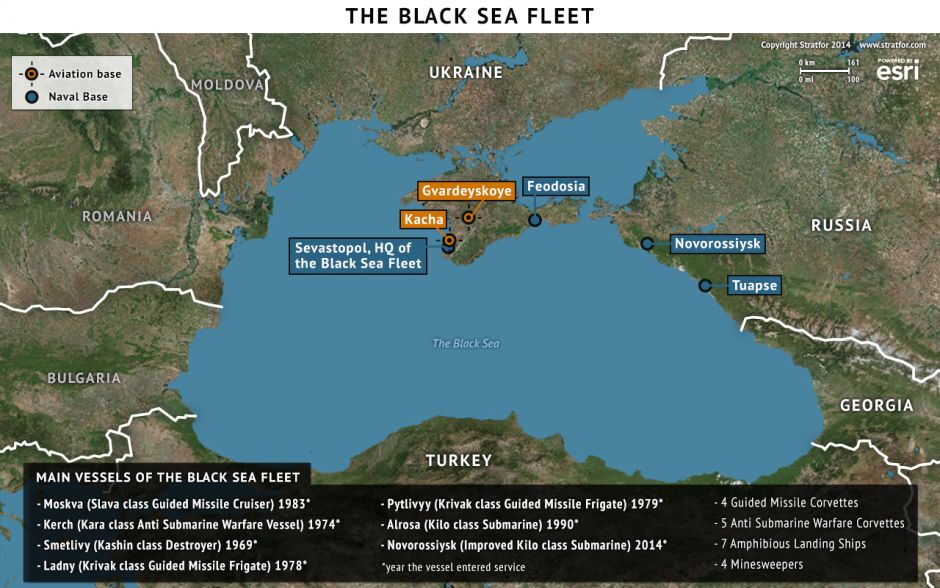
Russia is also building up its numbers in the area and is set to deliver more warships to the Black Sea. The Novorossiysk, for instance, is scheduled to be the first of six submarines that will eventually be deployed to the Black Sea Fleet, which is slated to get some 80 new surface warships by 2020, bringing its total up to 206 ships. As with many Russian declarations, however, such plans consistently face delays and unforeseen obstacles, or simply fail to materialize.
It is also important to remember that naval power is determined by more than just warships. Russia's seizure of Crimea has allowed it to beef up its force projection capabilities in the Black Sea with the positioning of powerful anti-ship missiles, air defense systems and naval aviation assets in the newly annexed peninsula. For instance, in addition to Su-24 strike aircraft, the Russians have also begun to deploy relatively advanced Su-30 multirole aircraft to Crimea. Moscow will also build a base in Novorossiysk that will serve as the center for its naval presence in the Black Sea.
The Black Sea Fleet is no longer a force in precipitous decline. While the Kremlin is increasingly building it up as a key force in the region, it continues to suffer from several persistent legacy issues and constraints. The fleet will have to continue to compete with other Moscow funding imperatives, even from within the Russian navy, where the Black Sea Fleet is seen as a lower priority than the Northern and Pacific fleets. Additionally, Turkey is keen on protecting its status as the leading navy in the Black Sea and continues to invest heavily in its navy. The Black Sea Fleet may very well grow increasingly powerful over the next decade, but it will not be in a position to forcefully break out into the Mediterranean or even dominate the Black Sea any time soon.
