
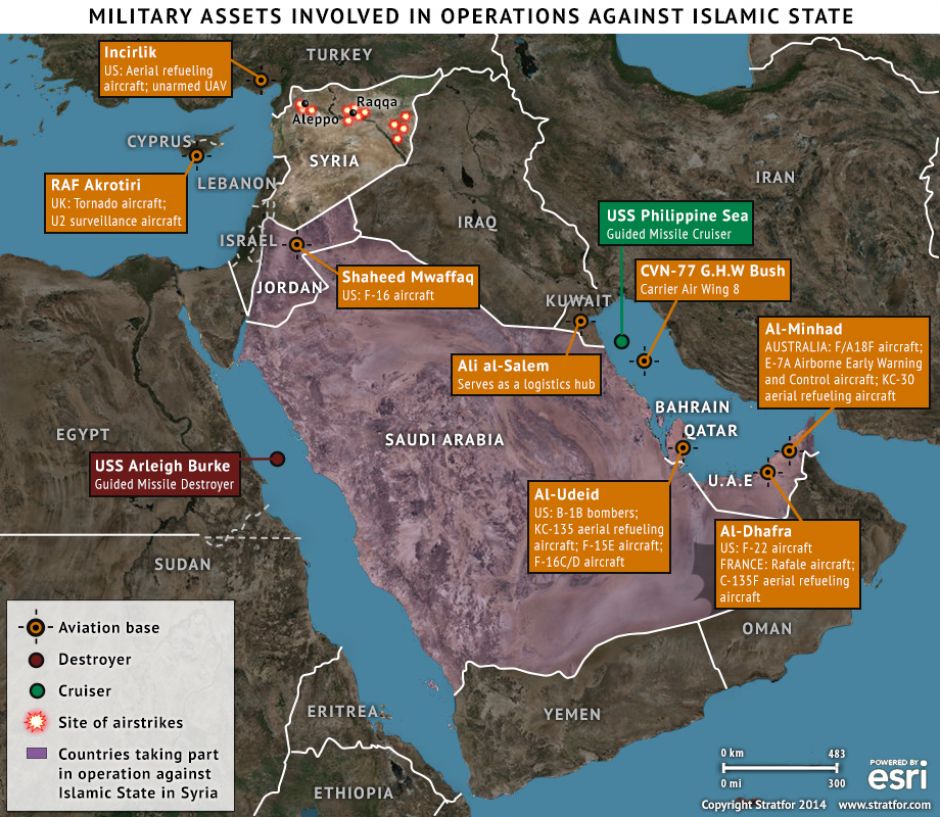
The airstrikes during the night of Sept. 22 were conducted in three distinct waves, the first of which consisted of Tomahawk cruise missiles striking targets in the vicinity of Aleppo and Raqaa. The second wave consisted of U.S. F-22 aircraft — used for the first time to conduct combat operations — striking targets near Raqaa. In the third wave, different types of U.S. fighter aircraft stationed in countries around the Persian Gulf and on the USS George H.W. Bush, as well as aircraft from U.S. allies in the region, struck targets closer to the Iraqi border in eastern Syria. Allied aircraft involved in the airstrikes in the third wave were fighter jets from the United Arab Emirates, Saudi Arabia, Bahrain and Jordan. Qatar contributed fighter jets to the operations as well, but these were allegedly unarmed and possibly conducted surveillance.
These initial strikes will lead into the next stage of operations, in which the United States and its allies will conduct damage assessments over targets in Syria and then look for indications of how successful the enemy considers the effectiveness of the strikes. Eventually, operations will move into sustained strikes resulting in constant attrition among the Islamic State fighters, limiting their capabilities and forcing them to alter the way they operate. As other elements of the strategy to counter the Islamic State come together, such as increased support to Syrian rebels fighting the Islamic State, air operations will likely become more continuous and more directly supportive of ground fighting, as has been the case in Iraq.
One of the main challenges that apparently shaped the composition and objectives of the overnight airstrikes is the presence of Syrian air defenses in the country's west. By using Tomahawk cruise missiles launched from a guided missile destroyer in the Red Sea and a guided missile cruiser in the Persian Gulf to strike the westernmost targets around Aleppo in the first wave, the United States avoided risking its manned aircraft. The aircraft operating closest to the Syrian air defenses — the F-22s that struck targets near Raqaa in the second wave — were the most modern U.S. aircraft used in the operation and have the lowest radar cross section. The third wave operated farther from Syrian air defenses to the east, and included EA-6B Prowler electronic warfare aircraft that are used to suppress enemy air defenses. These precautions were taken even though Syrian air defenses did not send out an active radar signal to track or target U.S. aircraft, strongly supporting the possibility that Syria received early warning from the United States about the airstrikes and chose not to interdict the international operations against the Islamic State in its territory.
U.S. Responses to Logistical Challenges
U.S. aircraft are spread around several bases in the Gulf countries, though most U.S. combat aircraft in the region are stationed on the USS George H.W. Bush aircraft carrier, currently located in the Persian Gulf. The air assets on board this carrier, Carrier Wing 8, include 48 F/A-18 aircraft. At least a part of this strike force took part in the third wave of the operations over Syria on Sept. 22, as did other aircraft stationed on the carrier such as the EA-6B Prowler. These aircraft would have been operating more than 850 miles from their origin, which is beyond their combat radius.
This makes aerial refueling assets necessary for the operations in Syria, just as they have been for operations over northern Iraq in recent weeks. These assets can extend the range of operations significantly. However, the dependence on aerial refueling tanker aircraft for the execution of these airstrikes is one of the major constraints in these operations. U.S. sources have already hinted at a lack of capacity for aerial refueling, and Washington has called upon its allies to assist in building this capacity in ongoing operations. Previously, when airstrikes were still limited to northern Iraq, a third of the air sorties conducted were by aerial refueling aircraft enabling other aircraft to conduct long-range combat patrols and surveillance flights.
Apart from support aircraft providing aerial refueling capabilities and suppression of enemy air defense, an important aspect of these operations will involve the deployment of command and control aircraft such as Airborne Warning and Control Systems. The deployment of such aircraft assists in managing the complexity of operations, something especially useful when ensuring coordination with allied forces. Besides helping to manage the battle space, such aircraft have surveillance capabilities that can assist in targeting efforts. The need for such aircraft, however, only increases the logistical weight of these operations.
Regional Basing Options
With U.S. allies in the region, such as Jordan, taking a more active role in the airstrikes, the prospect of flying more U.S. aircraft from bases in these countries becomes possible. Just like the possibility of using Turkish air bases, the potential to deploy air assets from bases in these countries would simplify the logistics that go into running long-range combat patrols and airstrikes assisted by aerial refueling. However, these countries face constraints relating to domestic politics and potential regional fallout from their participation in these operations.
The United States does have plans to run operations from within Iraq — from airports in Baghdad and Arbil, specifically — although so far these locations have hosted only logistical functions while strike aircraft continue to be deployed mostly from more distant locations around the Persian Gulf. The United States has announced that it will deploy A-10 ground attack aircraft to the theater, and due to their limited range but great ability to deliver firepower in a close air support role, these aircraft could be deployed effectively within Iraq to maximize their use. These positions inside Iraq, and likely Jordan as well, could also be used to mount combat search and rescue operations, the need for which have grown with the expansion of operations into Syria where government and rebel air defense systems raise the risk of damaging U.S. aircraft.
The United States wants to keep this intervention a limited operation, stopping short of deploying combat forces on the ground and being pulled into another Middle Eastern war. Still, to significantly damage the Islamic State will require large contributions of resources and combat power that will likely be tied down within this particular theater.
