
Argentina possesses one of the largest shale formations in the world, but the country is financially and technologically unable to exploit it. This led Buenos Aires to propose a hydrocarbon reform bill that unifies and simplifies the conditions for foreign investment. The reform would further recent attempts to set the minimum purchasing price for shale gas at $7.50 per million British thermal units and to ease restrictions on technological imports. Long-standing disagreements between the central government and outlying provinces have historically complicated energy reform. The provinces hold constitutional rights and levying authority over mineral resources, yet they depend on funds and tax redistribution from the central government.
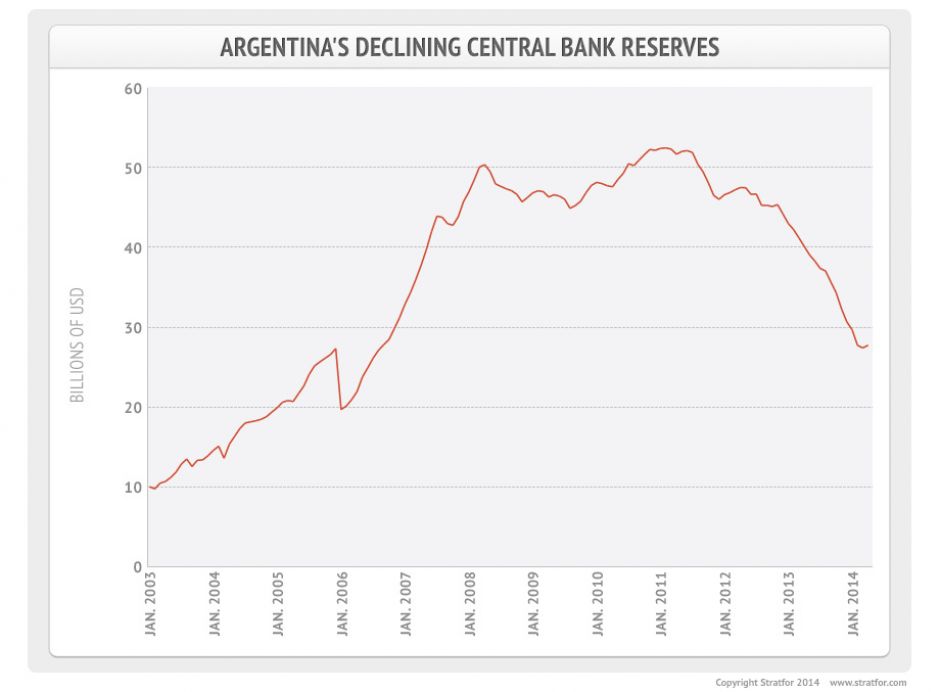
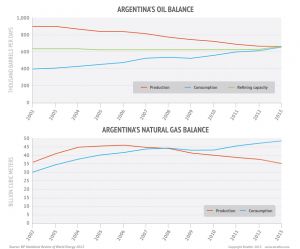
As Argentina's default status prevents the Ministry of Economy from accessing global capital markets, 802 trillion cubic feet of shale gas could provide a partial solution to the country's financial woes. More than a decade of declining energy production coupled with rising energy consumption has transformed the country from a net exporter of oil to a net importer, weakening its trade balance and draining its foreign exchange reserves. In 2013, Argentina imported some $12.5 billion in energy, more than 40 percent of the $28 billion in Central Bank exchange reserves. Capital flight and currency depreciation could soon lead Argentina’s public spending levels to a breaking point, which would equal about 50 percent of its gross domestic product, estimated at $500 billion.
A logical step toward improving Argentina's economic outlook would be establishing a unified legal framework to allow foreign investors to provide the capital needed for shale oil and natural gas exploitation. But the historical divide between the Argentine center and the periphery has historically limited foreign investment and prevented the petroleum industry from achieving its full potential in the country. Conflicting interests over management, taxation and royalties from hydrocarbon production have only further alienated most international investors.
The internal conflict in Argentina is complicated and deeply entrenched. The official emphasis on decentralization clashes with the pull of Buenos Aires. The provinces have long depended on Buenos Aires and its redistribution of tax revenues. This has allowed the provinces to build up sizable amounts of internal public debt, giving Buenos Aires a significant amount of financial and political control over the regions. But several reforms have given the provinces more autonomy. The 1994 constitutional reform granted provinces regional ownership of the resources found in their territory. In 2006, the so-called Short Law ratified a series of concessions to the provincial governments, including measures on taxation, royalties, and production-sharing agreements. But with the discovery of the Vaca Muerta basin potentials in 2010 and with the nationalization of the Yacimientos Petroliferos Fiscales oil and gas company (generally known as YPF) in 2012, the central government once again began exerting control over oil and natural gas resources, reigniting old tensions.
Recent Developments
In 2013, the administration of Argentine President Cristina Fernandez de Kirchner granted Chevron, in conjunction with YPF, the right to exploit several concessions in Neuquen province's Vaca Muerta fields. This move triggered an unsuccessful judicial challenge from the Organization of Petroleum Producing Provinces, who said their constitutional rights had been violated. In response, the central government refused to allow the affected provinces to restructure their debts. Buenos Aires then resorted to even more overt coercion by cutting off federal funding for these provinces.
YPF is currently lobbying the Kirchner administration to press forward with the proposed hydrocarbon reform bill that attempts to draw in sorely needed investment for the oil and natural gas sector. The reforms would modify key articles of the 1967 law that outline the timeframes for petroleum exploitation and the criteria for taxes and royalties. However, the provinces see this reform as yet another incursion into their jurisdiction and another attempt by Buenos Aires to economically subjugate the provinces.
Kirchner's party has enough seats to pass the reform in both chambers of parliament without the consent of provincial governors. Kirchner could also pass the bill as a presidential decree. If the bill passes, however, the governors have threatened to challenge it in Argentina's supreme court. This would extend the dispute, with little foreseeable benefit to either side. Despite divisions among the provinces, all sides are keen to reassure worried foreign investors and to capitalize on foreign funds and the revenue from energy production. With this in mind, the central government, YPF and the provinces themselves are negotiating informally, hoping to resolve their disputes and to come up with a framework that can attract external capital.
A Solution May Come Soon
Disagreements center on who has the authority to levy taxes and royalties on oil and gas production and to impose production-sharing agreements on private consortiums associated with provincial companies. YPF and Buenos Aires understand that the individual rights of each province create a complex legal patchwork that is undesirable for foreign investors. Time and money are major constraints for the core and the periphery alike, and this could cause their interests to converge in the long run. The effects of Argentina's recent default are felt countrywide, meaning that prolonged deliberations are now an unaffordable luxury.
To attract foreign investors, Argentina needs hydrocarbon reform that is uniform throughout the country. The smooth passage of a reform bill through Congress would send a clear message to foreign capital markets. A simplified, transparent and unified regulatory framework with a common rule covering all future concessions has the potential to benefit everyone. Negotiations between governors and the Kirchner administration will thus most likely result in a broad tax pact to unify and simplify oil production. It would feature a royalty ceiling of between 12 and 15 percent and make a maximum 3 percent of gross income taxable by the provinces. The timeframe for concessions could also be standardized. This would extend exploitation rights for conventional resources from 20 to 30 years and from 30 to 40 years for unconventional resources. Finally, the reform will likely extend the geographical limits for offshore exploitation under federal jurisdiction. It is still unclear whether production-sharing agreements would be granted to the provincial authorities or handled by the central government (thereby benefiting YPF). The eventual answer could redefine the way private investors partner with consortiums for petroleum production.
On Aug. 29, Buenos Aires and Neuquen province authorities endorsed an agreement signed by YPF and PETRONAS to exploit shale resources in Vaca Muerta. This is a good indication that an agreement on broader hydrocarbon reform is near. Stratfor sources say a final draft with the desired reforms will be submitted to Congress and will be voted on immediately after the Senate passes the budget in November.
