
Tusk first called for the European Union to set up an energy union March 29 and laid out his suggestion in an article in the Financial Times on April 21. His proposal came after EU leaders March 21 tasked the European Commission with presenting plans in June to reduce the bloc's energy dependence on Russia and after EU Council President Herman Van Rompuy called for greater energy sector integration. Tusk is discussing his plan with the French and German leadership April 24-25.
The energy union's goals as laid out by Tusk would be sufficient cross-border aid among members in case of energy supply cutoffs, more financial assistance from Brussels to integrate Europe's energy infrastructure, focus on the use of fossil fuels available in Europe (such as coal and shale gas) and more imports from European partners, especially the United States. But the union's most significant goal would be to have all members delegate the purchase of natural gas to a body that would negotiate on behalf of all.
The joint negotiating position would prevent natural gas suppliers, particularly Russia, from offering different prices between EU members. Countries currently pay different prices based largely on their political relationship with Moscow. For example, Finland, which is on better terms with the Russians than Lithuania is, pays some of the lowest natural gas prices to Russia while Lithuania pays some of the highest even though both are solely dependent on imports from Russia. Tusk mentioned the banking union, which is being put in place to fight the fragmentation of the European banking sector, and the fact that EU members have joint supervision of nuclear fuel purchases as examples of the successful delegation of power by member states that could inspire the European energy union.
French President Francois Hollande, Lithuanian Prime Minister Algirdas Butkevicius and Latvian Prime Minister Laimdota Straujuma have already come out in support of Tusk's plan. Germany's response has been more ambiguous. A German government spokesman said the proposal would be examined but said "solutions will have to take place within the framework of a market economy." German energy company E.ON criticized the plan, stating that it did not see how such a union could comply with EU free market rules. Germany's position on similar proposals has been consistent: In January, Hollande put forth the idea of stronger energy ties between Germany and France through a joint company, but the idea did not generate much enthusiasm on Germany's side.
The Limits of Euratom as a Model
In the 1950s, Europe's shortage of fossil fuels led West Germany, France, Italy, Belgium, Luxembourg and the Netherlands to jointly form Euratom, one of the founding institutions of the European Economic Community. Euratom's objective was to develop the nuclear sector, which the individual countries lacked the resources to do.
Linked to this early initiative is the European Union's Euratom Supply Agency, which was established in 1960 and aims to ensure that all EU members get access to nuclear fuel on an equitable basis and prevent any one country from negotiating privileged deals. The agency monitors the nuclear fuel market but most important is a party in any contract of nuclear material that involves an EU member. In practice, entities wanting to buy nuclear fuel still negotiate on their own behalf with a seller, but the Euratom Supply Agency then reviews the contracts.
This sort of transparency is something Tusk wants to see in natural gas contracts through the establishment of the energy union, with the end goal being that countries would buy natural gas together. It will be difficult, however, to convince countries that get better deals with Russia in bilateral negotiations to give that up. Although the European financial crisis raised doubts about the future of the currency union and required countries to ask for bailouts, the sense of solidarity among eurozone members has not been strong enough to more fundamentally aid weaker countries by, for example, jointly issuing debt. This lack of solidarity will probably show up in the debate about an energy union.
Even if there were an agreement on the political level, it would likely take years to change the market structure in Europe because EU competition rules would have to be changed. Private companies have long-term contracts with Russia's Gazprom that would need to be renegotiated and would legally challenge the delegation of natural gas contract negotiations.
Inevitable Change
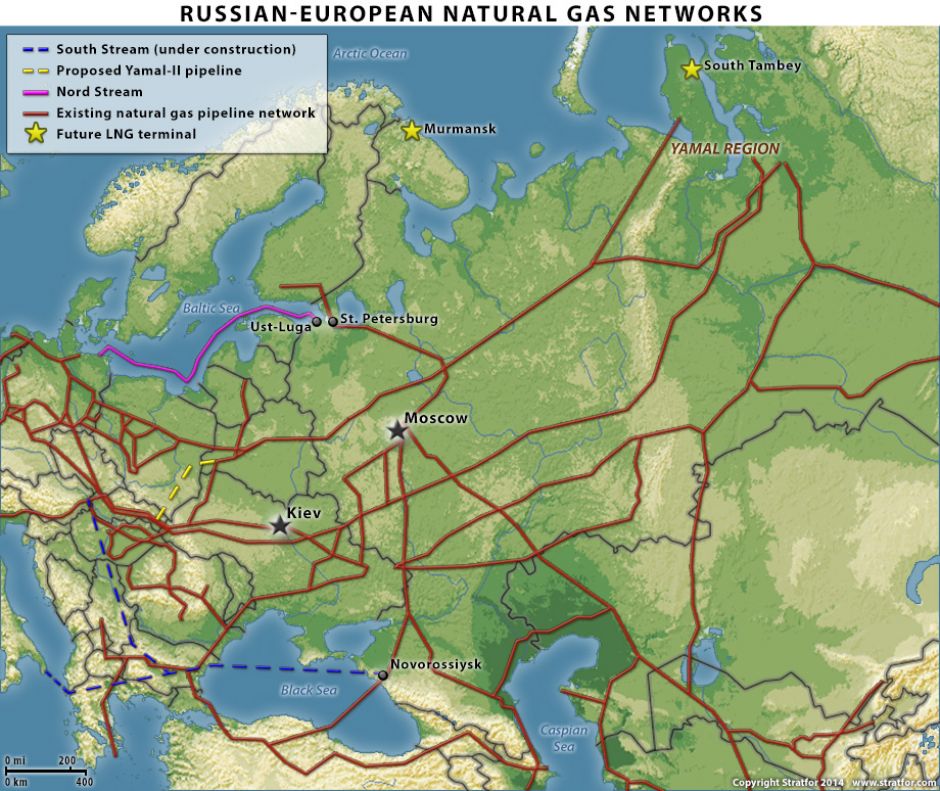
Even though the idea of joint price negotiations with Russia will be tough to pass, other efforts by EU members over the coming years will make it more difficult for Russia to set significantly different natural gas prices for European countries. As a consequence of the Ukraine crisis, plans to improve the physical integration of Europe's energy sector will likely get quicker political approval and financing from Brussels. Better cross-border natural gas links and reselling of Russian natural gas within Europe in the medium- to long term will level out prices across countries even more. Liquefied natural gas imports, the development of the shale gas sector and continued reliance on nuclear energy and coal will all be other options receiving additional support as tensions with Russia persist.
Still, the diversification efforts will lead to disputes among EU members as countries put their own energy security above that of the entire bloc. In the debate over the South Stream natural gas pipeline, for example, Bulgaria is pushing for the project so that disruptions in Ukraine will not affect European supplies, while others in Europe criticize the project for creating stronger links with Russia.
In 2010, former European Commission President Jacques Delors and then-European Parliament President Jerzy Buzek advocated the establishment of a European Energy Community. A year earlier, parts of Europe were harmed when a natural gas dispute between Ukraine and Russia resulted in natural gas shortages in Europe. Delors and Buzek's idea did not materialize, but the European Union has made some efforts to integrate its natural gas infrastructure. Similarly, Tusk's proposal is unlikely to become reality, but elements of it will be more seriously pursued because of the current crisis.
