
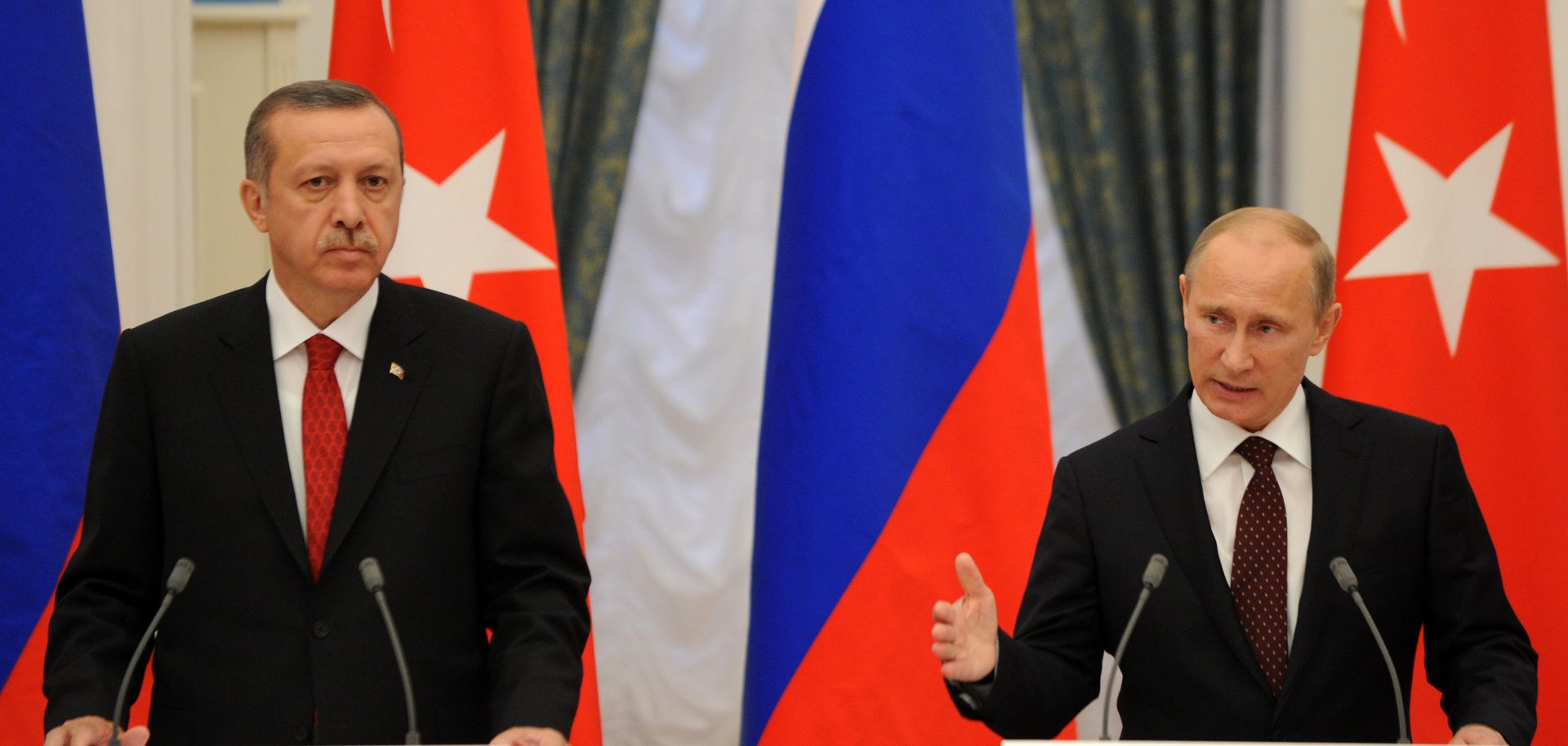
From Turkey's perspective, Russia's actions in Crimea are drawing uncomfortable parallels with Moscow's imperial ambitions from centuries ago. On Tuesday, Turkish Prime Minister Recep Tayyip Erdogan and Russian President Vladimir Putin talked over the phone. While Russian media portrayed the conversation as Turkey and Russia reaffirming their common opposition toward "radical and extremist" Maidan forces, we do not need an NSA leak to know that this was a conversation laden with geopolitical tension.
What is a Geopolitical Diary? George Friedman explains.
When the Russian military began maneuvering in Crimea this past week, Turkey quickly dispatched its foreign minister to Kiev, where he said that Ukraine's territorial integrity must be maintained. The message was clearly intended for Moscow, which was deliberately waving the threat of annexing the strategic peninsula in the name of protecting ethnic Russians.
This is familiar (and unsettling) history for the Turks. Back in the late 18th century, Russia — with its eyes on a warm-water port in the Black Sea — began eating away at the fringes of the Ottoman Empire in southern Ukraine and the Caucasus. The Russo-Turkish War of 1768-74 culminated in the Treaty of Kucuk Kaynarca, which codified Crimean neutrality into law. According to the agreement, Crimea, which at the time was populated by Tatars, a Turkic ethnic group, would not become independent from the Ottoman Empire, nor would it be annexed by another country — specifically, Imperial Russia. That treaty was short-lived, and Russia ended up annexing the entire peninsula anyway in 1783.
Several decades later, a decaying Ottoman Empire, dubbed the "Sick Man of Europe," met the Russians at Crimea again, this time with French and British backing, during the Crimean War. On the pretext of protecting Eastern Orthodox subjects in Ottoman territory — another historical echo of the current situation — Russian forces took aim at Ottoman possessions along the Danube and then at the Bosporus and Dardanelles, the Turkish-controlled gateway to the Black Sea. Meanwhile, Ottoman, British and French forces struck the Russian underbelly in Crimea. The military conflict resulted in massive casualties on all sides and a humiliating defeat for Russia.
Fast-forward to the present, and the Turks are again pursuing their imperative to maintain a balance of power in the Black Sea. As the gatekeeper of the Turkish Straits, Turkey is responsible for upholding the Montreux Convention, which restricts the size of non-Black Sea warships and determines how long they can remain in Black Sea waters. When the Russians invaded Georgia in 2008, and NATO had warships in the Black Sea with Turkish permission, Moscow subtly reminded Turkey of the consequences of challenging Russia when it held up thousands of Turkish trucks at Russian border posts. Already holding enormous economic leverage over Ankara, given that it supplies some 60 percent of Turkey's natural gas needs, Moscow can once again tighten the screws on Turkey if it tries to challenge Russia's moves in Ukraine.
Ankara can offer rhetorical support for the roughly 300,000 Crimean Tatars that remain on the peninsula, but it is unlikely to go beyond that in challenging Moscow. Turkey simply lacks the geopolitical weight (and energy independence) at this time to seriously take on Russia in this borderland, especially when the Europeans and Americans are facing their own limitations in countering Putin's moves. In the longer term, Turkey will try to counterbalance Russia more effectively in the Caucasus, working through its relationships with Azerbaijan and Georgia. An independent Crimea also raises the long-term potential for renewed Russian-Turkish competition on the peninsula. But Turkey will have to get its own house in order before it can take those kinds of assertive steps abroad, and that is going to take a while.
