
The American and Canadian energy industries have transformed so quickly that pipelines connecting producing regions with consumption centers are now overwhelmed. Bottlenecks have even led to discounted prices for benchmark crudes such as West Texas Intermediate and Western Canada Select, a prospect that could threaten future investment. (Benchmark crudes serve as a reference price for oil buyers and sellers.)
With pipeline projects facing political scrutiny, oil producers have turned to North America's unrivaled railway network. In 2013 alone, rail transport rose by 70 percent. And even though it costs roughly $10 more per barrel to ship it that way than by pipeline, railways offer several advantages. First, they can adapt to increased production volumes because the infrastructure is already in place. Second, they can carry any type of crude, so they have fewer restrictions in where they can take their cargo. For example, light sweet crude extracted from North Dakota's Bakken formation frequently goes to refineries along the Atlantic Coast that operate most efficiently when using light sweet crude. However, there are no pipelines that can take Bakken oil east, so most Bakken oil is transported by rail.
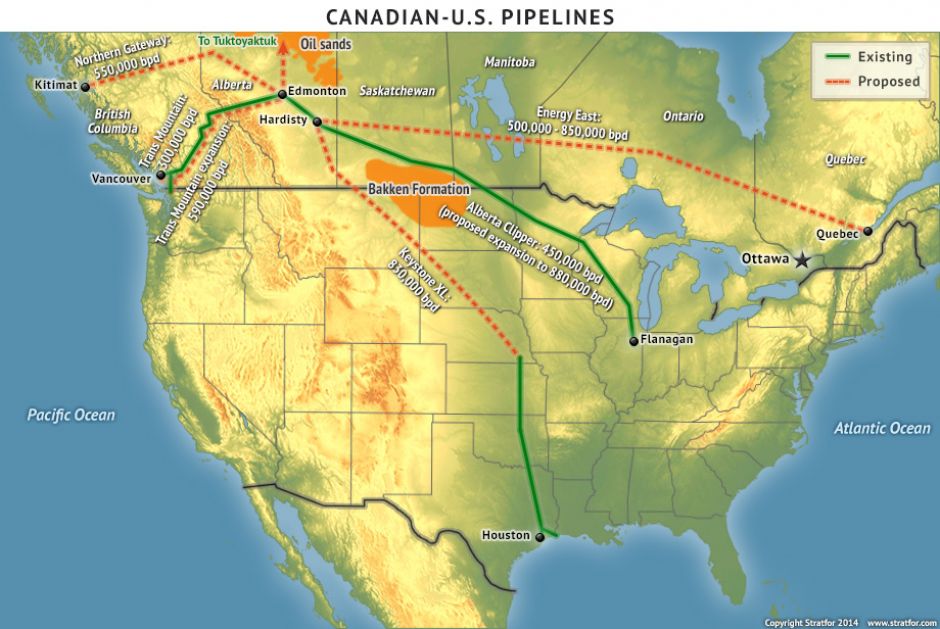
But as with Bakken oil, constraints in pipeline capacity preclude most of Canada's oil from reaching this region. With the U.S. government still deliberating the Keystone XL pipeline, Canada is building out its rail on-loading infrastructure in Alberta to move the oil by rail instead. The first terminal became operational in December 2013, and by 2015 it is projected to have a capacity of around 830,000 barrels per day — roughly the same capacity as Keystone XL.
Reconciling Safety Concerns and Economic Gains
The United States and Canada will have to continue transporting crude by rail if they want their energy revolutions to continue. However, the growth in rail transportation has also given rise to more frequent and sometimes deadly accidents, in which oil spills or combusts after a tanker has derailed. A particularly bad accident took place in Lac Megantic, Quebec, where a massive explosion destroyed parts of the town.
Of course, Ottawa and Washington must reconcile safety concerns and economic gains that accompany increased oil production. So far, much of the concern involves older DOT 111 tanker cars, which are structurally weaker than the upgraded versions, the DOT 111As. Because of their deficiencies, DOT 111s are more likely to rupture and lose their contents during a derailment.
Details surrounding the regulations Washington created in response to these concerns are still unclear, but they are unlikely to disrupt rail transport significantly. There is simply too much at stake economically. Instead, the regulations will probably phase out older tankers and replace them with better ones. Ottawa has already adopted this model, stipulating that only DOT 111A cars can carry light sweet crude.
Currently, only about 15 percent of North America's tanker car fleet is built to those standards. Retrofitting old cars or building new ones is expensive, and the Canadian Transportation Research Forum estimates that transitioning the entire tanker car fleet could cost as much as $1 billion. And though this would be cheaper than most large-scale oil and natural gas projects, the companies involved probably would be unable to quickly retrofit the tanker fleet.
For all the talk of safety concerns, transporting oil by rail is in some ways safer for the environment than transporting oil by pipeline. From 2002 to 2012, approximately 2.2 gallons of oil were spilled for every million miles per ton of oil transported by rail, compared to 6.3 for pipelines. In addition, the rail industry claims that transporting by rail produces less than half the emissions produced by piping oil.
The primary concern involving rail transport pertains to fires, which the oil carried in tankers is predisposed to start in the event of a crash. Lighter crude such as that produced at Bakken has a lower flash point than most crude and thus is easier to ignite. The bitumen produced at Canada's oil sands is not even categorized as flammable. To pass through pipelines, it must first be diluted with lighter crudes, which significantly lower its flash point. It is also mixed with harsh chemicals such as benzene — hence the environmental concerns over the Keystone XL pipeline. Washington would work around these issues, as Canada has, by issuing regulations based on what is being shipped. This would lower the number of tankers that need to be overhauled.
Transporting oil by rail may be even more beneficial for Canada than it is for the United States. Canada's primary oil price benchmark, Western Canada Select, spent much of 2013 roughly $40 below the international price of oil. Producing oil from oil sands is extremely expensive and energy intensive — some operations cost as much as $100 per barrel. Meeting the international market price is vital for Canada; investors could lose interest if Canadian oil is unprofitable.
Diversifying its customer base is vital for Canada. China, India and Japan all would be interested in buying Canadian oil if it were available, and Canada is interested in obliging them. There are several proposals for pipelines that would connect Alberta to either the Atlantic or Pacific coasts, but rail might be a quicker and more attractive option because Canada would have to build only oil tanker loading terminals.
As with pipelines, refineries and other aspects of oil and natural gas industry, Washington and Ottawa must balance the needs for safety with those of the economy. Transporting high volumes of crude by rail is a relatively new phenomenon that will have to be regulated accordingly. Expanding transport capacities, whether by rail, pipeline or any other method, will remain a vital part of the growth of North America's energy supply and energy flexibility — something that will become even more important as North America targets Asian export markets.
