
Other than an oil pipeline running from Tanzania’s Dar es Salaam into Zambia and a Kenyan fuel products pipeline, East Africa’s pipelines exist only on paper. Of the many different proposed projects, only a few seem feasible because of a lack funding. However, recent oil exploration projects and changing energy needs throughout the region could lead to the further development of pipeline connections across East Africa.
Existing Pipelines and Projects
Currently, the largest pipeline in the region is the Tazama Pipeline. This 1,700-kilometer (about 1,000-mile) pipeline carries crude oil from Dar es Salaam’s oil terminal to a refinery in Zambia. The pipeline serves only to provide the Zambian market with fuel and, like the Tazara Railway, its original strategic purpose was to enable Zambia to reduce its dependence on a supply chain running through then-apartheid South Africa. This strategy is no longer necessary, and Zambia imports most of its refined products by truck from South Africa.
The pipeline, which was constructed in 1968, has deteriorated severely and requires refurbishment or replacement. While its original design capacity allowed it to carry 22,000 barrels per day, it currently only moves about 12,000 barrels per day. Since this pipeline caters completely to the needs of Zambia and the Democratic Republic of the Congo's Katanga province, it is of little strategic importance to East Africa itself. Zambia is contemplating the construction of a second refinery in Hoima, along with a second pipeline. A parallel Tazama Pipeline is being proposed, but so is one passing through Angola, which would make the existing Tazama Pipeline even less important.
The other pipelines in East Africa are part of a network of product pipelines within Kenya that carry fuel products from the Mombasa refinery into inland Kenya. The refinery was designed to handle 80,000 barrels per day of crude oil but currently refines only about 32,000 barrels per day of crude into fuel products. The Mombasa refinery is decrepit and outdated; its owner, Indian conglomerate Essar, has put the refinery up for sale. The Kenyan government could buy the refinery to keep it operational, but funding to modernize it is not forthcoming.
From the Mombasa refinery, fuel moves through the pipeline to Nairobi, where some of it is consumed and some is sent further through the product pipelines to Kisumu and Eldoret. There are plans to expand this pipeline by building a new section between Eldoret and the Ugandan capital of Kampala. This would cost an estimated $300 million, though it would lower the costs of Uganda's fuel imports considerably, since Uganda currently depends on product trucked in from Kenya. Another extension from Kampala to Rwanda’s Kigali has also been proposed, but the feasibility of this would depend on the completion of the Eldoret-Kampala section. However, these planned extensions could be replaced by another proposal to convert the pipeline to transport oil from Uganda toward Mombasa. A spur toward Lake Turkana in Kenya could connect to oil production there as well if the oil there is found to be commercially viable. Moreover, Uganda has plans to construct its own refinery, which would negate the need for a products pipeline.
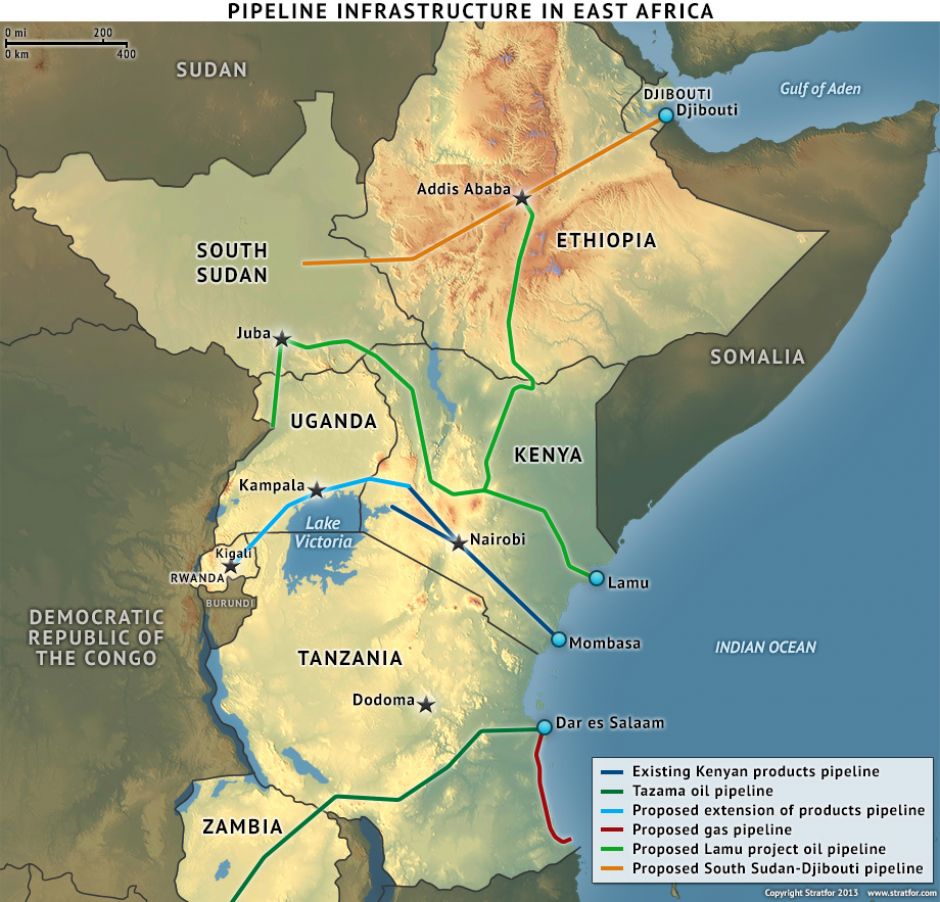
A larger ongoing project is the construction of a gas pipeline in Tanzania. This pipeline intends to connect natural gas finds in the Mnazi Bay concession in southern Tanzania to the economic hub of Dar es Salaam. Work on the 532-kilometer pipeline will commence soon — pipeline materials have begun arriving in the country — and the project could be completed in three years. The pipeline is designed to transport 22 million cubic meters of natural gas per day, and its construction is being financed with part of a $1.2 billion loan from the Export-Import Bank of China. There are plans to export gas from Dar es Salaam, and proposals for the construction of a liquefied natural gas terminal in southern Tanzania, which would mean that natural gas would not necessarily need to move through this pipeline to be exported. However, the construction of the liquefied natural gas terminal is not scheduled for completion until 2016.
A Less Feasible Project
A much more prestigious (yet seemingly unrealistic) project is the oil pipeline that is part of the Lamu Port and South Sudan-Ethiopia Transport project, which is based on the development of the Lamu port. The main goal of this long-proposed pipeline is to give South Sudan an alternative means of exporting its fuel. South Sudan currently depends on Sudan for its exports, but this route has proven unreliable due to political conflicts resulting in shutdowns. This pipeline could also facilitate Kenya’s future oil transport, as development is underway near Lake Turkana. Oil would be exported through 1,700 kilometers of pipelines to the Kenyan port of Lamu, which is being developed with Chinese funding. However, money for the $3 billion crude pipeline — which would carry 500,000 barrels per day of oil to the Kenyan coast — has not been secured. So far the Chinese, along with the Japanese and Europeans, have notably declined funding for the proposed pipeline.
However, the planned Lamu oil infrastructure is not limited to the crude pipeline. Plans include the construction of a products pipeline with a capacity of about 100,000 barrels per day running from the Lamu port into the Kenyan interior. From there, a 450-kilometer extension to Ethiopia has also been proposed. This pipeline would carry fuel products from a new refinery that would be constructed in Bargoni, near Lamu. This refinery would have a capacity of 120,000 barrels per day of crude, but just like the main crude pipeline, the construction of this refinery still needs funding, in this case $2.8 billion.
If the main Lamu pipeline were built, recent oil finds in Uganda likely would lead to the extension of this crude pipeline to the Ugandan oil fields. The discoveries near Lake Albert have already prompted the Ugandan government to fast-track the construction of a refinery in Hoima with a capacity of 30,000 barrels per day. Oil production in Uganda, which has estimated reserves of 3.5 billion barrels, will also require an efficient export route. If the main Lamu crude pipeline were constructed, Uganda could tap into it, but other plans have been proposed. The most feasible of these, perhaps, is the addition of a crude pipeline to, or the conversion of, the existing Kenyan products pipelines that would carry crude in the other direction to Mombasa.
A Potential Route Through Ethiopia
Another country with potential in oil and gas production is Ethiopia. The country has not yet confirmed the presence of oil, but exploration is underway and encouraging signs have been reported. However, current proposals for crude pipelines concerning Ethiopia are limited to a pipeline that would mainly cater to South Sudan. In its search for alternative export routes, South Sudan has considered Ethiopia from time to time. Apart from a plan to transport oil by truck across roads through Ethiopia into Djibouti — an undertaking that would be far too expensive and slow to be a plausible alternative — Juba and Addis Ababa have signed a memorandum of understanding on the construction of a crude pipeline between South Sudan and Djibouti, through Ethiopia. The price of this pipeline, which would take three years to construct, is estimated at $3 billion, and nobody has come forward to fund the project yet. South Sudan has considered multiple pipeline projects over different routes that would reduce its dependence on Sudan, but so far no one has offered these projects financing.
The energy map of East Africa is changing as new oil and gas fields are developed, and energy consumption may be on the rise in the region's economic centers. However, without funding from foreign investors, some of the pipeline infrastructure that would meet East Africa's changing energy needs may never get past the planning stages. While some of these pipeline projects are viable, such as Tanzania’s gas pipeline from Mnazi Bay to Dar es Salaam that is in progress, the pipeline projects that would diversify South Sudan’s export options are much less realistic. Despite the risks of occasional pipeline shutdowns, the global consumer is perfectly content having South Sudan transport oil through Sudan, which requires no additional funding. For Uganda, exporting oil via a rehabilitated Mombasa pipeline would require limited funding compared to Kenya’s grand $22 billion vision for the Lamu Port and South Sudan-Ethiopia Transport projects, and a spur from Nairobi to Lake Turkana could be feasible as well.
